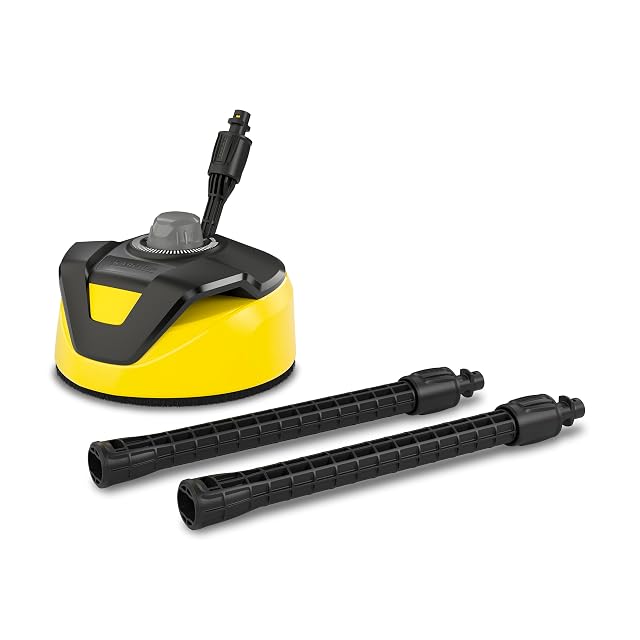
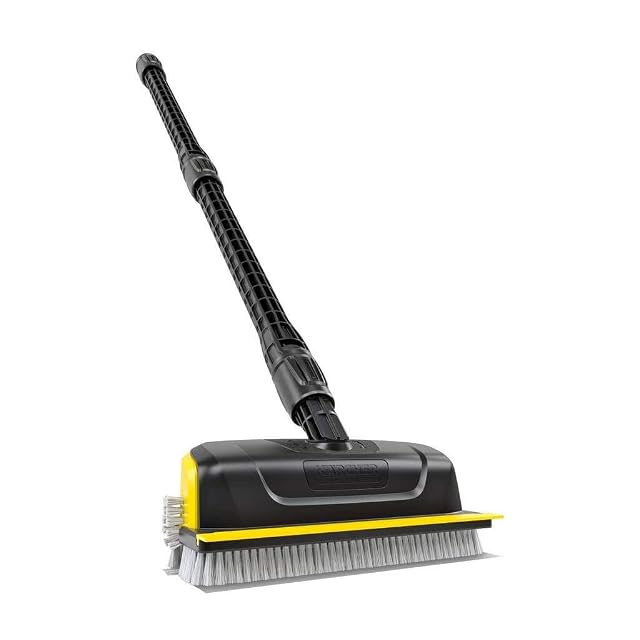
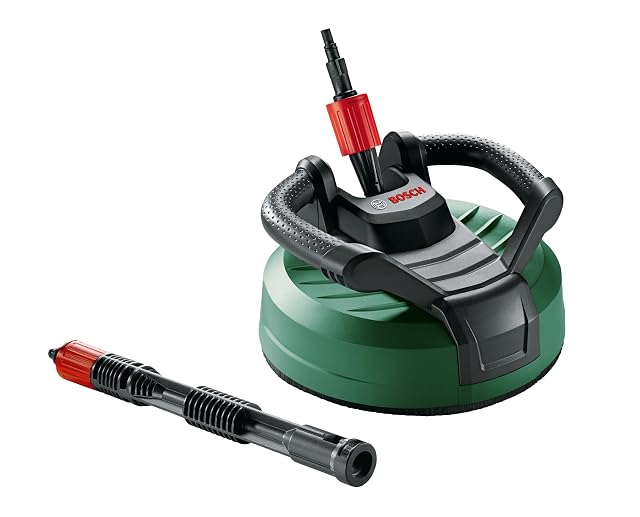
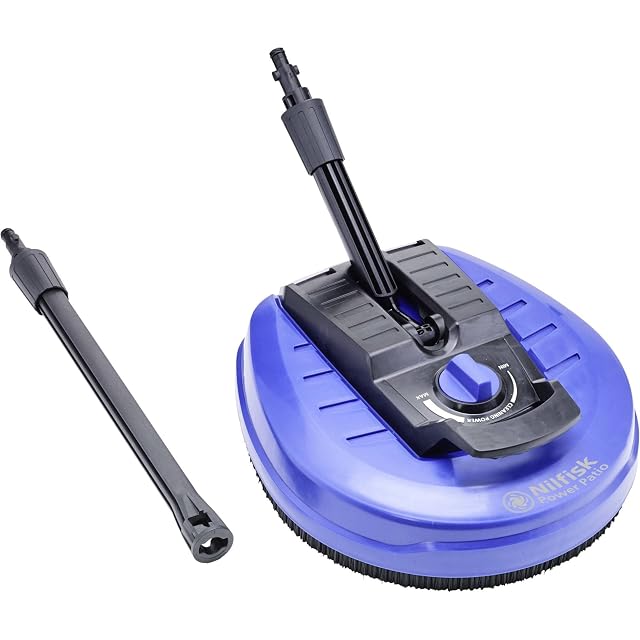
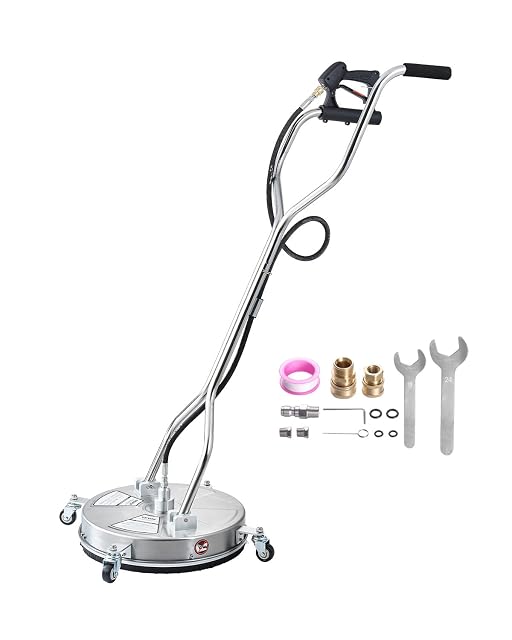
A surface cleaner turns striped, exhausting terrace work into an even pass. Width is what everyone compares, and flow rate is what decides whether width helps.
Two flat jets on a spinning arm under a hood. The hood contains the splash, the arm keeps the jets moving so nothing is dwelt on, and the result is an even surface instead of a striped one.
Why the stripes disappear
By hand, the jet cleans a narrow band and every overlap shows. A surface cleaner covers a fixed width at a constant distance and speed, which is exactly what a hand cannot do for twenty minutes.
Width is a flow-rate decision
Match the head to the machine, not to the job. Domestic washers at 350 to 500 l/h drive the 280 to 300 mm (11 to 11.8 in) heads well. The 400 mm (15.7 in)-plus heads want trade flow behind them.
Adjustable height protects soft surfaces
Fixed-height heads are set for concrete. On timber and soft stone, a few millimeters more standoff is the difference between clean and furred. If any of your surfaces are softer than paving, buy the adjustable one.
What to check on the box
The fitting, the pressure rating, whether the body is plastic or steel, and whether there is a bristle ring around the skirt — the ring is what stops the wash from reaching a wall you have just painted.
Which washer does your job need?
You clean a patio or drive
A surface cleaner, which is the accessory that most changes how long the job takes.
You have soft or old stone
Test in a hidden corner first, because a surface cleaner still applies real pressure.
You have a small area
A lance and patience may be enough, and storage becomes the deciding factor.
You want no splashing
A surface cleaner's skirt contains most of it, which is half the reason people buy one.
Picking by the surface
Large patios and drives
The main case. An even, controlled clean without the streaking a hand-held lance leaves.
Contained cleaning
Where the skirt keeps water and dirt off walls, windows and you.
Edges and corners
Where a surface cleaner cannot reach and a lance still has to finish the job.
Delicate surfaces
Where testing first matters, because the pressure is still real underneath the housing.
What to measure, and what to ignore
Diameter
A wider head covers more per pass but demands more flow. Matching it to your machine's output matters more than picking the biggest.
Compatibility with your lance
The fitting is maker-specific. This is where an otherwise good purchase fails.
Build and bearings
The spinning arms run in a bearing that takes grit and water. It is the part that determines how long the tool lasts.
Wheels or skids
Whether it glides on wheels or slides on brushes. Wheels are easier on delicate surfaces; brushes seal better.
Replaceable nozzles
The jets inside wear like any nozzle. A model whose jets can be replaced outlives one whose cannot.
Which figure for which surface
Your surface
The tool
The check
Large concrete drive
A wide surface cleaner
Your machine's flow
Small patio
A narrower head or a lance
Storage space
Old or soft stone
Test first
Pressure is still real
Any
Check the lance fitting
Maker-specific
What to avoid doing
Buying a head too large for the machine
A wide head starved of flow cleans poorly and slowly. Matching diameter to output matters more than size alone.
Not testing on old stone
A surface cleaner still applies real pressure. Soft or weathered stone can be marked, and a hidden corner tells you before the whole patio does.
Ignoring the fitting
Lance connections are maker-specific. This is where most disappointed purchases originate.
Expecting it to do the edges
It cannot reach walls and corners. A lance still finishes the job, and planning for that avoids a striped result.
By how hard you will work it
The drive owner
Gets the biggest gain from a surface cleaner matched to their machine's flow.
The small patio owner
May be well served by a lance, since storage and setup become the deciding factors.
The owner of old stone
Tests first, works at lower pressure, and accepts a slower job.
Servicing, storage and working life
Surface cleaners fail at the bearing that lets the arms spin and at the jets inside. Grit and standing water are what kill the bearing, and a tool put away wet lasts noticeably less well than one rinsed and drained.
Rinse the underside after use; grit trapped in the housing wears the bearing.
Replace worn jets where the design allows it; performance recovers immediately.
Store it drained rather than full of water.
Check the skirt or brushes for wear; a worn skirt stops containing the spray.
Safety
Contained pressure is still pressure.
Do not lift the head while the trigger is pulled; the jets are unguarded underneath.
Keep feet clear of the skirt edge.
Wear eye protection despite the containment; edges still throw spray.
No, and this is the mistake that wastes the most money in the category. The jets spin because water passes through them. A 465 mm (18.3 in) head behind a low-flow machine turns slowly and cleans worse than the lance it replaced. Check your liters per hour before buying width.
Will it fit my machine?
Only if the fittings match. Kärcher bayonet, Nilfisk Click&Clean and Bosch each use their own system, and the trade heads use a 3/8 in quick connect that no domestic machine has. An adapter exists for most combinations, but check before ordering, not after.
What does a surface cleaner actually do?
It spins jets inside a skirted housing, cleaning evenly and containing the spray. It removes the streaking a hand-held lance leaves.
What size should I buy?
One matched to your machine's flow rather than the largest available. A wide head starved of water cleans slowly and poorly.
Is it safe on old stone?
It still applies real pressure. Test in a hidden corner first, because weathered or soft stone can be marked.
Does it clean the edges?
No. It cannot reach walls and corners, and a lance is still needed to finish, which is worth planning for.
Why has mine stopped spinning?
Usually a worn bearing or a blocked jet. Rinsing the underside after use is what prevents both.
Can I use one on a wooden deck?
Only with great care and after testing, since decking boards are far softer than paving. Many people get a better result with a brush and a deck cleaner.
Lances, nozzles and detergents from the same aisle, at the price we read. Confirm the fit against the machine you choose before ordering: it turns on the coupling and the part number, which the listing gives.
The washers above come from the catalog of this site. Specifications are those the manufacturer and the Amazon page publish; prices are what Keepa reported for the date below, and both move. The order follows declared specifications, stated strengths weighed against stated limits, and price. No machine here has been put to work by us, and nothing on this page pretends otherwise.
Last checked on
Prices quoted in these summaries are dated readings. The live price is shown next to each product.
The tool we use ourselves
Chosen your machine? Now buy it at the right price.
Pressure washers and floor washers swing by a hundred dollars or more across the year, and
the biggest "discounts" often land at prices the same model sold for six weeks earlier.
UniverTrack tracks the real price history across retailers, spots fake
reductions, and alerts you when it is genuinely the moment to buy.
Real price historyBuy-now alertsAI buying assistant