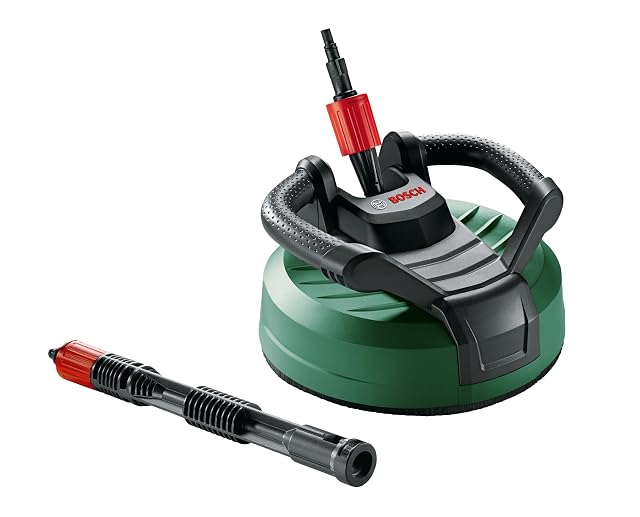
What the maker puts in writing
- “This surface cleaner is designed for use with pressure washers. It cannot operate independently and is not for direct connection to standard garden hoses”
- “two high pressure water jets for NON-MARKING Cleaning… the changeable nozzles of the surface cleaner attachment help you easily switch cleaning pattern bewteen power washing and soft washing”
- “20” large size to cover bigger cleaning area than nozzles, two high-speed spinning nozzles are 8x faster than other surface cleaners… this high-pressure power washer attachment will dramatically increase water use efficiency”
- “uses lightweight & environmentally friendly PP material, solid brass and fully sealed bearing. The upgraded bearing will prevent leaking and blocking, keeping you dry and safe… great heat and chemical resistance. Cold water, hot water, even soap water are all available”
- “this 20 inch pressure washer surface cleaner has 2 handles and 4 universal wheels, you can easily hold it by 2 angle-adjustable handles, more effortless than one-handed operation… the wheels of this attachment keep the nozzles at a fixed height”
- “ideal for all kinds of floors: concrete, wood, tile, brick… Compatible with most electric/gas pressure washers (2000+ PSI & 2+ GPM)”
- Title: 4500 PSI · Catalog: 7860 g (277.3 oz) · 508 × 508 × 1651 mm (20 × 20 × 65 in)
Hot water and detergent, which nothing else here allows
“great heat and chemical resistance. Cold water, hot water, even soap water are all available.”
This is the real reason to consider this head, and it follows directly from the material everyone else attacks.
The Simpson 16.5” at $104.89, in stainless steel, publishes the opposite: “Surface cleaner is only for cold water use; max temp 140° F.”
The constraint is never the shell. It is the bearing grease and the seals inside it, which soften and wash out above a certain temperature. Polypropylene is chemically inert and thermally tolerant, and a fully sealed bearing keeps hot water away from the lubricant.
So the two claims together are coherent engineering, not marketing.
Which puts the TOR 14“‘s line in perspective: “Unlike cheap plastic or thin aluminum competitors, the TOR surface cleaner is constructed from premium rust-proof stainless steel.”
For cold water at high pressure, stainless is stiffer, heavier and better. For hot water or detergent — which is what actually lifts grease off a garage floor rather than merely moving it — it is the wrong material.
And at least ten of the seventeen listings here publish no temperature guidance at all, so cold is the safe assumption for all of them.
The solid brass fittings are the right companion: brass at the water connection, plastic where only stiffness is needed, and a sealed bearing between them.
Twenty inches, and what it demands to work
The widest head on this shelf by three and a half inches. The field: 12 (Westinghouse, Greenworks, Hiclean) · 14 (JANZ, TOR, JaxonBilt) · 15 (Westinghouse, Greenworks, Kärcher) · 16.5 (Westinghouse, Simpson) · 20 (this).
And here is the arithmetic nobody advertises. Eight listings state a jet count and all eight say two. Nobody publishes three or four.
So at equal flow, a wider head spreads the same water over a bigger circle. Energy per square inch falls as the disc grows. Wider is not stronger — wider needs more flow.
Which is why the stated floor matters: “2000+ PSI & 2+ GPM”. On a small electric washer at 1.8 GPM, a 20-inch disc with two nozzles will turn slowly and clean weakly — and for that machine the Westinghouse 12” (max 3000 PSI, 2.3 GPM, “not intended for use with gas units”) or the Hiclean 12” (“exclusively for electric”) are the right tools.
The title says 4500 PSI and the bullets give no ceiling at all, which is the one place this listing is less clear than its rivals. For comparison the Westinghouse 16.5” publishes up to 4400 PSI, and the JANZ, TOR, JaxonBilt and Simpson all publish 4000.
Changeable nozzles, which only this listing offers
“the changeable nozzles… help you easily switch cleaning pattern between power washing and soft washing.”
A genuinely useful feature and unique here.
The nozzles set the fan angle, and fan angle is what decides whether you are cleaning concrete or stripping a deck. A narrow, hard pattern cuts stains out of a driveway. A wider, softer one cleans painted wood or tile without lifting the finish.
Every other head on this shelf has a fixed pattern. Two listings ship spare nozzles of the same type — the JANZ 14” with “2 x easily replaceable nozzles” and the TOR 14” with “2 Replacement Nozzles” — which is about wear, not about changing the pattern.
Worth pairing with what the listing claims next: “ideal for all kinds of floors: concrete, wood, tile, brick, protecting floors well during power washing.” That claim is only credible because the pattern can be softened, and the non-marking language in the second bullet depends on the same thing.
Two handles, which at this weight is necessary
“2 handles and 4 universal wheels, you can easily hold it by 2 angle-adjustable handles, more effortless than one-handed operation.”
7860 g is 17.3 pounds, the heaviest head on this shelf by nearly half again:
MEKOH 7860 g · Simpson 5375 g · JANZ and JaxonBilt 3175 g · Greenworks 15” 2445 g · Kärcher 1724 g · Greenworks 12” 1111 g · Hiclean 998 g. The Westinghouse 15” claims 4 lb, the 12” two.
So the two handles are not a convenience. A one-handed grip on seventeen pounds at the end of a wand is a wrist injury; two handles with an adjustable angle let you push from the shoulders.
Which is also why the bullet titled “Lightweight Yet Strong Enough” is the one claim here that cannot be let past. Seventeen pounds is not lightweight by any reading, and the listing’s own design decisions — four wheels, two handles — exist precisely because it is not.
Weight is, however, a genuine advantage on a floor, and the JANZ 14” states the physics: a head must be “heavy enough not to rise up under high pressure”, because the jets point down and reaction lifts it. Too light on a 4000 PSI machine and it skates and chatters.
What seventeen pounds rules out is vertical work. Five listings claim walls — both small Westinghouse heads, the Westinghouse 16.5”, and the Kärcher at 1724 g (60.8 oz) with “hard vertical surfaces like brick and stucco”. This one says nothing about it, which is honest.
And the catalog’s 1651 mm (65 in) third dimension is the packed carton with its handle assembly, not the tool.
Eight times faster than the rest of this page
“two high-speed spinning nozzles are 8x faster than other surface cleaners.”
A different baseline from everybody else, and much bolder.
The rest of the shelf measures against a bare spray nozzle:
JANZ 14”, Westinghouse 12” — 4× faster
TOR 14” — 5× faster, with “save 80% of your time”, which is internally consistent
JaxonBilt 14” — 10× faster
Simpson 16.5” — 10× more coverage, which is geometry rather than timing and the most defensible phrasing on the shelf
This claims to be eight times quicker than the other eleven products on this page, including a 16.5-inch stainless head from an established maker.
Twenty inches against sixteen and a half is 1.47 times the width, and about the same ratio in area per pass. Nothing published here supports a factor of eight.
Take the twenty inches as the fact — it is the widest head on the shelf and that is a real advantage on a long driveway — and read the multiplier as advertising.
The water-efficiency point in the same bullet is sounder: a wide head uses the same water for less time, because it covers more ground per pass. The Kärcher makes the same argument about “reducing your cleaning time and water usage”.
Not a garden hose, said first
“It cannot operate independently and is not for direct connection to standard garden hoses.”
First bullet, and the TOR 14” opens the same way: “It connects to your pressure washer gun/wand only — garden hoses will NOT work.”
Two of twelve listings putting that warning first tells you how often it goes wrong. A garden tap delivers perhaps 60 PSI where these need two thousand, so a head on a hose dribbles and does not spin.
The TOR adds the point nobody else raises: “Machines with 3/8” outlets need an adapter (not included).” at least twelve of the seventeen listings here use a 1/4 inch quick connect, which is domestic; larger and commercial washers use 3/8 inch.
Four wheels, and a sealed bearing
“the wheels of this attachment keep the nozzles at a fixed height to protect the spray nozzles and your floors.”
Fixed height is the anti-streak mechanism on every head here, and three rivals say so: “streaks are eliminated by maintaining the nozzles at a fixed height” (JANZ), “eliminates streaks” (Kärcher), “maintains a consistent nozzle height” (Hiclean).
Four listings publish four wheels: this, the JANZ, TOR and JaxonBilt. The Hiclean 12” uses three, which cannot rock on uneven concrete the way four can — though under seventeen pounds and two handles, four is the right choice.
The fully sealed bearing, “upgraded… will prevent leaking and blocking, keeping you dry and safe”, is the component that matters most. The swivel seal is what fails on these tools, and when it hardens it sprays upward at the operator. Three other listings address it: a “heavy-duty bearing” (JANZ), “heavy-duty bearings” (TOR), and the Hiclean’s “all-metal rotating spinner” against “plastic spinners that often break”.
Sealing it is also what makes the hot-water claim possible.
What is not published
No ceiling pressure in the bullets, only in the title — where ten rivals state one.
No warranty, on the most expensive head here. Both Greenworks listings publish 3 years and the Westinghouse 16.5” publishes 180 days.
No inlet filter, which the JANZ and TOR have. The TOR calls clogged nozzles “a common issue in other brands”, and the Simpson concedes it by shipping a nozzle cleaning tool. On a head whose selling point is changeable nozzles, a filter protecting them would have followed naturally.
No spare nozzles or extension wands, where the JANZ ships seven items, the TOR five, and the JaxonBilt two 15-inch wands. At twenty inches and seventeen pounds, an extension to stand upright is not optional — and it is not in the box.
No usage guidance, where the Simpson gives the only instruction on this shelf: “use a slow, steady pace while applying light pressure to maintain even distance to the ground.”
And one of its six bullets is a gift-audience heading — “For Dads/Husbands/Men/Him” — occupying a slot that could have carried the ceiling pressure, the warranty or the hot-water temperature limit.
Availability
Read on the day this page was built: $210 at the American Amazon shop.
Read from Keepa on the day this page was last revised; stock and price both move without notice.
Prices quoted in this text were read on 2026-10-04. The live price is at the top of the page.