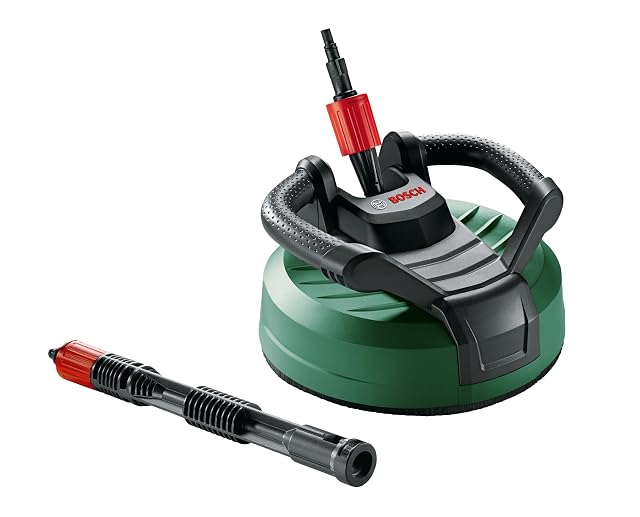
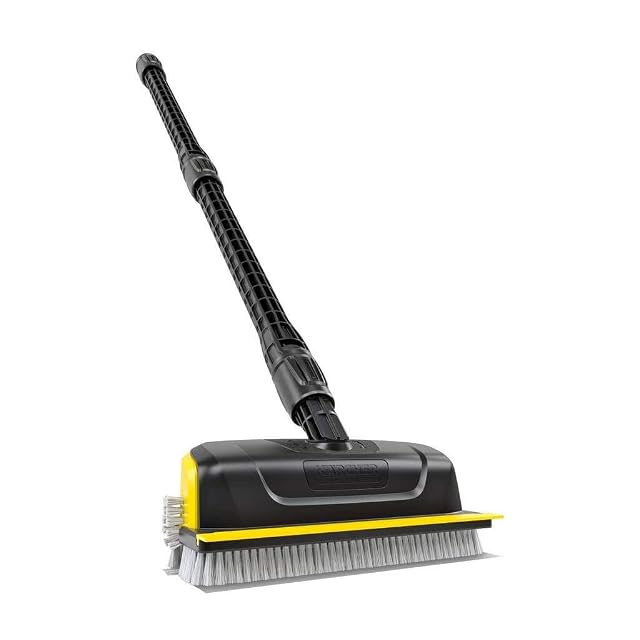
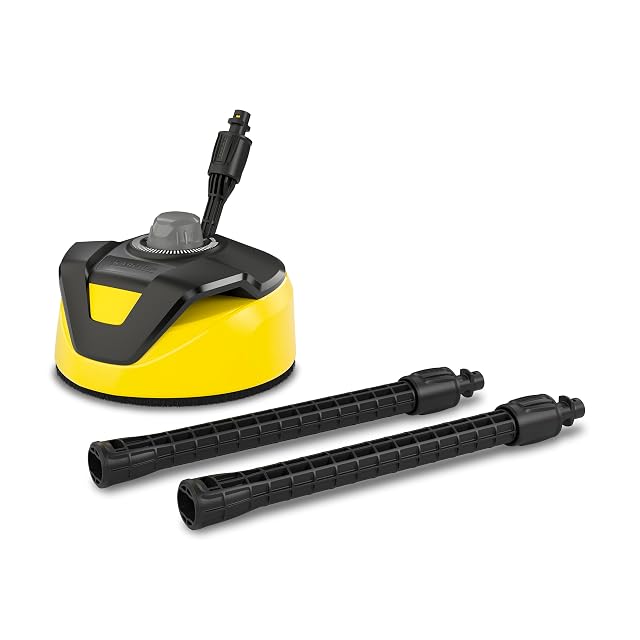
What the maker puts in writing
- “Cleans driveways, patios, and sidewalks up to 10 times faster than a standard pressure washer nozzle”
- “Premium Stainless Steel Build – Rust-resistant surface cleaner, durable construction designed for long-lasting performance”
- “Equipped with 4 swivel casters for smooth operation”
- “Features 1/4” quick-connect fittings and two 15” extension wands, no bending required”
- “Compatible with most gas and electric pressure washers rated 2000–4000 PSI Ryobi, Craftsman, DeWalt, Simpson, Kärcher, Westinghouse, Briggs & Stratton, Generac”
- Catalog: 3175 g (112 oz) · 381 × 381 × 864 mm (15 × 15 × 34 in)
Eight brands, which is the longest list here
Ryobi, Craftsman, DeWalt, Simpson, Kärcher, Westinghouse, Briggs & Stratton, Generac.
The spread tells you something the PSI range already implies: this is meant to be universal. Electric lines sit alongside gas engine brands — Briggs & Stratton and Generac make petrol machines, Ryobi and Craftsman mostly electric — which matches the stated 2000 to 4000 PSI window covering both camps.
Compare the alternatives. The Hiclean 12” names “RYOBI, GREENWORKS, WESTINGHOUSE, CRAFTSMAN, BAUER” — all electric — because it is built “exclusively for electric pressure washers”. The TOR 14” names “Ryobi, Simpson, Greenworks, Sun Joe”.
What a brand list does not replace is the two numbers on your own machine. Every one of those brands makes washers across a wide range, and a Ryobi at 1900 PSI and a Ryobi at 3300 PSI are quite different propositions for a 14-inch head.
Which is where this listing leaves a gap: it publishes pressure and not flow.
A surface cleaner has no motor. Its nozzles sit on a swivel and are driven by the water leaving them, in reaction, like a lawn sprinkler.
Pressure decides how hard the water hits the concrete. Flow decides how fast the arm turns. A 4000 PSI machine at low flow can spin a head more slowly than a 2200 PSI machine at 2.5 GPM.
Five listings here publish GPM:
JANZ 14” — 1.8 to 3.7 · Simpson 16.5” — 2.5 to 4 · Kärcher 15” — up to 2.7 · Westinghouse 12” — max 2.3 · MEKOH 20” — 2+
The JANZ is the direct comparison: same 14 inches, same 2000–4000 PSI, same 3175 g (112 oz), and it tells you the flow window.
And nobody here publishes a minimum except the Westinghouse 15” (2500 PSI), the Simpson (2000 PSI and 2.5 GPM) and the Kärcher (a 2600–3200 PSI window, so a 3600 PSI machine is above its range).
Ten times faster, and the listing that says it better
10× faster is the boldest claim on this shelf, and it comes from a 14-inch head.
The Simpson 16.5” at $104.89 claims the same multiple and phrases it correctly: “10X more coverage than a standard nozzle” — coverage, not speed, from a head 2.5 inches wider.
That distinction is the whole thing. A bare wand cleans a useful strip an inch or two wide; fourteen inches is a genuine transformation in area per pass. But you do not walk ten times faster, and overlap, edges and a second pass over stains eat most of the arithmetic.
The rest of the shelf is more restrained at the same width:
JANZ 14” — 4× faster · Westinghouse 12” — 4× faster · TOR 14” — 5× faster, with “save 80% of your time”, which checks out · MEKOH 20” — 8× faster than other surface cleaners, a different and much bolder baseline · Simpson 16.5” — 10× more coverage
So two 14-inch heads here claim 4× and 5× where this claims 10×, on identical width and pressure range.
Take the fourteen inches as the fact.
Stainless, four casters, two wands
Stainless steel puts this with the JANZ, TOR, Simpson and Westinghouse 16.5” — five of twelve. The TOR argues the case against the alternative: “Unlike cheap plastic or thin aluminum competitors.”
Worth knowing that the most expensive head on this shelf is plastic for a defensible reason. The MEKOH 20” at $209.99 uses “PP material, solid brass and fully sealed bearing” and claims “great heat and chemical resistance. Cold water, hot water, even soap water are all available” — where the Simpson, in stainless, says “only for cold water use; max temp 140° F”.
Four swivel casters matches the JANZ, TOR and MEKOH. Their real job is not rolling but height: streaks come from a nozzle that is nearer the ground one moment than the next, and wheels fix that geometry. The Hiclean 12” uses three instead, which cannot rock on uneven concrete the way four can.
Two 15-inch extension wands is the genuine equipment advantage here. Only three other listings ship one at all — the JANZ, the TOR and the Greenworks 15” — and the rest expect you to use the short wand your washer came with. “No bending required” is the whole point: a driveway is half an hour, and without an extension you spend it stooped.
Three thousand one hundred and seventy-five grams, and why that is right for a driveway
Identical to the JANZ 14”, and on the correct side of the weight argument for floor work.
The JANZ states the physics: “It is heavy enough not to rise up under high pressure.” The nozzles point down, so by reaction the jets lift the head. Too light on a 4000 PSI machine and it skates and chatters, and a head not sitting flat makes stripes.
The opposite case belongs to the light heads and a different job: the Westinghouse 12” calls two pounds “an easy lift for vertical use on walls and fences”, and the Kärcher at 1724 g (60.8 oz) claims “hard vertical surfaces like brick and stucco”.
This listing says nothing about vertical use, which at 3175 g (112 oz) is honest by omission.
The published weights: Hiclean 998 g (35.2 oz) · Greenworks 12” 1111 g (39.2 oz) · Kärcher 1724 g (60.8 oz) · Greenworks 15” 2445 g (86.2 oz) · this and JANZ 3175 g (112 oz) · Simpson 5375 g (189.6 oz) · MEKOH 7860 g (277.3 oz). The Westinghouse 15” claims 4 lb and the Westinghouse 12” two.
What is not published
No jet count, where eight listings here state one and all eight say two. That matters for sizing: at equal flow, a wider head spreads the same water over a bigger circle, so wider is not stronger — wider needs more flow.
No flow figure, as above.
No inlet filter, which the JANZ and TOR both have. The TOR calls clogged nozzles “a common issue in other brands”, and the Simpson confirms it by shipping a nozzle cleaning tool with the note that “naturally-occurring buildup can gather in the nozzles over time”.
No spare nozzles. Both the JANZ and TOR include two, and nozzles are the wear part — a blocked one is the usual reason a head stops spinning evenly.
No skirt described, which every substantive listing here covers. It does two jobs: holds nozzle height constant against streaks, and contains the spray so grit does not land on the car.
No warranty, where both Greenworks listings publish 3 years and the Westinghouse 16.5” publishes 180 days.
No maximum water temperature. For stainless with greased bearings, cold is the safe assumption.
Availability
Read on the day this page was built: $60 at the American Amazon shop.
Read from Keepa on the day this page was last revised; stock and price both move without notice.
Prices quoted in this text were read on 2026-10-04. The live price is at the top of the page.