Skip to content

The best car wash kits and foam cannons for 2026

Washing a car with a pressure washer is mostly about not touching the paint until the grit is gone. A foam cannon does that, and the rest of the kit decides whether what follows adds scratches. We cover cannons and their fittings, wash mitts, wheel brushes and drying towels — and the order of operations that makes them work.

What we recommend

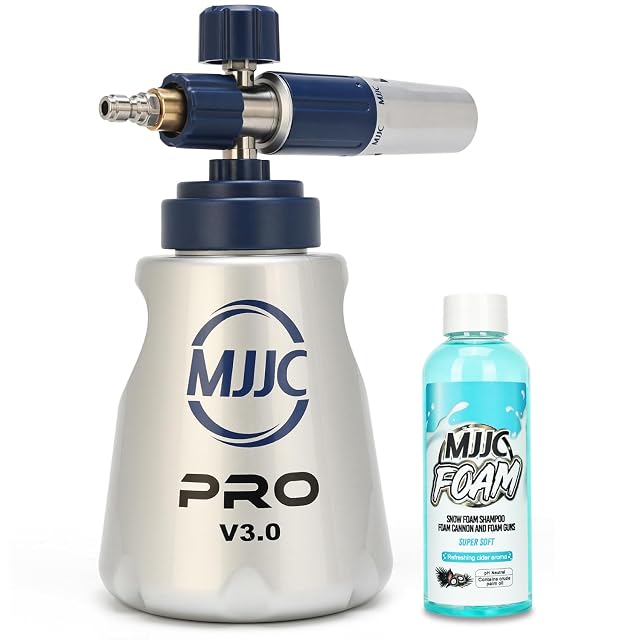
  1. MJJC PRO V3.0 foam cannon for pressure washers, product photograph

    MJJC PRO V3.0 Foam Cannon

    Foam that clings long enough to soften grit — which is what stops the wash mitt scratching.

    Body
    Stainless steel
    Dilution
    Adjustable
    Amazon reference
    B0FL17VGJF
    EAN
    4573104415323
    • Adjustable dilution: thick foam for dwell, thinner for rinsing down
    • Stainless body rather than the usual plastic and brass mix
    • Costs as much as some entry pressure washers
    ≈ $120 / £130 / 120 €
    Check price on Amazon

Which one for which need

Foaming the whole car in one pass

Thick foam clings long enough to lift the dust; runny foam is gone before that. The lance's capacity and its dilution setting decide the result.

MJJC PRO V3.0 Foam Cannon

Containing everything needed from the start

A kit with no grit guard or no drying towel gets completed piece by piece, dearer than a set. The stated contents list is what gets compared here.

MJJC PRO V3.0 Foam Cannon

Who each type suits

First wash at home
A kit saves buying foam cannon, mitt and shampoo separately, often badly matched. The gain is mainly in forgetting nothing.
Regular washing
The two-bucket method counts for more than the kit: one wash bucket, one rinse bucket with a grit guard, and the mitt rinsed between each panel.
Dark-coloured car
That is where micro-scratches show. A long-pile microfibre mitt and systematic rinsing are worth all the products in the world.

The trade-offs to weigh

Complete kit against chosen parts
A kit costs less and often contains a mediocre mitt or shampoo. Assembling it yourself costs more and avoids replacing the weak item six months later.
Foam cannon against foam nozzle
The cannon thickens the foam and makes it cling long enough to work; the nozzle sprays a dilute mix that runs off at once. On a dirty car the difference is clear.
Speed against scratch risk
Touchless washing preserves the clear coat and does not remove everything. Contact cleans better and scratches if the mitt is not rinsed. It is discipline, not product, that settles it.

Questions buyers ask

Does a pressure washer damage paintwork?

Not at a reasonable distance and moderate pressure. What damages it is the rotary nozzle, a point-blank jet on an existing chip, and going over the seals.

What is the two-bucket method?

One shampoo bucket, one clean-water bucket with a grit guard at the bottom. The mitt is rinsed in the second between each panel: the grit falls under the guard instead of going back onto the bodywork.

Is a specific shampoo needed?

A pH-neutral shampoo if you want to keep a wax or a ceramic treatment. A generic degreaser cleans very well and takes the protection off with the dirt.

How do I avoid marks when drying?

Dry with microfibre rather than letting it dry, especially in hard water and in sunshine. A car left to dry keeps the mark of every drop.

Can I wash in the sun?

That is the best way to have the shampoo dry before you rinse, which leaves halos. Failing shade, work panel by panel.

Is touchless washing enough?

For dust and rain, yes. For established road film or insects, no: contact will be needed, and therefore a clean mitt and plenty of rinsing.

How often should I wash?

As soon as the dirt is visible rather than on a fixed schedule. Road salt and bird droppings attack the clear coat in days, not weeks.

How many microfibre cloths does a car take?

Three at least: one for washing, one for drying, one for glass and sills. Kits that hold only one get topped up at the first wash.

What to remember

The result comes from the method, not the kit: two buckets, a mitt rinsed often, foam given time to work, and microfibre drying. The pressure washer is an excellent rinsing tool and a poor contact tool.