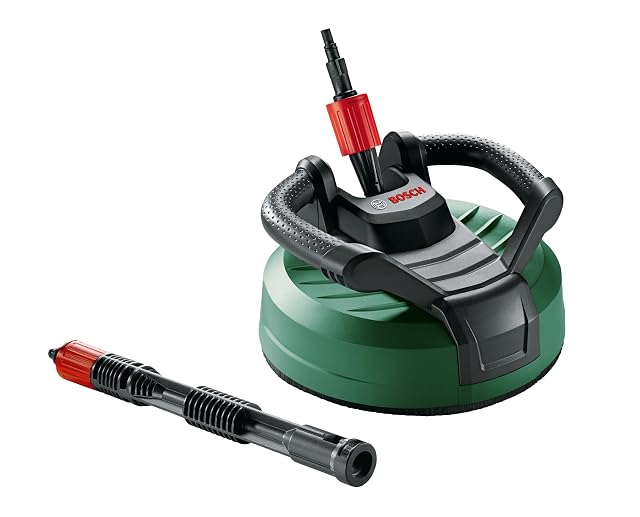
What the maker puts in writing
- “Optimized exclusively for electric pressure washers up to 3200 PSI, delivering superior rotation speed and cleaning power compared to other models that compromise performance in order to also be compatible with gas pressure washers”
- “Featuring three rotating wheels with HiMobility technology, this surface cleaner glides smoothly across concrete surfaces, providing superior maneuverability and reducing back fatigue”
- “Covers a 12” wide cleaning path with dual spinning nozzles, dramatically cutting down cleaning time while reducing water usage”
- “Metal Spinner Mechanism: Designed to last longer than typical plastic spinners that often break, this all-metal rotating spinner provided reliable, ultra-low friction, streak-free rotation”
- “Compatible with RYOBI, GREENWORKS, WESTINGHOUSE, CRAFTSMAN, BAUER and other major electric pressure washer brands”
- “maintains a consistent nozzle height to eliminate streaks”
- Catalog: 998 g (35.2 oz) · 381 × 102 × 381 mm (15 × 4.02 × 15 in)
The one piece of engineering reasoning on this shelf
“Optimized exclusively for electric pressure washers up to 3200 PSI, delivering superior rotation speed and cleaning power compared to other models that compromise performance in order to also be compatible with gas pressure washers.”
This is the only listing here that explains a design decision rather than asserting a benefit, and the reasoning holds.
A surface cleaner has no motor. The two nozzles sit on a swivel and are driven by the water leaving them, in reaction, like a lawn sprinkler.
A head rated to 4000 PSI — the JANZ, TOR, JaxonBilt and Simpson all are — must carry bearings and a swivel stiff enough to survive that. Heavy internals spin slowly when fed a modest flow.
A head rated to 3200 PSI can use lighter internals that turn freely on a 1.8 to 2.3 GPM electric machine.
So the restriction is not a shortcoming. It buys rotation speed exactly where a domestic washer needs it, and rotation speed is what distributes the water evenly.
The only other listing that excludes gas is the Westinghouse 12” at $26.09, which states it plainly — “not intended for use with gas units” — and never says why.
And the brands named here are the right ones for the claim: Ryobi, Greenworks, Westinghouse, Craftsman, Bauer are all electric lines.
Metal where it counts, and a plastic body
“Metal Spinner Mechanism: Designed to last longer than typical plastic spinners that often break, this all-metal rotating spinner provided reliable, ultra-low friction, streak-free rotation.”
The spinner is the rotating arm carrying both nozzles, mounted on the swivel that feeds high-pressure water into a moving joint. It is under constant load from pressure and rotation at once, and it is where these tools fail.
Three rivals advertise the same region from the other side — the bearing. A “heavy-duty bearing” on the JANZ, “heavy-duty bearings” on the TOR, a “fully sealed bearing” on the MEKOH claimed to “prevent leaking and blocking, keeping you dry and safe”.
Putting metal in the spinner and leaving the body light is the sensible allocation. The body holds a skirt and some wheels; it is not the part under stress.
Compare the two extremes on this shelf. Five listings are stainless steel throughout: the JANZ, TOR, JaxonBilt, Simpson and Westinghouse 16.5” — with the TOR attacking “cheap plastic or thin aluminum competitors” by name. And the most expensive head here, the MEKOH 20” at $209.99, is PP plastic with brass, defended on grounds the stainless heads cannot match: “great heat and chemical resistance. Cold water, hot water, even soap water are all available” — where the Simpson in stainless says “only for cold water use; max temp 140° F”.
Three wheels, and the geometry nobody mentions
“three rotating wheels with HiMobility technology… reducing back fatigue.”
The listing sells the rolling and misses the better argument: three points define a plane, so a tripod always sits flat whatever the surface does.
Four wheels on a cracked or settled driveway can rock, and rocking changes the nozzle height for a moment — which is the whole anti-streak mechanism, as this listing itself states: “maintains a consistent nozzle height to eliminate streaks”.
Four listings here publish four wheels: the JANZ, TOR, JaxonBilt and MEKOH. The other seven — the Kärcher, Simpson, three Westinghouse and two Greenworks heads — do not state a count at all.
The case for four is stability under a push: a tripod can tip if you lean on one edge, which is why the MEKOH 20” needs four wheels under 7860 g (277.3 oz) and two handles.
At 998 g (35.2 oz) and twelve inches, three is the right answer here.
Nine hundred and ninety-eight grams, which is the lightest here
The published weights: this 998 g (35.2 oz) · Greenworks 12” 1111 g (39.2 oz) · Kärcher 15” 1724 g (60.8 oz) · Westinghouse 15” a stated 4 lb · Greenworks 15” 2445 g (86.2 oz) · JANZ and JaxonBilt 14” 3175 g (112 oz) · Simpson 16.5” 5375 g (189.6 oz) · MEKOH 20” 7860 g (277.3 oz). The Westinghouse 12” claims two pounds.
Light cuts both ways, and both arguments on this shelf are correct about different jobs.
For walls, light is the only option. The Westinghouse 12” names it — “an easy lift for vertical use on walls and fences” — and the Kärcher claims “hard vertical surfaces like brick and stucco”. Nobody holds the MEKOH’s seventeen pounds against a gable end.
For driveways under pressure, the JANZ 14” has the physics: “It is heavy enough not to rise up under high pressure.” The jets point down, so reaction lifts the head — too light on a strong machine and it skates and chatters.
Which is the second reason the electric-only restriction makes sense here. At 998 g (35.2 oz) on a 3200 PSI ceiling, the lift force stays manageable. The same weight under a 4400 PSI gas machine would not sit still.
Twelve inches, and the arithmetic of width
“Covers a 12” wide cleaning path with dual spinning nozzles.”
Eight listings on this shelf state a jet count and all eight say two. Nobody publishes three.
So at equal flow, a wider head spreads the same water over a bigger circle — energy per square inch falls as the disc grows. Wider is not stronger. Wider needs more flow.
Which is exactly why the three 12-inch heads here are the electric ones, and the MEKOH 20” demands “2000+ PSI & 2+ GPM” as a floor.
Twelve inches is more passes on a long driveway. It is also what fits a porch step, a narrow path and the gap between a car and a garage wall.
No speed multiplier is claimed, which is unusual on this shelf — the claims elsewhere run 4× (JANZ, Westinghouse 12”), 5× (TOR), 8× against other surface cleaners (MEKOH), 10× (JaxonBilt) and 10× more coverage (Simpson, the most honest phrasing since it describes geometry rather than timing).
What is not published
No flow figure, and this is the real gap. The whole argument of the listing is about rotation speed at low flow, and it never says what flow it needs. Five listings here publish GPM: JANZ 1.8–3.7, Simpson 2.5–4, Kärcher up to 2.7, Westinghouse 12” max 2.3, MEKOH 2+.
No minimum pressure. Three listings publish one: the Westinghouse 15” at 2500 PSI, the Simpson 16.5” at 2000 PSI and 2.5 GPM, the Kärcher 15” as a 2600–3200 window.
No warranty, where the Greenworks 12” at $34.99 — five dollars cheaper, same width — publishes 3 years, and the Westinghouse 16.5” publishes 180 days.
No inlet filter, which the JANZ and TOR both have, and which the TOR describes as preventing “a common issue in other brands”.
No accessories. The JANZ ships seven items including two spare nozzles; the TOR five.
No maximum water temperature. With a plastic body and a metal spinner the practical answer is cold, as on every stainless head here except the MEKOH.
Availability
Read on the day this page was built: $40 at the American Amazon shop.
Read from Keepa on the day this page was last revised; stock and price both move without notice.
Prices quoted in this text were read on 2026-10-04. The live price is at the top of the page.