What the maker puts in writing
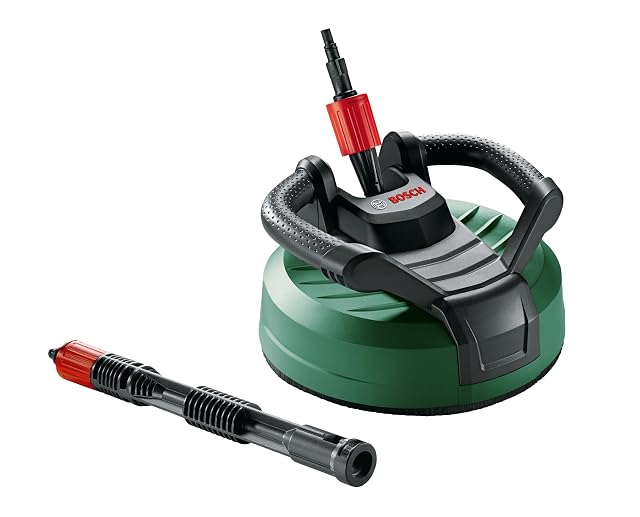
- “Max 3000 PSI and max 2.3 GPM; This 12 inch surface cleaner delivers powerful, professional results on flat surfaces like decks, patios, driveways, sidewalks, walls and garage floors. Dual rotating jets spray evenly for a uniform blast”
- “Up to 4X faster than going back and forth with a regular spray wand, which is slow, uneven and leaves streaks”
- “compatible with most electric pressure washers—not intended for use with gas units”
- “At only two pounds, the lightweight, compact build creates less fatigue… The splash-free skirt also stops water from hitting nearby objects”
- “ideal for hard-to-reach spots, tight corners or small spaces; Great for porch steps, deck stairs or narrow walkways; At just two pounds, it’s an easy lift for vertical use on walls and fences”
- Catalog: 305 × 305 × 76 mm (12 × 12 × 2.99 in)
Why “not for gas units” is a feature and not a limitation
A surface cleaner has no motor. The two nozzles are mounted on a swivel and driven by the water leaving them — in reaction, like a lawn sprinkler. Everything else about the tool is a compromise between the pressure it must survive and the flow it must spin on.
A gas washer typically delivers 3000 to 4400 PSI at 2.5 to 4 GPM. This is rated 3000 PSI and 2.3 GPM.
Two listings on this shelf exclude gas, and the other one explains the engineering better than anybody here. The Hiclean 12” at $39.99: optimized “exclusively for electric pressure washers up to 3200 PSI, delivering superior rotation speed and cleaning power compared to other models that compromise performance in order to also be compatible with gas”.
That is a genuine trade. A head built to survive 4000 PSI needs heavier bearings and a stiffer swivel, and heavy internals spin slowly on a 1.8 GPM electric machine. By restricting itself, a lighter head spins freely on the washer most people actually own.
So read the exclusion as a specification, not a shortcoming — and check your own washer before buying.
Two pounds, and what light is genuinely for
Two pounds, stated three times.
The opposite argument appears on the JANZ 14” at $39.99: “It is heavy enough not to rise up under high pressure, is easy to control.”
Both are correct, and they describe different jobs.
A surface cleaner’s jets point down and slightly back. By reaction, they push the head up. Too light on a powerful machine and it skates, chatters and cleans unevenly — which is the JANZ argument.
But you cannot hold seventeen pounds against a wall, and this listing names the use: “an easy lift for vertical use on walls and fences”.
Weight on this shelf, from the catalog: MEKOH 20” 7860 g (277.3 oz) · Simpson 16.5” 5375 g (189.6 oz) · JANZ and JaxonBilt 14” 3175 g (112 oz) · Greenworks 15” 2445 g (86.2 oz) · Kärcher 15” 1724 g (60.8 oz) · Greenworks 12” 1111 g (39.2 oz) · Hiclean 12” 998 g (35.2 oz). And in bullets: the Westinghouse 15” claims 4 lb, this claims two.
Worth noting that the MEKOH at 7860 g (277.3 oz) titles its own bullet “Lightweight Yet Strong Enough”.
Five listings mention vertical work: both larger Westinghouse heads (“horizontally and vertically”), this one, and the Kärcher (“hard vertical surfaces like brick and stucco”). The MEKOH does not, which at 7.8 kg (17.2 lb) is honest by omission.
Two jets, and why wider is not better
“Dual rotating jets spray evenly for a uniform blast in every pass.”
Eight listings on this shelf state a jet count and every one of them says two. Nobody publishes three or four.
Which produces the fact nobody advertises: at the same flow, a 20-inch head spreads the same water over a much bigger circle than a 12-inch head. Energy per square inch falls as the disc grows.
Wider is not stronger. Wider needs more flow.
That is precisely why the three 12-inch heads here restrict themselves to electric washers, and why the MEKOH 20” demands “2000+ PSI & 2+ GPM” as a floor.
So the width to buy is the one your washer can feed, not the largest you can afford. With an electric machine at 1.8 to 2.3 GPM, twelve inches is the right answer.
The skirt, which is the other half of the job
“Just slide the brush skirt of the cleaning deck over any dirty surface… The splash-free skirt also stops water from hitting nearby objects.”
Two functions in one part, and the second is underrated.
It holds the nozzle height constant, which is what eliminates streaks — the listing’s own point about a spray wand being “slow, uneven and leaves streaks”. A hand-held jet is nearer the ground at one moment than the next, and the difference shows as zebra stripes on concrete.
It contains the spray, which matters more than it sounds. Pressure washing a driveway without a shroud puts grit on your car, your windows and your neighbor’s paintwork.
A brush skirt rather than a rubber one is the softer choice — gentler on a deck board, less effective at sealing on rough concrete.
The Kärcher describes the same thing as a “shroud and splash-free skirt”, the JANZ as a “splash-free skirt”, the TOR as a skirt that “keeps you dry”.
Four times faster, which is the modest claim here
The speed multipliers on this shelf, and they are not all measuring the same thing:
Against a spray nozzle — this 4×, JANZ 4×, TOR 5× (with “save 80% of your time”, which is internally consistent), JaxonBilt 10×
Against other surface cleaners — MEKOH 8×, a quite different and much bolder baseline
As coverage, not speed — Simpson 10× more coverage, which is geometry and the most honest phrasing on the shelf
Four times is the conservative end. It is also the one that matches the physics: a 12-inch swathe against a jet covering perhaps three inches of useful width, at a pace you can actually walk.
The JaxonBilt 14” claims 10× in speed with a smaller head than the Simpson 16.5”, which claims 10× in coverage.
What is not published
No minimum pressure or flow, which is the figure that decides whether it works at all. Only the Westinghouse 15” (“minimum of 2500 PSI”), the Simpson 16.5” (“minimum 2000 PSI and 2.5 GPM”) and the Kärcher 15” (a 2600–3200 PSI window) publish one.
No material. Five listings here publish stainless steel — the Simpson, Westinghouse 16.5”, JANZ, TOR and JaxonBilt — the Hiclean publishes an “all-metal rotating spinner” against “plastic spinners that often break”, and the MEKOH publishes PP plastic with brass. This publishes nothing.
No warranty. The two Greenworks listings publish 3 years; the Westinghouse 16.5” publishes 180 days.
No inlet filter, which the JANZ and TOR both have — and the TOR names clogged nozzles as “a common issue in other brands”, which the Simpson’s included nozzle-cleaning tool quietly confirms.
No accessories. The JANZ ships two extension wands, two spare nozzles, three spray tips, two O-rings, a filter, Teflon tape and a nozzle cleaner — the fullest bundle here, at thirteen dollars more.
Availability
Read on the day this page was built: $26 at the American Amazon shop.
Read from Keepa on the day this page was last revised; stock and price both move without notice.
Prices quoted in this text were read on 2026-10-04. The live price is at the top of the page.