What the maker puts in writing
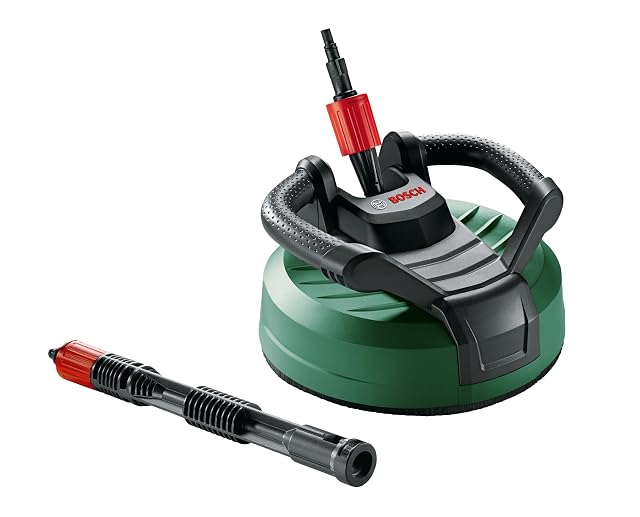
- “This 15” surface cleaner can concentrate up to 3400 PSI for quick cleaning of large areas like decks, patios, driveways, walls and more”
- “Rated up to 3400 PSI and minimum of 2500 PSI, this surface cleaner is powerful enough to eliminate stuck-on dirt without harming the surface material”
- “intended for use with most pressure washers using a 1/4” quick connection; Plug-and-go design means no new adapters are necessary”
- “POWERFUL YET LIGHTWEIGHT: Get powerful cleaning in a small package with this 4 lb, 15 inch surface cleaner”
- “The 15” cleaning area will make quick work of large, flat areas both horizontally and vertically” on “brick, wood, concrete, and more”
- Catalog: 381 × 381 × 102 mm (15 × 15 × 4.02 in)
“Rated up to 3400 PSI and minimum of 2500 PSI.”
The maximum protects the tool. The minimum decides whether it works at all.
A surface cleaner has no motor: its nozzles sit on a swivel and are driven by the water leaving them, in reaction, like a lawn sprinkler. Below a certain pressure and flow the arm turns too slowly, and you get uneven cleaning and visible stripes — or nothing turning at all.
Three listings on this shelf publish a floor:
this — minimum 2500 PSI
Simpson 16.5” — recommended minimum 2000 PSI and 2.5 GPM, which pairs pressure with flow and is the most complete version
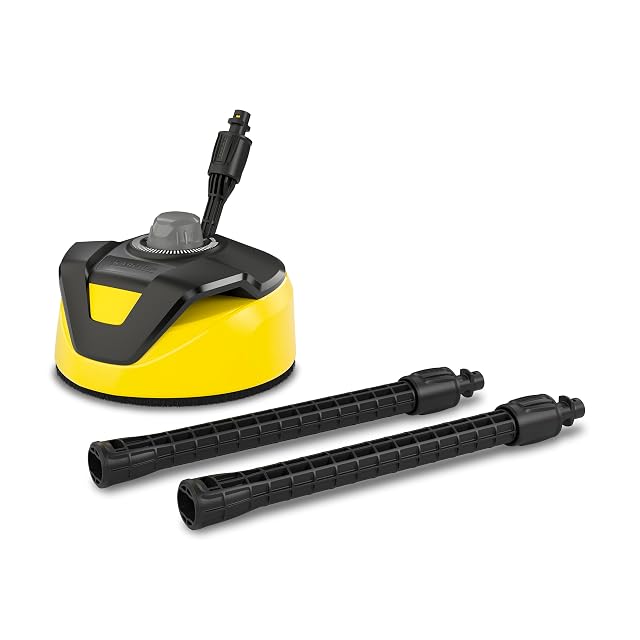
Kärcher 15” — 2600 to 3200 PSI, a window rather than a floor, so a 3600 PSI machine is above its range
The other nine publish a ceiling or nothing: 3000 PSI (Westinghouse 12”), 3200 (Hiclean), 4000 (JANZ, TOR, JaxonBilt), 4400 (Westinghouse 16.5”), “2000+” (MEKOH), and nothing whatsoever from either Greenworks listing.
So before ordering, read your washer’s own label for both numbers — the PSI and the GPM — and check them against both ends of a range, not just the top.
Why a narrow window is a specification, not a limitation
2500 to 3400 PSI is where most domestic pressure washers sit, and building for that band rather than for everything has a real benefit.
Below it: the small electric machines at 1800 to 2300 PSI, which this will not spin properly. For those, the Westinghouse 12” at $26.09 (max 3000 PSI, “not intended for use with gas units”) or the Hiclean 12” at $39.99 (up to 3200 PSI, “exclusively for electric”).
Above it: the larger gas machines at 3600 to 4400 PSI, where the JANZ, TOR and JaxonBilt at 2000–4000 PSI, the Simpson at 2000–4000, or this maker’s own stainless 16.5” at $89.99 rated to 4400 take over.
The argument for the narrow band is made explicitly by the Hiclean, about itself: a universal head “compromise[s] performance in order to also be compatible with gas pressure washers”. A head built to survive 4400 PSI needs heavier internals, and heavy internals spin more slowly at modest flow.
This listing does not make that argument. Its four pounds — against 3175 g (112 oz) for the stainless 14-inch heads and 5375 g (189.6 oz) for the Simpson — shows it has made the same decision.
Four pounds, and the vertical case
“POWERFUL YET LIGHTWEIGHT… this 4 lb, 15 inch surface cleaner.”
Four pounds is 1814 g (64 oz), which places this between the Kärcher 15” at 1724 g (60.8 oz) and the Greenworks 15” at 2445 g (86.2 oz) — so the three 15-inch heads here are all in the same light class.
And that is what makes the vertical claim credible: “large, flat areas both horizontally and vertically”, on “brick, wood, concrete”.
The shelf on vertical use:
Westinghouse 12” — “an easy lift for vertical use on walls and fences”, at a stated two pounds
Kärcher 15” — “hard vertical surfaces like brick and stucco”, at 1724 g
Westinghouse 16.5” — “horizontally and vertically”, weight unpublished
this — “horizontally and vertically”, at four pounds
Simpson 16.5” (5375 g) and MEKOH 20” (7860 g) — silent, which is honest
One caution none of these listings raises: used vertically there are no wheels on the wall. The whole anti-streak mechanism is wheels holding the nozzles at a fixed height, and against a wall you are holding that distance by hand. The skirt helps; it is not the same thing.
The counter-argument for weight belongs to the JANZ 14”, and it is physically correct: “It is heavy enough not to rise up under high pressure.” The jets push down, so reaction lifts the head — too light on a strong machine and it skates.
So: light for walls, heavy for driveways. At four pounds and a 3400 PSI ceiling, this is built for the first.
Without harming the surface material
“powerful enough to eliminate stuck-on dirt without harming the surface material.”
The phrase is worth taking seriously, because it names what a surface cleaner is actually for.
A bare wand concentrates everything into a single jet that dwells wherever you hesitate — which is how people carve grooves into decking and strip mortar from brickwork. A surface cleaner holds two nozzles at a fixed height and spins them, so the energy is spread and nothing dwells.
That is why these heads are safe on wood where a wand is not, and why the surfaces named here include wood alongside concrete.
The MEKOH makes the same point — “No one want floors to be damaged… ideal for all kinds of floors: concrete, wood, tile, brick” — and the JANZ explains the mechanism: “Streaks are eliminated by maintaining the nozzles at a fixed height.”
Worth knowing that the JANZ kit also includes “3 x 0-degree spray nozzle tips” for the wand, which are the opposite tool: a pencil jet with no fan at all, which will mark soft wood in one pass.
What is not published
No flow figure. Five listings publish GPM — JANZ 1.8–3.7, Simpson 2.5–4, Kärcher up to 2.7, Westinghouse 12” max 2.3, MEKOH 2+ — and flow is what spins the head, so for a listing that publishes both ends of its pressure range the omission is odd.
No jet count. Eight listings here state one and all eight say two.
No material, where this maker’s own 16.5” publishes stainless steel, as do the JANZ, TOR, JaxonBilt and Simpson.
No wheel count. The JANZ, TOR, JaxonBilt and MEKOH publish four; the Hiclean publishes three — and three points define a plane, so a tripod cannot rock on uneven concrete where four wheels can.
No warranty, where its own 16.5-inch sibling publishes 180 days and both Greenworks listings publish 3 years.
No inlet filter, which the JANZ and TOR both have — and the absence of which the Simpson quietly concedes by including a nozzle-cleaning needle instead.
No accessories listed, where the JANZ ships seven items and the TOR five.
Availability
Read on the day this page was built: $40 at the American Amazon shop.
Read from Keepa on the day this page was last revised; stock and price both move without notice.
Prices quoted in this text were read on 2026-10-04. The live price is at the top of the page.