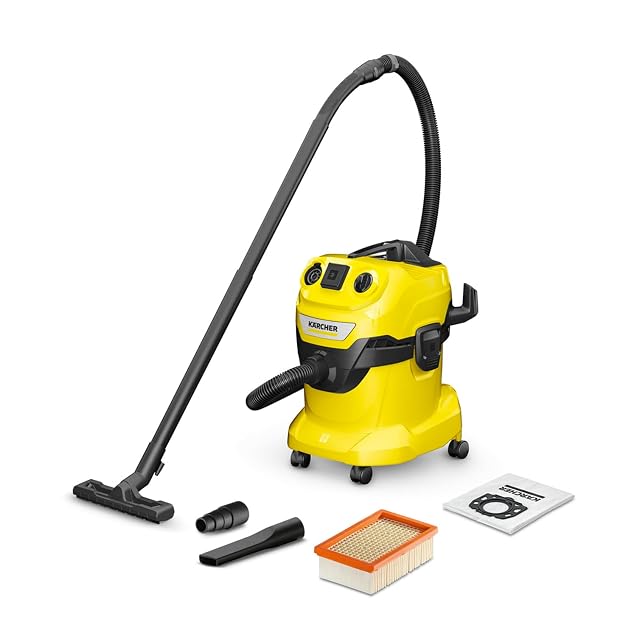
L class covers sawdust, garden debris and household mess. M class is required for plaster, concrete and MDF. This is the one that cannot be fixed later with an accessory.
2. The power take-off socket
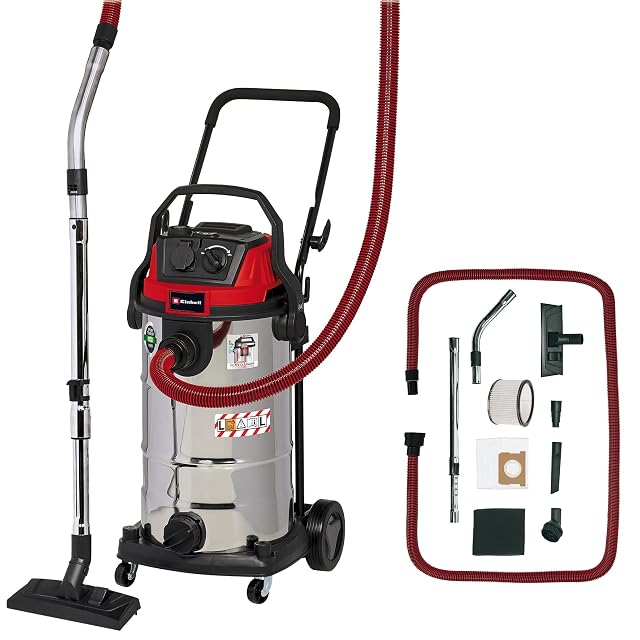
A socket on the machine turns a vacuum into dust extraction: the tool plugs into the vacuum, the vacuum starts with the trigger. Check the rating — Einhell’s 2,000 W socket runs a mitre saw, where a small socket runs only a sander.
3. Airflow and suction
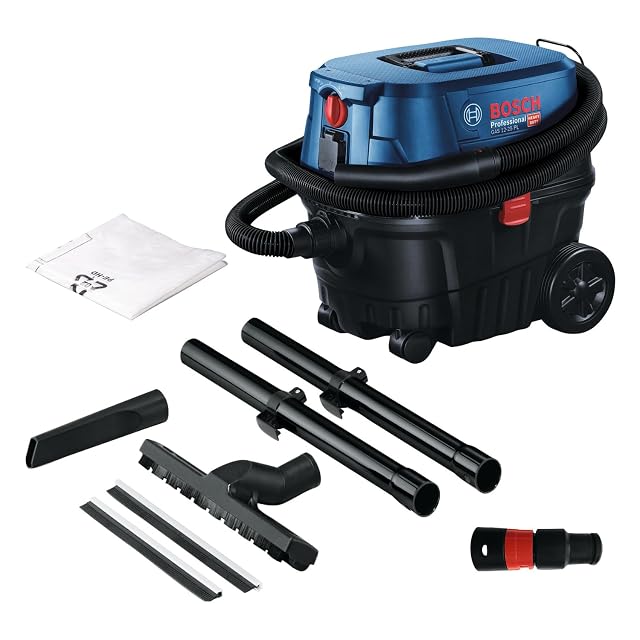
Published by Bosch Professional (65 l/s, 200 mbar) and, for suction, by Einhell (225 mbar). Nobody else in this comparison gives either. Where a figure exists, use it; where it does not, our review says so.
4. Reach and filter handling
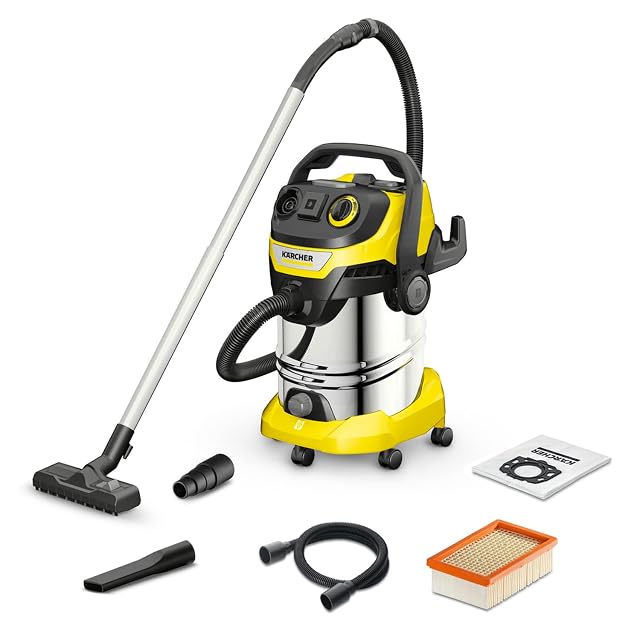
Cable plus hose decides how often you move the machine — the Kärcher WD 6 P S gives eleven meters. A filter cleaning button decides whether suction returns mid-job without opening the machine.
Which washer does your job need?
You have a workshop
A wet and dry vacuum is the right tool, and filter choice matters more than motor size.
You deal with spills and floods
Tank capacity and how you empty it are the practical specifications.
You cut wood or plaster
Fine dust is the real problem, and a suitable filter class matters for your lungs.
You want a house vacuum
This is not it; they are loud, heavy and made for other work.
Picking by the surface
Workshop debris
The main case. Sawdust, offcuts and general mess that a household vacuum would choke on.
Liquid spills
Where the wet capability is the whole point, and where removing the filter correctly first matters.
Fine dust
Where filter class and a good seal decide whether the dust ends up in the tank or back in the room.
Car interiors
Where the suction and the crevice tools do well, and where a smaller machine is easier to handle.
What to measure, and what to ignore
Filtration
Fine dust from wood, plaster and masonry is a health matter. The filter class and how well the machine seals decide what you breathe.
Tank capacity and emptying
A large tank full of water is heavy. A drain plug turns emptying from a struggle into a moment.
Switching between wet and dry
Most machines need the filter removed or changed for liquids. How easy that is decides whether you do it properly.
Hose diameter and tools
A wide hose passes debris that a narrow one blocks with. The tools included shape what the machine is good for.
Power take-off
A socket that starts the vacuum with a power tool. On a workshop machine it is genuinely useful.
Which figure for which surface
Your work
What matters
The note
Workshop debris
Hose diameter and capacity
Wide hoses block less
Liquid spills
Tank and drain
Remove the filter first
Fine dust
Filter class and sealing
A health matter
Power tools
A power take-off socket
Starts with the tool
What to avoid doing
Vacuuming liquid with the dry filter fitted
It soaks, clogs and can damage the motor. Every machine has an instruction for this and it exists for a reason.
Using an unsuitable filter for fine dust
Plaster and wood dust pass straight through a coarse filter and back into the room. That is a health issue rather than an inconvenience.
Vacuuming hot ash
This is a fire risk and a dedicated ash vacuum exists precisely because of it.
Overfilling with liquid
Most machines have a float cutoff, but relying on it repeatedly is how water reaches the motor.
By how hard you will work it
The woodworker
Needs good filtration, a wide hose and a power take-off.
The householder
Needs modest capacity and easy emptying for spills and car interiors.
The renovator
Needs a filter class suited to plaster and masonry dust above all else.
Servicing, storage and working life
These machines lose suction as the filter clogs, and a filter that has been through fine plaster dust will never fully recover. Water left in the tank after a wet job goes stale and rusts anything steel inside.
Clean or replace filters regularly; suction loss is almost always the filter.
Empty and dry the tank after wet use rather than leaving water in it.
Check the hose for blockages when suction drops suddenly.
Keep the float mechanism clean so the cutoff works when it needs to.
Safety
Dust, liquids and electricity together.
Never vacuum hot ash, embers or anything smouldering.
Do not vacuum flammable liquids or solvents.
Wear a suitable mask with fine dust; the vacuum is not a substitute for one.
Use an appropriate residual current device when vacuuming liquids.
What is the difference between airflow and suction?
Airflow, in liters per second, carries debris along the hose — it is what matters when the vacuum is connected to a saw. Suction, in millibars, is how hard the machine lifts material out of a crevice. A machine strong in one and weak in the other feels wrong in use, and wattage tells you neither.
Do I need M class?
If you will vacuum plaster, concrete or MDF dust, yes. An L-class machine passes a share of fine mineral dust through the filter and back into the room. Fitting a better filter to an L-class body does not reclassify it — dust class is a property of the whole machine.
Can I use one as my house vacuum?
You can, but they are loud, heavy and designed for other work. A household vacuum is far more pleasant for carpets and stairs.
Do I have to remove the filter for liquids?
On most machines yes, or fit the wet filter. Vacuuming water with the dry filter in place clogs it and can damage the motor.
What filter do I need for plaster dust?
One rated for fine dust, in a machine that seals well. Coarse filters pass fine dust straight back into the room, which is a health issue.
Can I vacuum ash?
Not from a fire that may still be hot. A dedicated ash vacuum exists precisely because this is a fire risk.
Why has my suction dropped?
Almost always a clogged filter, sometimes a blocked hose. Both are quick to check and are the first place to look.
What is a power take-off socket?
A socket on the vacuum that starts it automatically when a power tool is switched on. On workshop machines it is genuinely useful.
Lances, nozzles and detergents from the same aisle, at the price we read. Confirm the fit against the machine you choose before ordering: it turns on the coupling and the part number, which the listing gives.
The washers above come from the catalog of this site. Specifications are those the manufacturer and the Amazon page publish; prices are what Keepa reported for the date below, and both move. The order follows declared specifications, stated strengths weighed against stated limits, and price. No machine here has been put to work by us, and nothing on this page pretends otherwise.
Last checked on
Prices quoted in these summaries are dated readings. The live price is shown next to each product.
The tool we use ourselves
Chosen your machine? Now buy it at the right price.
Pressure washers and floor washers swing by a hundred dollars or more across the year, and
the biggest "discounts" often land at prices the same model sold for six weeks earlier.
UniverTrack tracks the real price history across retailers, spots fake
reductions, and alerts you when it is genuinely the moment to buy.
Real price historyBuy-now alertsAI buying assistant