What the maker puts in writing
- “Beast Series High-Performance Motor with 320 Air Watts of Power, 20kPa”
- “Equipped with High-Efficiency Cartridge Filter & Dust Bag for Capturing Fine Dust Particles Down to 1 Micron in Size”
- “25-Feet of Cleaning Reach with Premium Kink-Resistant Hose and Power Cord”
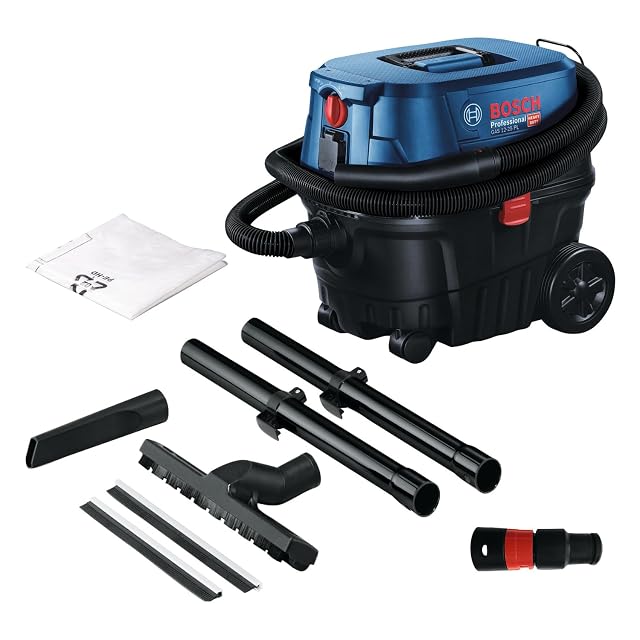
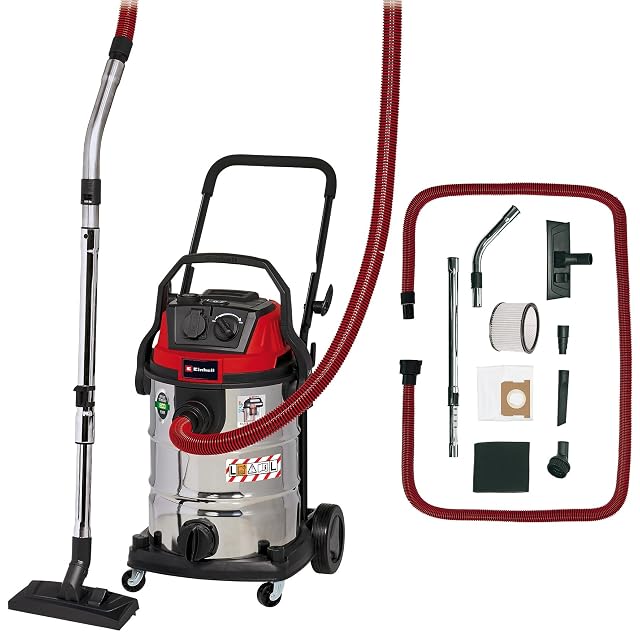
- “9 Accessories, including a Car, Utility, and Crevice Tool for Various Tasks”
- “Complete Vac Organization with On-Board Hose, Cord and Accessory Storage”
- Title: “5-Gal 5.5 PHP”
- Catalog: 6985 g (246.4 oz) · 472 × 340 × 419 mm (18.6 × 13.4 × 16.5 in)
Air watts are airflow multiplied by suction — the work done at the nozzle — and this is the strongest figure published anywhere on this shelf.
What the alternative looks like. Seven of twelve listings publish peak horsepower alone, and peak horsepower is not a power figure:
this — 5.5 PHP = 4100 W · Craftsman 17040 — 5.0 PHP = 3730 W · Shop-Vac — 4.5 PHP = 3356 W · Vacmaster VOC508S — 4 PHP = 2983 W · Craftsman 17250 — 2.5 PHP = 1865 W · Armor All ×2 — 2 PHP = 1490 W
A 120 V American socket on a 15 A breaker supplies about 1800 W. So the top four cannot be sustained; they are measured at stall or over a fraction of a second.
And this listing settles the matter by publishing both. Alongside its 5.5 PHP it gives 320 air watts. Its own sibling the VOC508S at $74.99 gives 4 Peak HP and 135 air watts.
Four to 5.5 peak HP is +37 per cent. A hundred and thirty-five to 320 air watts is +137 per cent.
So $22.65 between the two Vacmasters buys 2.4 times the real power — which is the single most useful comparison available on this shelf, and it exists only because one maker published both scales.
Twenty kilopascals, and the machines charging three times as much for it
20 kPa is the depression the pump can pull, and three listings here publish it:
Vacmaster VFB511H, $97.64 — 20 kPa
Giraffe Tools SGV-W18A8M-I, $297.49 — 20 kPA
Giraffe Tools SGV-W18AR11M-G, $331.47 — 20 kPA
So three times the price buys the same stated suction.
What it does buy is a wall-mounted machine with its attachments mounted beside it, a 30 foot retractable hose with a guidance system that “can roll up the hose neatly without kinking”, a 4.5 gallon tank with “orange quick-release latches”, a 24-month warranty, and on the dearer one a remote control.
And what it costs is weight and installation: both Giraffe Tools listings state, twice, that “The vacuum diameter is 291920 inch, and 60LBS, needs team lift”. Sixty pounds bolted to a garage wall is a serious fixing.
This machine is 6985 g (246.4 oz), stands on the floor, and publishes 320 air watts — which neither Giraffe Tools listing does.
If you want a vacuum permanently installed in a garage, the wall units are the product. If you want suction, this is.
One micron, which no other listing quantifies
“High-Efficiency Cartridge Filter & Dust Bag for Capturing Fine Dust Particles Down to 1 Micron in Size.”
The only filtration figure on this shelf, and it is the right threshold.
Ordinary visible dust is 10 microns and up, and any filter stops it. What passes a cheap filter is the fraction below about 5 microns — plaster dust, brick dust, cement, sawdust fines — and that fraction does two things: it reaches deep into the lungs, and it destroys the motor it passes through.
So a one-micron rating is as much a claim about the air coming out of the machine as about the dirt going in. On a shop vacuum used after cutting plasterboard, it is the specification that matters most.
The two-part arrangement is the other half, and it is why the rating is credible. A dust bag takes the bulk so the cartridge only sees fines — which is what stops a cartridge clogging in ten minutes on a plaster job. Without the bag, a one-micron cartridge blinds almost immediately.
For comparison: the Bissell 2035M publishes “2 stage filtration” with no rating. The other ten listings publish no filtration figure at all, and several name only a filter bag — which is a dry-only item on machines sold as wet and dry.
Which raises the one gap here: this listing names a cartridge filter and a dust bag, and no foam wet filter. Its own sibling the VOC508S is explicit about needing both — “a cartridge filter for dry pick-up and a foam wet filter for wet pick-up” — and the Armor All AA255W supplies both. Running water through a cartridge ruins it, so on wet work check what is fitted.
Twenty-five feet, published as a total
“25-Feet of Cleaning Reach with Premium Kink-Resistant Hose and Power Cord.”
Two listings on this shelf add it up, and both are Vacmasters: this at 25 feet, the VOC508S at 16.
Everyone else gives the parts:
Bissell 18P03 — a 32 ft hose (wall-mounted) · Giraffe Tools ×2 — 30 ft retractable · this — 25 ft · Craftsman 17040 — 22 ft · Armor All AA255W — 18 ft · Shop-Vac and VOC508S — 16 ft · Armor All AA155 — 10 ft · Kärcher — a 3.9 ft hose, battery so no cord · Craftsman 17250 — a 5 ft hose, cord not published · Bissell 2035M — nothing
Twenty-five feet covers a double garage from one socket, which on a five-gallon machine is the right pairing: a big drum is for a big job, and a big job wants reach.
Kink-resistant is the detail worth having. A hose that folds flat under its own weight at the drum inlet loses most of its airflow, and it does it without being obvious — you assume the vacuum is weak.
Nine accessories, and storage for them
Nine, including car, utility and crevice tools, with “complete vac organization with on-board hose, cord and accessory storage”.
Mid-shelf on count: the Armor All AA255W publishes thirteen, the Bissell 18P03 seven, the Armor All AA155, VOC508S and both Giraffe Tools machines six, the Craftsman 17250 four.
The storage bullet is the one that matters in a year. Nine loose nozzles in a garage become three, and three listings here address it: this, both Armor All models, and the Craftsman 17040 with an “attached organization caddy”. Both Giraffe Tools machines mount the attachments on the wall and note that it “reduces accessories missing”.
What is not published
No tank material, where its own cheaper sibling publishes “stainless steel” — the only stainless tank on this shelf. Both Armor All machines publish polypropylene, and the Bissell 18P03 a “semi-translucent” plastic tank.
No foam wet filter, as above.
No blower. Six machines here convert: both Armor All models, both Bissells, the Craftsman 17250 and the Kärcher. Neither Vacmaster does.
No hose bore. Three listings publish one: the Craftsman 17040 at 1-7/8 inch, the Craftsman 17250 and Armor All AA255W at 1-1/4 inch — a 2.25 times difference in cross-section, which decides whether the hose passes wood chips or blocks on them.
No drain. The Shop-Vac at $139.99 is the only machine here with one, a “bottom drain outlet… without lifting or tilting the machine”. On five gallons that means lifting about 19 liters of dirty water by hand.
No fill indicator, which only the Bissell 18P03 has — a semi-translucent tank plus an “LED Full Water Tank Indicator”. Overfilling is how water reaches the motor, which is the one failure that ends a wet vacuum.
No warranty. Both Craftsman machines publish “3 Year Limited Warranty” and both Giraffe Tools machines “24-Month Warranty and Service”. The other eight, this included, publish none.
And no gallon qualification. Only the Craftsman 17250 admits on this shelf that “gallons indicated reflect drum volume, not necessarily [usable capacity]” — the motor and filter take the top of the drum, and on wet work nobody fills to the brim. Read five gallons as the drum.
Availability
Read on the day this page was built: $98 at the American Amazon shop.
Read from Keepa on the day this page was last revised; stock and price both move without notice.
Prices quoted in this text were read on 2026-10-04. The live price is at the top of the page.