What the maker puts in writing
- “POWERFUL PERFORMANCE: 5.0 Peak HP provides the power of a large shop vac in a small package”
- “OPTIMAL STORAGE: Attached organization caddy keeps accessories in one place”
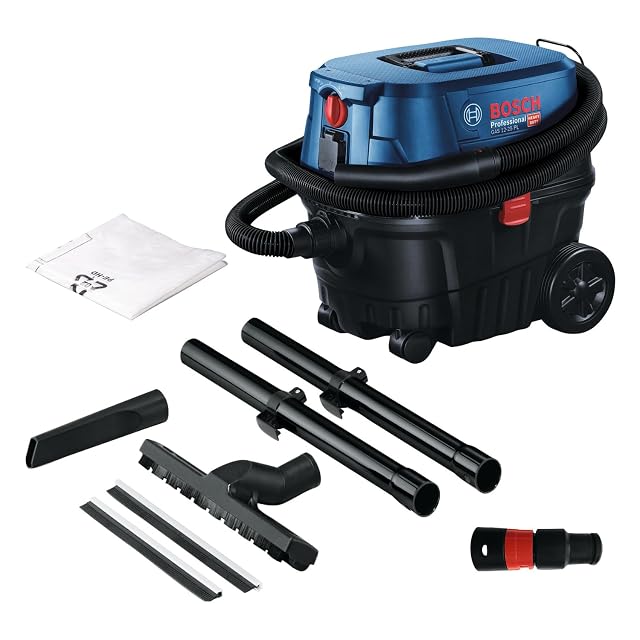
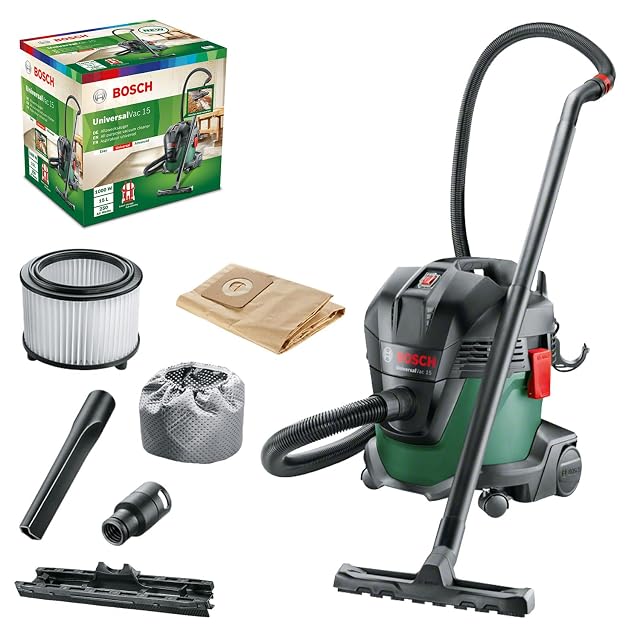
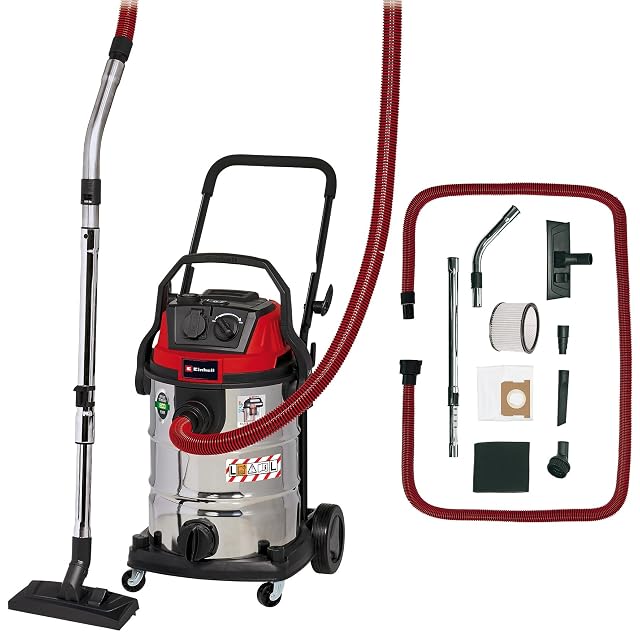
- “ACCESSORIES INCLUDED: 1-7/8 in. x 7 ft. POS-I-LOCK Hose, Car Nozzle, Utility Nozzle, Dusting Brush, 2 Extension Wands, and Cartridge Filter”
- “COMPATIBLE FILTERS: CMXZVBE38740 and CMXZVBE38741 Genuine CRAFTSMAN Vac Filters”
- “COMPATIBLE DUST BAGS: CMXZVBE43271 Genuine CRAFTSMAN Dust Bags”
- “VAC WARRANTY: 3 Year Limited Warranty”
- Description: “The 15-foot cord and 7-foot hose gives you space to move around the room”
- Catalog: 7257 g (256 oz) · 356 × 511 × 414 mm (14 × 20.1 × 16.3 in)
One and seven eighths of an inch, which changes what the machine can do
This is the only 1-7/8 inch hose on the shelf, and it is 2.25 times the cross-sectional area of the 1-1/4 inch bore on the only two other listings that publish one — this maker’s own CMXEVBE17250 at $44.99 and the Armor All AA255W at $67.71.
What that buys is debris passage. Wood offcuts, plasterboard crumbs, acorns, bottle caps, leaves, screws — all of which stop a 1-1/4 inch hose dead. Clearing a blocked hose means disconnecting it and shaking it out over a bin, and on a workshop floor it happens repeatedly.
It also moves considerably more air, which is what lifts standing water rather than merely dragging it.
What you give up is velocity. A narrow bore moves less air faster, which is better at pulling fine dust out of a seat rail or a window track — and the slimmer nozzles physically fit where a two-inch one will not.
Which is why the sibling 17250 publishes the only incompatibility on this shelf: “NOT COMPATIBLE WITH: CMXZVBE38662 Car Cleaning Kit.” That kit is built for this bore.
So the division is clean: workshop floor, this machine. Car interior, the narrow one.
POS-I-LOCK is the other half. The 17250 uses a “Friction Fit” cuff, which pulls off if the hose catches; this one locks. On a 7-foot hose dragged across a garage, that matters.
Three part numbers, which is the most serviceable listing here
Filters: CMXZVBE38740 and CMXZVBE38741. Dust bag: CMXZVBE43271.
A cartridge filter is a consumable. It clogs, the pleats tear, and on wet work it is the part you destroy first.
Eight of these twelve listings do not say what kind of filter the machine contains, let alone what to reorder. A shop vacuum with an unobtainable filter is a drum with a motor on it.
Two filter numbers rather than one also tells you something useful: there are two options for this machine, which normally means a standard cartridge and a finer one.
The sibling 17250 publishes its filter bag number too, and between them the two Craftsmans are the only machines on this shelf you can confidently maintain in five years.
What this listing does not publish is a filtration rating. The Vacmaster VFB511H at $97.64 is the only machine here that quantifies it: “capturing fine dust particles down to 1 Micron”, using a cartridge and a dust bag together — the bag taking the bulk so the cartridge only sees fines.
Twenty-two feet, from a long cord
15 ft cord + 7 ft hose.
The cord is the longer half, which is the right way round: a long hose is heavy to drag and loses airflow, where a long cord costs nothing.
Bissell 18P03 — a 32 ft hose (wall-mounted) · Giraffe Tools ×2 — 30 ft retractable · Vacmaster VFB511H — “25 feet of cleaning reach” · this — 22 ft · Armor All AA255W — 18 ft · Vacmaster VOC508S — “16 feet” · Shop-Vac — 16 ft · Armor All AA155 — 10 ft · Kärcher — a 3.9 ft hose, battery so no cord · Craftsman 17250 — a 5 ft hose, cord not published · Bissell 2035M — nothing published
Twenty-two feet covers a single garage from one socket without moving the drum.
Five peak horsepower, which is 3730 watts
A 120 V American socket on a 15 A breaker supplies about 1800 W at maximum. So this figure is measured at stall or across a fraction of a second — a catalog convention, not a measurement.
The shelf’s peak HP claims: Vacmaster VFB511H 5.5 · this 5.0 · Shop-Vac 4.5 · Vacmaster VOC508S 4.0 · Craftsman 17250 2.5 · Armor All ×2 2.0.
And what exposes the scale is that Vacmaster publishes both:
VFB511H — “5.5 PHP” and “320 Air Watts of Power, 20kPa”
VOC508S — “4 Peak HP” and “135 air watt motor”
Four to 5.5 peak HP is +37 per cent. A hundred and thirty-five to 320 air watts is +137 per cent.
Air watts — airflow multiplied by suction, the work done at the nozzle — is the only figure worth comparing, and only Vacmaster publishes it here. Three listings publish kPa, two publish amps, and seven publish peak horsepower alone.
So judge this one on the bore, the reach and the drum, which are all real figures.
The description’s own phrasing is at least honest about what the claim is for: “the power of a large shop vac in a small package” — a size comparison rather than a performance one.
4 gallons, which is mid-shelf: Armor All 1.5 and 2.5 · Kärcher 1.8 · Craftsman 17250 2.5 · this and Bissell 18P03 4 · both Giraffe Tools 4.5 · Vacmaster ×2 and Shop-Vac 5 · Bissell 2035M 6.
And the sibling 17250 is the only listing on this shelf that admits what the number describes: “Gallons indicated reflect drum volume, not necessarily [usable capacity].”
The motor and filter occupy the top of the drum, and on wet work nobody fills to the brim, because water reaching the motor is the one failure that ends the machine. So read four gallons as the drum.
At 7257 g (256 oz) this is among the heavier floor machines here — only the two Giraffe Tools wall units at 27 kg (59.5 lb) are heavier — and four gallons of water is about fifteen liters, which is fifteen kilos to carry out.
Which is where the Shop-Vac at $139.99 has the advantage nobody else does: a “bottom drain outlet… without lifting or tilting the machine”.
The caddy, which is why you still own five nozzles
“OPTIMAL STORAGE: Attached organization caddy keeps accessories in one place and easy to get to.”
Five loose accessories in a workshop become two within a year.
Three other listings address it: both Armor All models with on-board storage, and the Vacmaster VFB511H with “complete vac organization with on-board hose, cord and accessory storage”. Both Giraffe Tools machines mount the attachments on the wall and note it “reduces accessories missing”.
Two extension wands is the other equipment note worth having — enough to reach a ceiling corner or under a bench without kneeling. The Armor All AA255W supplies three; six listings here supply none.
What is not published
No wet filter, and on a machine titled “Wet Dry Shop Vacuum” that is the significant gap. The accessory list names a cartridge filter only.
A cartridge traps fine dust and is ruined the moment water passes through it — it clogs, sags, then lets dust straight into the motor. A foam sleeve handles water. The Vacmaster VOC508S at $74.99 states the pairing explicitly — “a cartridge filter for dry pick-up and a foam wet filter for wet pick-up” — and the Armor All AA255W supplies both.
So on this machine, check what is fitted before the first spill, and budget for a foam sleeve.
No air watts, kPa or amps.
No blower. Six machines here convert: both Armor All models, both Bissells, the Craftsman 17250 and the Kärcher. This does not, and nor does the sibling’s larger brother — which is an odd regression, since the cheaper 17250 does.
No tank material, where the Vacmaster VOC508S publishes stainless steel and both Armor All machines polypropylene.
No drain and no fill indicator — the Shop-Vac has the first, the Bissell 18P03 the second with an “LED Full Water Tank Indicator”.
Availability
Read on the day this page was built: $120 at the American Amazon shop.
Read from Keepa on the day this page was last revised; stock and price both move without notice.
Prices quoted in this text were read on 2026-10-04. The live price is at the top of the page.