What the maker puts in writing
- “Versatile 3-in-1 Cleaning: Combines vacuuming, spraying, and water extraction in one unit. Ideal for carpets, upholstery, and car interiors”
- “Features a 5-gallon debris tank and a 4.5L clean water tank, allowing extended cleaning sessions without frequent refills or emptying”
- “Remote Control Spray Handle: Built-in spray trigger on the handle enables easy switching between spraying and vacuuming”
- “With a 6-ft hose and 10-ft cord, this vacuum cleans wide spaces with ease”
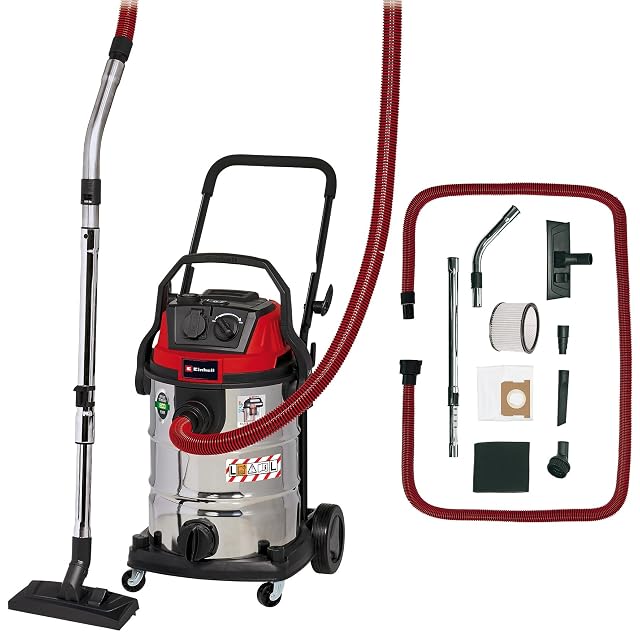
- “Handheld Shampoo Nozzle, Upholstery Nozzle, Carpet Shampoo Nozzle, Crevice Tool, Floor Brush”
- “Convenient Drainage System: Bottom drain outlet allows for quick and mess-free disposal of dirty water without lifting or tilting the machine”
- Title: “5-Gallon 4.5 Peak HP 3-in-1”
- Catalog: 6804 g (240 oz) · 361 × 381 × 509 mm (14.2 × 15 × 20 in)
It washes, where everything else on this shelf lifts
“Combines vacuuming, spraying, and water extraction in one unit.”
This is a different class of machine sitting on a shelf of shop vacuums, and the difference is worth being clear about.
A vacuum removes what is loose. Dust, grit, sawdust, standing water — anything not attached to the surface.
An extractor removes what is bonded in. Solution is pumped from the 4.5 liter clean water tank, sprayed into the pile, and immediately sucked back into the debris tank with whatever it has released. Spilled coffee, a pet accident, years of traffic on a stair carpet.
Nothing else on these twelve listings does it. The nearest neighbors are plain wet vacuums with a foam filter.
The spray trigger on the handle is the right implementation: you spray and recover in the same stroke, rather than walking back to a switch on the drum. The listing calls it a “Remote Control Spray Handle”, which overstates it — it is a trigger on a wand — but the function is correct.
And the nozzle set follows: a handheld shampoo nozzle, a carpet shampoo nozzle, an upholstery nozzle, plus the ordinary crevice tool and floor brush.
What no listing on this shelf mentions is the consequence of extraction: fabric stays damp for several hours, and carpet left wet in a cold room smells. Work in warm weather or with a window open, and make a second dry pass over each stroke to pull more water back.
The only drain here, which matters more than it sounds
“Bottom drain outlet allows for quick and mess-free disposal of dirty water without lifting or tilting the machine.”
Five US gallons is about nineteen liters, which is twenty kilos.
Emptying a wet vacuum without a drain means unclipping the motor head, lifting the drum, carrying it to a gully and tipping it — and the hard part is that the weight shifts as it pours.
Five other machines here hold four gallons or more:
Bissell 2035M — 6 gallons (and a stated “Dirt Cup Capacity: 23 L”, which is consistent)
Vacmaster VFB511H and VOC508S — 5 gallons
Giraffe Tools ×2 — 4.5 gallons
Craftsman 17040 and Bissell 18P03 — 4 gallons
None of them has a drain.
The nearest alternative is on the two Giraffe Tools machines: “Press the orange quick-release latches to detach the heavy-duty tank. Slide it out, empty debris, and click it back into place” — better than unclipping a motor head, and still a carry.
On an extractor the drain earns its place twice over, because you are putting water in as well as taking it out, so the tank fills on every job.
5 gallons of debris, 4.5 liters of clean water.
The clean tank is the one to size up. Four and a half liters of solution covers a car interior comfortably and a flight of stairs; on a room-sized carpet you will refill.
And the ratio is right: the debris tank has to be far larger than the clean one, because it receives the water plus everything the water released, plus enough margin that it cannot overflow into the motor.
Which is the failure to watch on any wet machine. Water reaching the motor is the one fault that ends it, and this listing publishes no fill indicator. The Bissell 18P03 is the only machine here with one — a semi-translucent tank plus an “LED Full Water Tank Indicator”.
On an extractor, the arithmetic at least warns you: if you have sprayed 4.5 liters into a carpet and the debris tank holds nineteen, you will not fill it.
Sixteen feet of reach, which is the short end
6 ft hose + 10 ft cord.
For a five-gallon machine that is modest:
Bissell 18P03 — a 32 ft hose · Giraffe Tools ×2 — 30 ft retractable · Vacmaster VFB511H — “25 feet of cleaning reach” · Craftsman 17040 — 22 ft · Armor All AA255W — 18 ft · this and Vacmaster VOC508S — 16 ft · Armor All AA155 — 10 ft · Kärcher — a 3.9 ft hose, battery so no cord · Craftsman 17250 — a 5 ft hose, cord not published
For a car on a driveway, sixteen feet is fine — you set it on the ground beside the door. For a staircase it means moving the machine every few steps, and a machine with four and a half liters of water in it is not light.
The bullet’s claim that this “cleans wide spaces with ease” and reduces “the need to unplug and reposition” is the one piece of overreach on an otherwise plain page.
4.5 peak HP is 3356 watts. A 120 V American socket on a 15 A breaker supplies about 1800 W.
So it is measured at stall or over a fraction of a second. The shelf’s claims: Vacmaster VFB511H 5.5 · Craftsman 17040 5.0 · this 4.5 · Vacmaster VOC508S 4.0 · Craftsman 17250 2.5 · Armor All ×2 2.0.
And Vacmaster proves the scale is unusable by publishing both on its two machines: “5.5 PHP” with “320 Air Watts”, against “4 Peak HP” with “135 air watt motor” — +37 per cent claimed, +137 per cent real.
Air watts is airflow multiplied by suction: the work at the nozzle. Only Vacmaster publishes it here. Three listings publish kPa (both Giraffe Tools and the VFB511H, all at 20 kPa), two publish amps, seven publish peak horsepower alone.
On an extractor, though, raw suction is not the figure that decides the result. Water recovery is — how much of what you sprayed comes back out of the carpet. No listing on this shelf publishes a recovery rate, and the practical answer is two passes per stroke: one wet, one dry.
What is not published
No air watts, kPa or amps.
No filtration figure. The Vacmaster VFB511H at $97.64 is the only machine here that quantifies filtration, at 1 micron; the Bissell 2035M publishes “2 stage”.
No filter type at all, which on a machine handling both water and dry debris is a real gap. A cartridge filter is ruined by water; a foam sleeve handles it and traps no dust. The Vacmaster VOC508S spells out that both are needed — “a cartridge filter for dry pick-up and a foam wet filter for wet pick-up” — and the Armor All AA255W supplies both.
No blower. Six machines here convert; this is not one of them.
No detergent specification. An extractor needs a low-foam solution: ordinary washing-up liquid foams enough to fill the recovery tank with bubbles and carry them into the motor. No listing says so.
No warranty. Both Craftsman machines publish 3 years and both Giraffe Tools machines 24 months. The other eight, this included, publish none.
And no gallon qualification — only the Craftsman 17250 admits on this shelf that “gallons indicated reflect drum volume, not necessarily” the usable capacity.
Availability
Read on the day this page was built: $140 at the American Amazon shop.
Read from Keepa on the day this page was last revised; stock and price both move without notice.
Prices quoted in this text were read on 2026-10-04. The live price is at the top of the page.