What the maker puts in writing
- “Powerful 11 amp motor for excellent wet and dry cleaning”
- “6 gallon capacity to get the job done whether big or small”
- “Includes a blowing function, for clearing dirt and debris from porches, garages and doorways or even to blow up inflatable mattresses and toys with the included tools”
- “2 stage filtration designed to help extend the Life of the filter and provide easier cleaning”
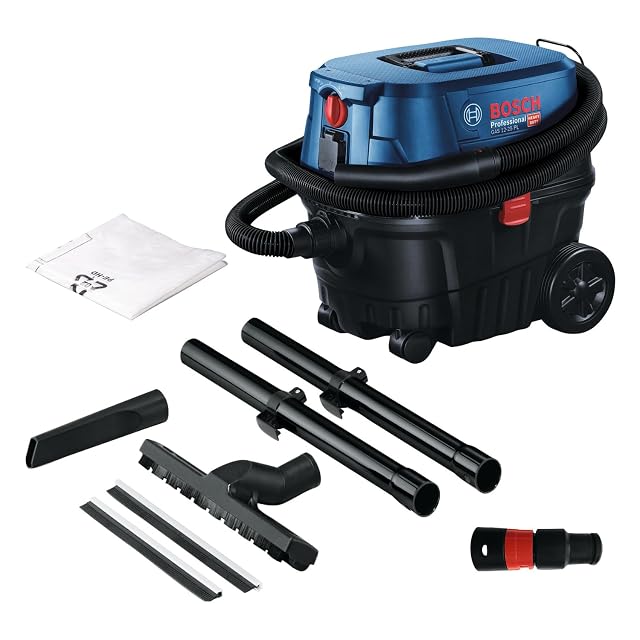
- “Specialized auto tool kit includes crevice tool, precision blowing/suction tool, precision wet suction tool, upholstery brush and detailing/inflatable nozzle tools. Dirt Cup Capacity: 23 L”
- Description adds: “the combination floor tool for excellent cleaning on hard floors, area rugs and low pile carpeting. The wet floor tool is designed for cleaning up wet messes”
- Catalog: 7303 g · 406 × 406 × 622 mm
Six gallons, and the only capacity on this shelf stated twice
“6 gallon capacity” and “Dirt Cup Capacity: 23 L”.
Twenty-three liters is 6.08 US gallons. The two agree, and this is the only listing here that publishes its capacity in two units and lets you check one against the other.
That is worth something, because the figures on this shelf generally do not invite checking. Only the Craftsman 17250 admits what a gallon number normally describes: “gallons indicated reflect drum volume, not necessarily [usable capacity]” — the motor and filter occupy the top of the drum, and on wet work nobody fills to the brim.
The shelf, for scale: Armor All 1.5 and 2.5 · Kärcher 1.8 · Craftsman 17250 2.5 · Craftsman 17040 and Bissell 18P03 4 · Giraffe Tools ×2 4.5 · Vacmaster ×2 and Shop-Vac 5 · this 6.
And the cost of the largest drum is at the other end. Twenty-three liters of water weighs twenty-three kilos, and this listing publishes no drain. Emptying means unclipping the motor head, lifting the drum, carrying it to a gully and tipping it — with the weight shifting as it pours.
Only the Shop-Vac at $139.99 has a “bottom drain outlet… without lifting or tilting the machine”. The Giraffe Tools pair offer a halfway measure: “orange quick-release latches… slide it out, empty debris, and click it back”.
So six gallons is a drum you empty rarely and dread when you do.
Eleven amps, which is at least a real unit
Eleven amps at 120 volts is 1320 watts of input power — a figure a domestic socket can genuinely supply, and directly comparable with the Bissell 18P03’s 12 amps (1440 W).
Those two are the only amp figures on this shelf.
Seven of twelve listings publish peak horsepower instead, and peak horsepower is not a power figure:
Vacmaster VFB511H 5.5 PHP = 4100 W · Craftsman 17040 5.0 = 3730 W · Shop-Vac 4.5 = 3356 W · Vacmaster VOC508S 4.0 = 2983 W · Craftsman 17250 2.5 = 1865 W · Armor All ×2 2.0 = 1490 W
A 120 V socket on a 15 A breaker caps near 1800 W, so the top four are measured at stall or across a fraction of a second.
And Vacmaster proves the scale unusable by publishing both on its own two machines: “5.5 PHP” with “320 Air Watts”, against “4 Peak HP” with “135 air watt motor” — +37 per cent in claimed horsepower, +137 per cent in real power.
What amps still does not tell you is output. Input watts describe the electricity; air watts describe the work at the nozzle, and only Vacmaster publishes those. Three machines publish kPa, all three at 20 kPa.
So eleven amps puts this in the honest middle of the shelf: a comparable figure that is not quite the right figure.
“crevice tool, precision blowing/suction tool, precision wet suction tool, upholstery brush and detailing/inflatable nozzle” — and in the description, “the combination floor tool for… hard floors, area rugs and low pile carpeting. The wet floor tool is designed for cleaning up wet messes.”
Four tools across two jobs, and the distinction is the useful part.
A dry floor tool has a brush strip and relies on airflow. A wet floor tool has a rubber lip that pulls standing water into a line the suction can lift — which a brush cannot do, because water runs around bristles.
Most listings on this shelf supply one floor tool or none. The Armor All AA255W at $67.71 is the other machine that addresses it, with a “floor brush/squeegee nozzle” doing both in one head.
And a precision wet suction tool is a small thing with a clear use: a footwell, a seat seam, a windowsill after a leak — somewhere a floor tool cannot reach and where water would otherwise be mopped by hand.
Which fits the stated purpose: “professional results in and out of the home… garages, cars and outdoor areas”.
Two stage filtration, without a number
“2 stage filtration designed to help extend the Life of the filter and provide easier cleaning.”
The mechanism is right and unquantified. A coarse first stage takes the bulk so the fine stage only sees fines, which is what stops a filter blinding in ten minutes on plaster dust — and it is why the stated benefit is filter life rather than filtration quality.
What is missing is the rating. The Vacmaster VFB511H at $97.64 is the only machine on this shelf that publishes one: “capturing fine dust particles down to 1 Micron”, using a cartridge and a dust bag together.
Ten listings here, this included, publish no filtration figure at all.
And the gap that matters more on a wet/dry machine: this listing does not say whether the two stages include a wet filter. A cartridge traps dust and is ruined the moment water passes through it; a foam sleeve handles water and traps no dust. The Vacmaster VOC508S spells out that both are needed — “a cartridge filter for dry pick-up and a foam wet filter for wet pick-up” — and the Armor All AA255W supplies both.
The Kärcher at $172.99 is the only machine here claiming to need no swap: “the top-mounted cartridge filter… no matter if wet or dry dirt.”
The most specific blower claim on the shelf
“for clearing dirt and debris from porches, garages and doorways or even to blow up inflatable mattresses and toys with the included tools.”
Six of twelve machines convert to a blower: both Armor All models, both Bissells, the Craftsman 17250 and the Kärcher. Only this one claims inflation.
And “with the included tools” is doing real work in that sentence. Inflating needs a precision blowing tool that fits an air-bed valve, and the kit names a “precision blowing/suction tool” and a “detailing/inflatable nozzle”. Without those, a two-inch port is useless on a mattress.
The limit worth knowing: a vacuum blower moves a lot of air at low pressure. It fills an airbed quickly and will not firm it up at the end — the last few per cent still wants the pump that came with the bed. For a paddling pool, a lilo or a bouncy castle it is the right tool.
What is not published
No reach at all — neither hose nor cord length, which makes this the only machine on the shelf whose working radius is completely unstated.
What the others give: Bissell 18P03 — a 32 ft hose · Giraffe Tools ×2 — 30 ft retractable · Vacmaster VFB511H — “25 feet of cleaning reach” · Craftsman 17040 — 22 ft · Armor All AA255W — 18 ft · Shop-Vac and Vacmaster VOC508S — 16 ft · Armor All AA155 — 10 ft · Kärcher — a 3.9 ft hose, cordless.
On a six gallon machine weighing 7303 g, reach matters: you do not want to move it.
No air watts.
No filtration rating, and no statement of whether a wet filter is fitted.
No hose bore. Three listings publish one: the Craftsman 17040 at 1-7/8 inch, the Craftsman 17250 and Armor All AA255W at 1-1/4 inch — a 2.25 times difference in cross-section, which decides whether the hose passes wood chips or jams on them.
No drain and no fill indicator, on the largest drum here. Its own sibling the 18P03 has the indicator: a semi-translucent tank with an “LED Full Water Tank Indicator”. Overfilling is how water reaches the motor, which is the one failure that ends a wet vacuum.
No tank material, where the Vacmaster VOC508S publishes stainless steel and both Armor All machines polypropylene.
No warranty. Both Craftsman machines publish “3 Year Limited Warranty” and both Giraffe Tools machines “24-Month Warranty”. The other eight, this included, publish none.
Availability
Read on the day this page was built: $175 at the American Amazon shop.
Read from Keepa on the day this page was last revised; stock and price both move without notice.
Prices quoted in this text were read on 2026-10-04. The live price is at the top of the page.