What the maker puts in writing
- “Stays flexible and responsive in any condition - from brutal subzero cold to scorching 140 degrees F heat”
- “Engineered with premium Flexible Hybrid Polymer for a hose that bends without breaking down”
- “Tough fittings rated up to a beastly 4,000 PSI - built for serious pressure”
- “Integrated non-kink bend restrictor keeps the flow going, no matter how tight the twist”
- “Optimized for cold water use to deliver peak performance every time”
- “Proudly Made in the USA with domestic and imported components”
- “Versatile fitment options - available with M22 or Integrated Quick Connect fittings on select hoses”
- Description: “stays flexible when pressurized during use and offers minimal memory when depressurized. It also lays flat”
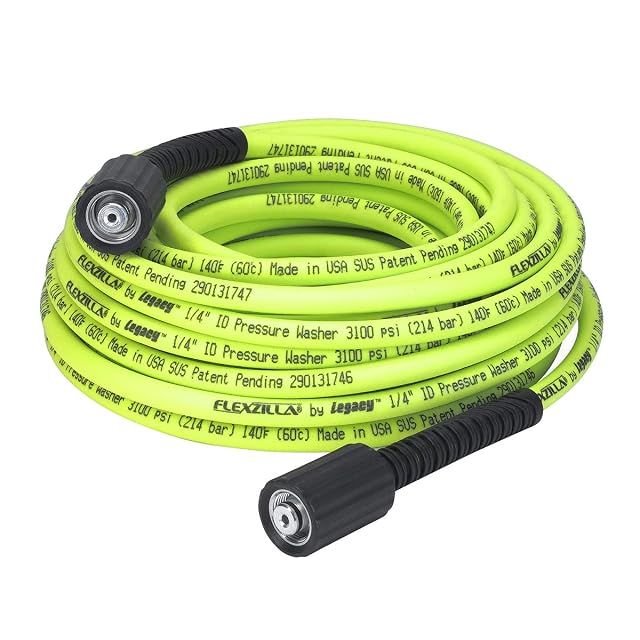
- Title: “1/4 in. x 50 ft., 3100 PSI, M22 Fittings, No-Kink, Lightweight, ZillaGreen” · Reference HFZPW3450M · Catalog: 1633 g (57.6 oz)
“Stays flexible and responsive in any condition - from brutal subzero cold to scorching 140 degrees F heat.”
No other hose here mentions cold at all, and the gap is not cosmetic.
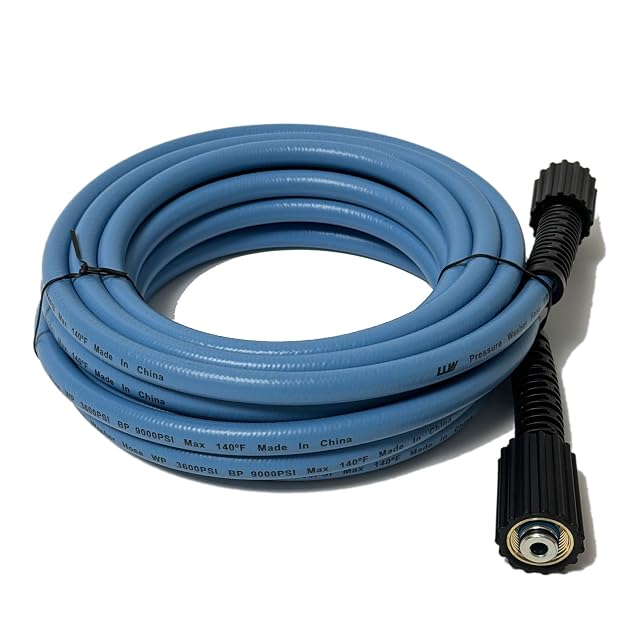
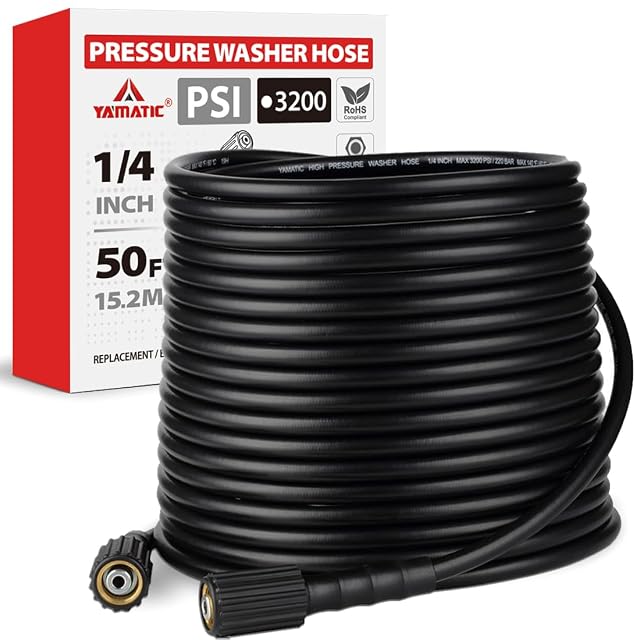
PVC — which is what the LULUW at $16.99 and the YAMATIC 50 FT at $32.99 are made of — stiffens markedly below freezing. A cold PVC hose comes off the reel in rigid loops, will not lie flat, and kinks where it is bent because the material has lost its give. Which is exactly when you least want to be fighting it: washing salt off a car in January, or clearing a path.
The claim rests on a named material — “premium Flexible Hybrid Polymer” — and the description adds the half that nothing else here claims:
“stays flexible when pressurized during use and offers minimal memory when depressurized. It also lays flat.”
Most hoses stiffen under pressure. A claim to stay supple while pressurized is a different property from being supple on the shelf, and it is the one that matters while you are working.
Coil memory is the other half, and it is the real daily annoyance of pressure washing: a hose takes the set of the coil it was stored in, then lies on the drive in circles, snags on corners and folds on itself when you pull. Both YAMATIC listings identify the problem — “reduce kinks and coil memory, helping the hose lay flatter”, and “Hose coil memory can affect water flow” — but the 50-footer makes that claim on a polyvinyl body, which is the stiffest material here.
So the material story is the strongest on the shelf. The rest of the page is less careful.
Three thousand one hundred, and the four thousand that is not the hose
The title: 3100 PSI.
Bullet three: “Tough fittings rated up to a beastly 4,000 PSI.”
The 4,000 belongs to the fittings. An assembly is worth its weakest component, and the weakest here is the hose at 3100 — which is the lowest hose rating on this shelf.
LULUW 3600 working · Simpson 3300 · RainBello 3200 MAX · YAMATIC 25 FT 3200 working · YAMATIC 50 FT 3200 working · this 3100
So the most expensive hose here carries the most conservative hose rating and the highest fitting rating, and the bullet quotes the second one.
Nothing in that is false. The sentence simply puts the larger number where a reader will take it for the product.
Two fair points on the other side. 3100 PSI is ample — domestic electric washers rarely exceed 2000, and the petrol machines on this site’s shelves reach the low 3000s. And over-specified fittings are a real good: the crimp at each end is where a hose assembly commonly lets go, so 4,000 PSI there is headroom in the right place.
No burst pressure is published, where two hoses here do give one and the comparison is instructive: the LULUW publishes 9000 against 3600 working, a ratio of 2.50; the YAMATIC 50 FT publishes 8700 against 3200, a ratio of 2.72. Those bursts are within 3.4 per cent of each other while the working figures differ by 12.5 — which is to say the headline PSI is largely a choice of safety factor. Without a burst figure, 3100 cannot be placed on that scale.
M22, and the listing will not say which M22
This is the real problem with the page, and it is more serious than the PSI presentation.
M22 comes in two sizes that share one name. M22-14mm and M22-15mm differ in the diameter of the inner nipple the seal rides on. They thread together and then either refuse to seal or let go under pressure. It is the single commonest mistake in this category.
The title says “M22 Fittings” — no millimeter figure. And bullet seven widens the uncertainty instead of closing it:
“Versatile fitment options - available with M22 or Integrated Quick Connect fittings on select hoses.”
So the listing spans more than one configuration, and leaves you to establish which one arrives.
The cheap hoses on this shelf are markedly more careful:
RainBello, $19.99 — bullet one: “Please check your connection size before purchasing. Will not work with AR Blue Clean, Sun Joe & other electric pressure washers with M22-15mm twist connect fittings”
YAMATIC 25 FT — fits “Ryobi, Troy Bilt, Greenworks, CRAFTSMAN, PowerStroke, Simpson”; rules out 3/4” garden hose thread, 3/8” quick-connect, and “certain Karcher, Stanley, Husky models”
YAMATIC 50 FT — fits “Ryobi, Troy-Bilt, Greenworks, Craftsman, Briggs & Stratton, Honda, Simpson”; rules out M22-15mm, 3/8 inch quick-connect, garden hose threads and “Sunjoe, AR Blue Clean, Karcher, Stanly”
Simpson, $25.71 — fits both, with a “dual o-ring design to fit both 14mm and 15mm connections” and a 14/15mm connector in the box
Confirm the fitting size with the seller before ordering this one, or buy the Simpson, which is the only hose on this shelf that cannot be bought wrong.
Nor is any fitting material given — both YAMATIC hoses and the LULUW specify brass, which is the right metal at a wet threaded joint; the RainBello specifies aluminum, which galls and corrodes against brass over a season.
The bend restrictor, which is the right place to put a part
“Integrated non-kink bend restrictor keeps the flow going, no matter how tight the twist.”
All six hoses here claim kink resistance. Only two have hardware for it, and they are this and the Simpson, with its “4-inch bend protectors at each end”.
The distinction matters because a hose does not usually fail in the middle. It fails at the fitting, where it goes from rigid metal to flexible tube in a few millimeters — and that transition flexes every single time you move the gun or drag the machine. Over a season the material breaks down at one line, and the hose takes a permanent kink there or bursts there.
A restrictor or protector is a tapered sleeve that spreads the bend over several inches instead of letting it happen at a point. Small part, large effect on service life.
The RainBello, both YAMATIC hoses and the LULUW rely on the body material being flexible, which addresses the length and not the ends.
“Integrated” is the better of the two arrangements, since a separate sleeve can slide out of place; the Simpson’s is specified as 4 inches, where this one gives no length.
ZillaGreen, which is more useful than a brand color sounds
A bright body rather than black, and it makes this the most visible hose on the shelf.
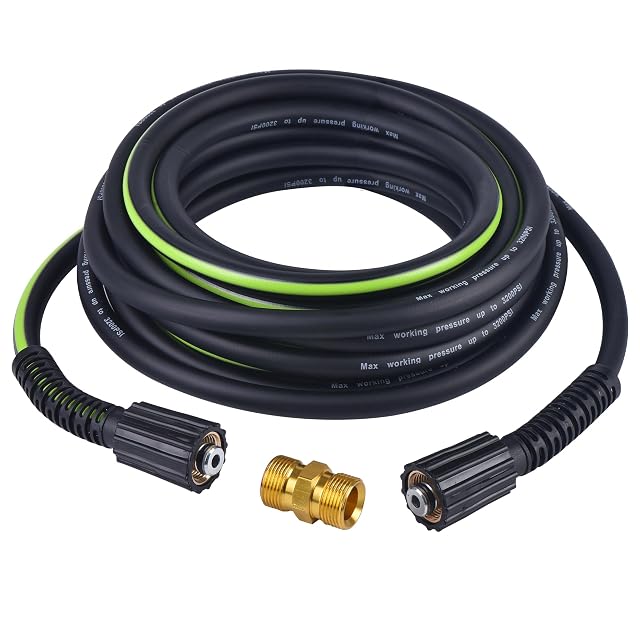
The RainBello is the only listing that explains why that matters, and the reasoning applies here with more force: “The black hose with a distinctive green stripe is used for quick identification on the job site, reducing tripping hazards and tangles.”
Consider the situation — fifty feet of hose across a wet drive or a dark deck while you walk backwards holding a gun, watching the surface rather than your feet, and the hose follows you in loops rather than staying where you put it. A dark hose on wet asphalt is genuinely hard to see.
A fully colored hose beats a stripe on black. The others: the LULUW is “Blue”, the Simpson “Natural”, and both YAMATIC listings publish no color at all.
At fifty feet this is the length where it counts most.
$53.92 for 50 feet.
YAMATIC 50 FT — 66¢/ft · LULUW — 68¢ · RainBello — 80¢ · Simpson — $1.03 · YAMATIC 25 FT — $1.04 · this — $1.08
So it costs 64 per cent more per foot than the other fifty-footer on this shelf, which also publishes a higher hose rating (3200), a burst figure (8700), the fitting size (M22-14mm), the fitting material (brass) and a plain statement of what is in the box.
What the premium buys is the first section of this page: cold flexibility, flexibility under pressure, minimal memory, a bend restrictor and a visible body. Those are real, and three of them are unique here.
Whether they are worth twenty-one dollars is a question about your season. Wash in cold weather and this is the hose on the shelf built for it. Wash between spring and autumn and the YAMATIC gives you the same reach for two-thirds less.
1633 g at the catalog — 32.7 g a foot, and identical to the YAMATIC 50 FT’s figure. Both are 3.6 lb exactly, which is a rounded pound value, so read it as a shipping weight on either rather than a measurement.
What is not published
No fitting size, as above — the omission that matters most.
No fitting material.
No burst pressure.
No hose pressure in the bullets. The 3100 appears only in the title; the bullets give 4,000 for the fittings.
No lower temperature figure. “Brutal subzero” is a word, not a number, where the upper end gets a precise 140 degrees F. A rating like −20 °F would be checkable; subzero is any temperature below freezing.
No bend-restrictor length, where the Simpson specifies 4 inches at each end.
No adapter or coupler, and no statement either way — where the YAMATIC 50 FT lists exactly what is absent (“no adapter kit, spray gun, wand, 3/8 inch quick-connect plug, or separate coupler”) and the Simpson ships the connector that lets a hose extend rather than replace.
No warranty term. “Proudly Made in the USA with domestic and imported components” is an origin statement, and the second half of it qualifies the first. The Simpson’s 90 Day limited accessory remains the only actual warranty on this shelf.
Availability
Read on the day this page was built: $54 at the American Amazon shop.
Read from Keepa on the day this page was last revised; stock and price both move without notice.
Prices quoted in this text were read on 2026-10-04. The live price is at the top of the page.