What the maker puts in writing
- “3600 PSI rated working pressure and 9000 psi burst pressure, suitable for most usage scenarios”
- “The maximum heat resistance temperature of this high-pressure hose is 140 ℉/60 ℃”
- “Our Pressure Washer Hose are made of PVC material, which can effectively prevent distortion and wear, and have a longer service life”
- “The M22 connector is made of high-quality brass, which is resistant to high temperature and corrosion, and can effectively prevent water leakage”
- “Our Pressure Washer Hose can be used as a replacement for most brands of cleaning machines on the market”
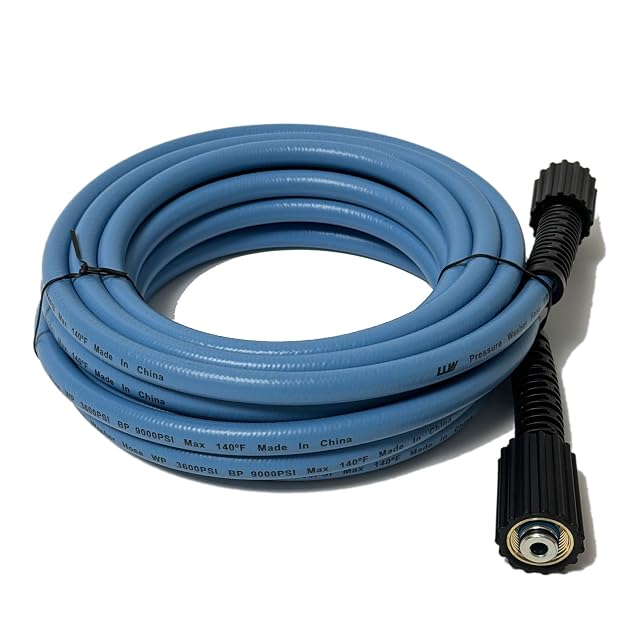
- Title: “25FT 1/4-inch… 3600PSI M22 14mm (0.55 in)… Blue” · Reference LULUW002 · Catalog: 862 g (30.4 oz), 7620 × 6 × 1 mm (300 × 0.24 × 0.04 in)
Thirty-six hundred PSI, and where it comes from
This is the highest working pressure on the shelf. It is also the only figure on this page that needs taking apart, because the shelf gives you the means to do it.
This: 3600 PSI working, 9000 PSI burst — a ratio of 2.50.
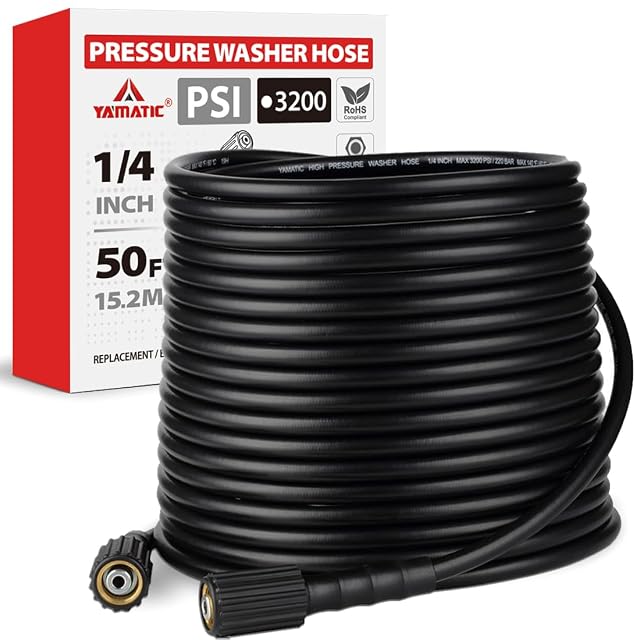
The YAMATIC 50 FT: 3200 PSI working, 8700 PSI burst — a ratio of 2.72.
Those two burst figures are within 3.4 per cent of each other. The two working figures differ by 12.5 per cent.
Burst pressure is the physical property: it is where the hose fails. Working pressure is a declaration — the burst figure divided by whatever safety factor the maker adopts.
So the 400 PSI that separates these two hoses is not stronger construction. It is LULUW using less of the margin.
Run it the other way: at YAMATIC’s 2.72 factor, a 9000 PSI burst would be declared at 3309 PSI.
None of which makes this hose unsafe. A 2.5× factor is a normal engineering margin, and the rating is honestly derived — the listing publishes both numbers, which is more than four of the six here manage. It simply means the headline is not worth paying for.
And for most buyers the whole question is academic. Domestic electric washers rarely exceed 2000 PSI; the petrol machines on this site’s shelves reach the low 3000s. Every hose on this shelf has headroom.
The shelf’s ratings, for the record: this 3600 · Simpson 3300 · RainBello 3200 MAX · both YAMATIC 3200 · Flexzilla 3100, whose own bullet quotes 4,000 for the fittings alone.
Fourteen millimeters, which is the spec that decides everything
M22 comes in two sizes that share one name. M22-14mm and M22-15mm differ in the diameter of the inner nipple. They screw together and then either refuse to seal or seal and let go under pressure.
The title says “M22 14mm (0.55 in)”. Bullet five says only “The M22 connector is made of high-quality brass”, without the size — so the size appears once, in the title.
Three listings on this shelf go further and name the machines that will not work:
RainBello — “will not work with AR Blue Clean, Sun Joe & other electric pressure washers with M22-15mm twist connect fittings”
YAMATIC 25 FT — rules out “certain Karcher, Stanley, Husky models that use non-M22 connections”, along with 3/4” garden hose thread and 3/8” quick-connect
YAMATIC 50 FT — rules out “Sunjoe, AR Blue Clean, Karcher, Stanly” and 3/8 inch quick-connect
That list applies here too, because the same outlets are excluded. If you own one of those machines, this hose will not fit, and this page will not tell you.
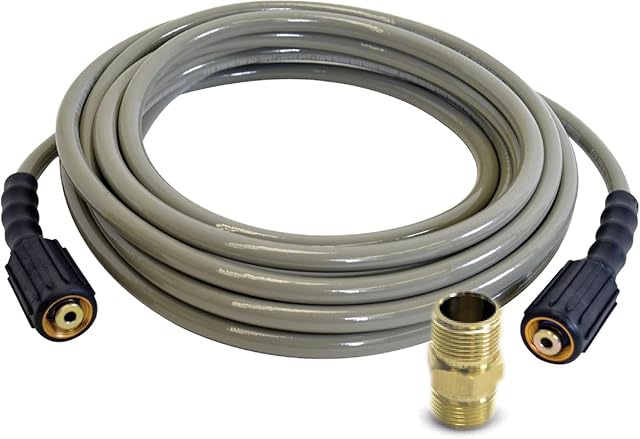
And one hose on this shelf sidesteps the question completely: the Simpson at $25.71 has “threaded fittings with dual o-ring design to fit both 14mm (0.55 in) and 15mm (0.59 in) connections” and ships a 14/15mm connector. If you do not know what your outlet is, that is the one to buy.
Brass is the right material for the fitting, and worth a word because one hose here is not. Brass does not corrode at a joint that stays wet, and it is soft enough to seat against a seal without cutting it. The RainBello uses “solid aluminum M22 connectors” and presents it as a feature; aluminum is lighter and cheaper, and it galls and seizes on a steel or brass male thread after a season outdoors. Both YAMATIC hoses are brass, like this.
A hundred and forty degrees, and the conversion is exact
“The maximum heat resistance temperature of this high-pressure hose is 140 ℉/60 ℃.”
140 °F is 60 °C exactly, which is a small thing and the kind of small thing that tells you a spec sheet was checked rather than assembled.
That figure is the category ceiling, and four of the six here publish it or say the equivalent: this, the Simpson (“up to 140 degrees Fahrenheit”, with “Cold Water Use” in the title), the Flexzilla (“scorching 140 degrees F heat”, “Optimized for cold water use”), and the YAMATIC 25 FT, which says “(cold water only)” without a number. The RainBello and the YAMATIC 50 FT publish nothing.
What it rules out: hot-water contractor machines, which run above 180 °F, and — this is the one people try — anything from a steam cleaner. The steam shelf on this site runs between 212 and 293 °F, with saturated steam at 4 bar near 291 °F.
The limit is really a statement about the PVC and the seals, not the brass. And it is the same ceiling the lance shelf publishes: the Xiny Tool and Simpson wands both state 140 °F.
PVC: what it buys and what it costs
“made of PVC material, which can effectively prevent distortion and wear.”
PVC is the commonest pressure-hose material and the cheapest, and that is most of why this is $16.99 — 68 cents a foot, second cheapest on the shelf.
Two consequences the page does not mention.
Coil memory. PVC holds the shape it was wound in. A new hose fights you for the first few uses and lies in loops on the drive rather than flat — which is the actual daily annoyance of pressure washing, more than pressure or length. Both YAMATIC hoses name it: “reduce kinks and coil memory, helping the hose lay flatter”, and “Hose coil memory can affect water flow”. The Flexzilla claims “minimal memory when depressurized. It also lays flat”. This listing says nothing about it.
Cold stiffness. Below freezing, PVC becomes markedly less flexible. That is precisely the gap the Flexzilla at $53.92 charges for — “stays flexible… from brutal subzero cold to scorching 140 degrees F heat” on a “Flexible Hybrid Polymer” body. If you wash in winter, the difference is real and worth money. If you wash from spring to autumn, it is not.
The materials across the shelf: PVC here and on the YAMATIC 50 FT (“polyvinyl body”) · hybrid rubber with braided polyester on the RainBello · polyester braid with a polyurethane jacket on the Simpson · flexible hybrid polymer on the Flexzilla · nothing named on the YAMATIC 25 FT.
862 g for 25 feet — 34.5 g a foot, the lightest 25-footer here that publishes a weight. The Simpson is 998 g, or 39.9 g a foot, though that includes its bend protectors and its adapter.
And the catalog dimensions are worth a note: 7620 × 6 × 1 mm (300 × 0.24 × 0.04 in). 7620 mm (300 in) is 300 inches, which is 25 feet exactly — so what is recorded is the hose, not the box. The RainBello carries the identical figure.
On length, the shelf divides four to two: 25 feet here, on the RainBello, the YAMATIC 25 FT and the Simpson; 50 feet on the YAMATIC 50 FT and the Flexzilla.
Which is the right choice depends on one thing the listings never mention. A longer hose costs pressure. Friction loss rises in proportion to length, and all six of these are 1/4 inch inside, where the water moves fast and the loss per foot is not trivial. Fifty feet loses about twice what twenty-five does. So the trade is reach against pressure at the nozzle, and 25 feet is the right default unless you genuinely cannot reach.
What is not published
No bend protectors. Only two hoses here have hardware for the one place hoses actually fail: the Simpson, with “4-inch bend protectors at each end”, and the Flexzilla, with an “Integrated non-kink bend restrictor”. Everything else, including this, treats kink resistance as a property of the material. At the fitting the hose goes from rigid to flexible in a few millimeters, and that transition flexes every time you move the gun.
No kink or coil-memory claim at all, which the other five all make in some form.
No cold rating, as above — only the 140 °F ceiling.
No adapter, where the Simpson ships one and can therefore extend an existing hose out of the box, and the YAMATIC 50 FT states plainly what is absent: “Hose Only, No Adapters… no adapter kit, spray gun, wand, 3/8 inch quick-connect plug, or separate coupler is included.”
No burst-pressure test standard, which is what would make the 9000 figure comparable rather than merely published.
No warranty. The Simpson’s 90 Day limited accessory is the only term on this shelf.
And “most brands of cleaning machines on the market” in bullet three is the claim the title’s own 14mm contradicts. The three listings that name excluded machines are being more useful than this one is.
Availability
Read on the day this page was built: $17 at the American Amazon shop.
Read from Keepa on the day this page was last revised; stock and price both move without notice.
Prices quoted in this text were read on 2026-10-04. The live price is at the top of the page.