What the maker puts in writing
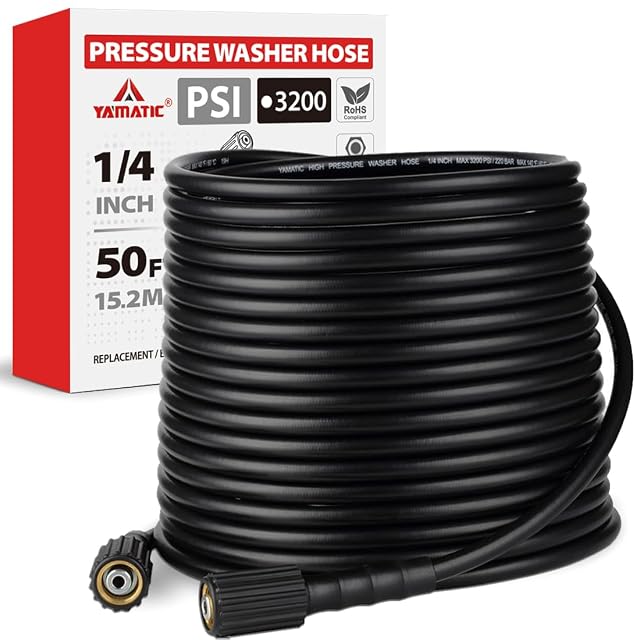
- “[Hose Only, No Adapters] Package includes one 50FT x 1/4 inch pressure washer hose with pre-installed M22-14mm fittings only; no adapter kit, spray gun, wand, 3/8 inch quick-connect plug, or separate coupler is included.”
- “this 50FT replacement power washer hose is rated up to 3200 PSI working pressure and 8700 PSI burst pressure for residential cars, patios, siding, driveways, and decks”
- “Mismatched fittings can cause leaks or failed setups, so both hose ends use M22-14mm female brass fittings for matching M22-14mm male pressure washer outlets and spray gun inlets.”
- “Hose coil memory can affect water flow, so the OEM-Upgraded polyvinyl body helps reduce twisting and restriction when fully uncoiled before use under pressure”
- “Fits select Ryobi, Troy-Bilt, Greenworks, Craftsman, Briggs & Stratton, Honda, and Simpson models with M22-14mm male connections; not direct fit for M22-15mm, 3/8 inch quick-connect, garden hose threads, or proprietary outlets (Sunjoe, AR Blue Clean, Karcher, Stanly).”
- Reference HOSE 3050AB · Catalog: 1633 g (57.6 oz)
$32.99 for 50 feet. The cheapest per foot on this shelf, and — oddly — cheaper than its own sibling.
this — 66¢/ft · LULUW — 68¢ · RainBello — 80¢ · Simpson — $1.03 · YAMATIC 25 FT — $1.04 · Flexzilla — $1.08
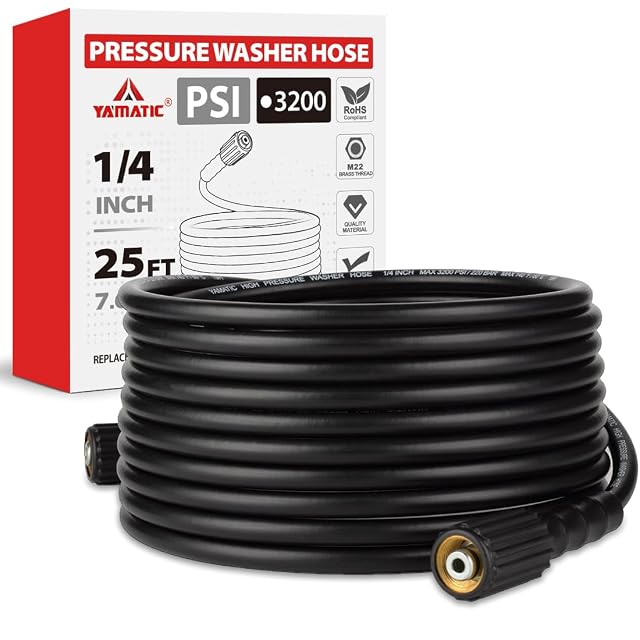
The twenty-five-foot YAMATIC is the same brand, the same 3200 PSI, the same M22-14mm female brass fittings and the same 1/4 inch bore, at $1.04 a foot. So this is 37 per cent cheaper per foot than the identical hose at half the length.
The explanation is where the cost sits. Most of the price of a short pressure hose is in the two fittings — crimped brass collars with seals, identical whatever the tube length between them. Spread one pair across twice the tube and the price per foot falls.
Which makes this the value buy on the shelf, with one caveat the listings never raise.
Fifty feet costs pressure, and nobody here says so
Friction loss in a hose rises in proportion to length, and steeply with velocity. Every hose on this shelf is 1/4 inch inside — narrow enough that at normal pump flow the water is moving fast.
So doubling the length roughly doubles the loss, and the shortfall appears where it matters: at the nozzle. The machine still makes its rated pressure; more of that pressure is spent pushing water down the hose instead of through the tip.
How much depends on your pump. A 1.2 GPM electric machine loses far less than a 3 GPM petrol one, because loss grows with the square of velocity. The This Hill unit on the steam shelf publishes 2 GPM; a domestic electric washer is typically under 2.
Two conclusions.
If your machine is near its limit for the job, buy the shorter hose.
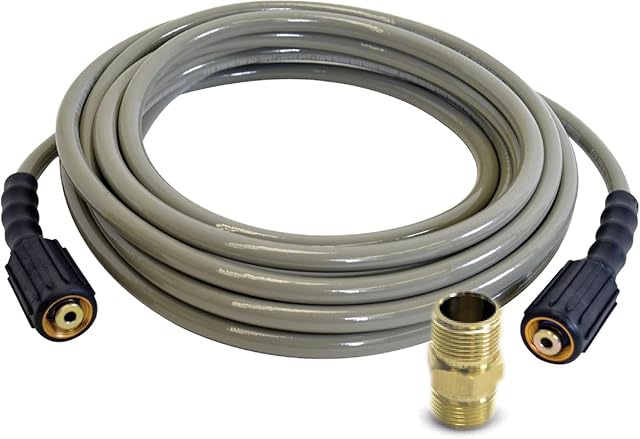
If you need reach only sometimes, the better answer on this shelf is the Simpson at $25.71, which ships a male-to-male connector so twenty-five feet becomes an extension to the hose the machine came with. Short when you want pressure, long when you need reach.
To this listing’s credit, it says plainly that no such coupler is in its box.
The most honest bullet on the shelf
“[Hose Only, No Adapters] Package includes one 50FT x 1/4 inch pressure washer hose with pre-installed M22-14mm fittings only; no adapter kit, spray gun, wand, 3/8 inch quick-connect plug, or separate coupler is included.”
Second on the page, before the pressure rating. No other listing here says what is absent.
Each exclusion has a consequence worth spelling out.
No adapter kit — so if your machine is M22-15mm, this will not work at all.
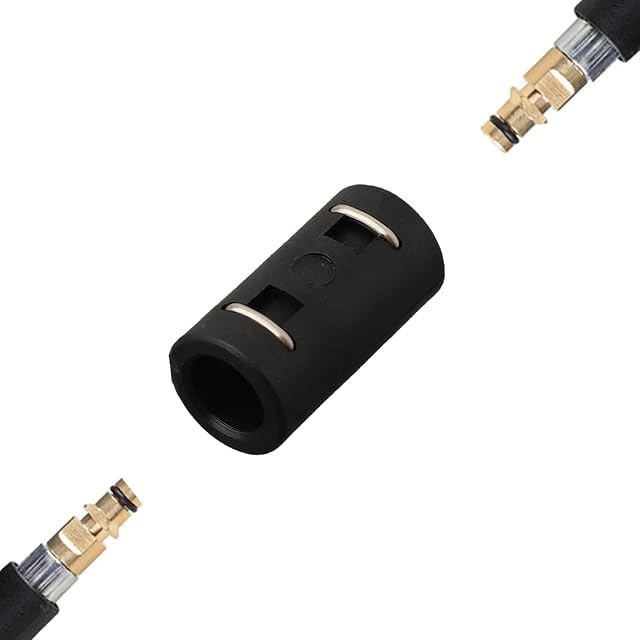
No 3/8 inch quick-connect plug — which some machines use, and which the telescoping wand on this site’s lance shelf requires at its inlet.
No coupler — so you cannot join this to your existing hose. Both ends are female, as every pressure hose is, because the machine outlet and the gun inlet are both male. Joining two needs a male-to-male piece.
The contrast is the Simpson, which ships a 14/15mm threaded connector and can be a replacement or an extension, and fits both M22 sizes with a dual o-ring design.
Everything else on this shelf is simply quiet about what is not there.
Eight thousand seven hundred, which is the widest margin published here
3200 PSI working, 8700 PSI burst — a ratio of 2.72.
Only one other hose here publishes a burst figure, and the comparison is instructive:
this — 3200 working, 8700 burst, ratio 2.72
LULUW — 3600 working, 9000 burst, ratio 2.50
Those two burst figures sit within 3.4 per cent of each other. The working figures differ by 12.5 per cent.
Burst pressure is the physical property: it is where the hose fails. Working pressure is a declaration — the burst figure divided by whatever safety factor the maker adopts. So the 400 PSI that separates these two hoses is not stronger construction. It is the ratio chosen.
Run it the other way: at this hose’s 2.72 factor, a 9000 PSI burst would be declared at 3309 PSI, not 3600.
Which means the lower headline here is the more conservative one, and that is worth knowing. Two of the six listings give both numbers; four give neither — the RainBello publishes “3200 MAX PSI” with no burst, the Simpson “up to 3300 PSI”, the YAMATIC 25 FT “up to 3200 PSI working”, and the Flexzilla a title of 3100 with a bullet quoting 4,000 PSI for the fittings alone.
For most buyers it is academic anyway: domestic electric washers rarely exceed 2000 PSI, so every hose on this shelf has headroom.
Fourteen millimeters, with seven brands named and seven exclusions
“Fits select Ryobi, Troy-Bilt, Greenworks, Craftsman, Briggs & Stratton, Honda, and Simpson models with M22-14mm male connections; not direct fit for M22-15mm, 3/8 inch quick-connect, garden hose threads, or proprietary outlets (Sunjoe, AR Blue Clean, Karcher, Stanly).”
M22 comes in two sizes that share one name. M22-14mm and M22-15mm differ in the diameter of the inner nipple the seal rides on, and they thread together and then leak or let go.
Bullet one puts the reasoning in writing, which is unusual: “Mismatched fittings can cause leaks or failed setups, so both hose ends use M22-14mm female brass fittings.”
Three hoses on this shelf name excluded machines — this, its 25-foot sibling (“certain Karcher, Stanley, Husky models”) and the RainBello (“AR Blue Clean, Sun Joe”, in bullet one). Two do not: the LULUW says “M22 14mm (0.55 in)” once, in its title, while claiming “most brands”; the Flexzilla, at $53.92, gives no size and warns that its own range ships “with M22 or Integrated Quick Connect fittings on select hoses”.
If you own a Sun Joe, an AR Blue Clean, a Karcher or a Stanley, none of the three M22-14mm hoses will fit, and the one to look at is the Simpson — “dual o-ring design to fit both 14mm and 15mm”, with the connector in the box.
Brass, as on its sibling, is the right material at a wet threaded joint: soft enough to seat on a seal without cutting it, and it does not corrode there. The RainBello is the only hose here with aluminum fittings, which hold pressure fine but gall against a brass or steel male thread and corrode galvanically against it — a joint that seizes rather than leaks.
Polyvinyl, and a claim in some tension with it
“Hose coil memory can affect water flow, so the OEM-Upgraded polyvinyl body helps reduce twisting and restriction.”
Coil memory is the real daily annoyance of pressure washing, and this listing identifies it correctly. A hose spends its life wound in a coil, the material takes a set, and unrolled it returns to those loops — lying on the drive in circles, snagging, and folding on itself when you pull against it. Every fold is a restriction, which is why the bullet links it to flow.
The tension is the material. Polyvinyl is PVC, which is the cheapest and the stiffest body on this shelf, and the one that holds its coil hardest. The LULUW is the other PVC hose here and makes no flexibility claim at all.
What the alternatives offer:
RainBello — hybrid rubber inner tube and cover over braided polyester, “helps the hose stay flexible… easier to handle and coil”
Simpson — polyester braid under a polyurethane jacket, “MorFlex technology… highly flexible and kink resistant”, plus “non-marring”
Flexzilla — flexible hybrid polymer, and the strongest claim here: “stays flexible when pressurized during use and offers minimal memory when depressurized. It also lays flat”, from “brutal subzero cold” upward
YAMATIC 25 FT — names no material at all
The bullet also contains the practical instruction, and it is good advice whatever the hose: “when fully uncoiled before use under pressure.” A coiled hose under pressure stiffens into its loops and then cannot be straightened — unroll the whole fifty feet before you pull the trigger.
1633 g at the catalog, which is 32.7 g a foot — the lightest per foot here, against the LULUW’s 34.5 and the Simpson’s 39.9. Though note the Flexzilla, also fifty feet, carries the identical 1633 g figure, which is 3.6 lb exactly — a rounded pound figure, so probably a shipping weight rather than a measurement on either.
What is not published
No temperature limit at all, and this is the clearest omission. Three hoses here publish 140 °F — the LULUW (“140 ℉/60 ℃”, a conversion that is exact), the Simpson (“up to 140 degrees Fahrenheit”, “Cold Water Use” in the title) and the Flexzilla (“scorching 140 degrees F heat”). Even its own 25-foot sibling says “(cold water only)”. This page says nothing, on a PVC body — and PVC is the material on this shelf least tolerant of heat. Treat 140 °F as the ceiling and the steam shelf on this site, which runs 212 to 293 °F, as out of the question.
No cold rating either, where the Flexzilla claims subzero flexibility and PVC is the material most affected by cold.
No bend protectors. Only the Simpson (“4-inch bend protectors at each end”) and the Flexzilla (“Integrated non-kink bend restrictor”) have hardware at the one place hoses actually fail — the fitting, where rigid meets flexible in a few millimeters and flexes every time you move the gun.
No color.
No warranty. The Simpson’s 90 Day limited accessory is the only term on this shelf; this page offers nothing, where its sibling at least offers “timely technical support”.
And no explanation of “OEM-Upgraded”, which is a comparison with no stated reference — the same phrasing its sibling uses as “OEM-QUALITY UPGRADE REPLACEMENT”.
Availability
Read on the day this page was built: $33 at the American Amazon shop.
Read from Keepa on the day this page was last revised; stock and price both move without notice.
Prices quoted in this text were read on 2026-10-04. The live price is at the top of the page.