What the maker puts in writing
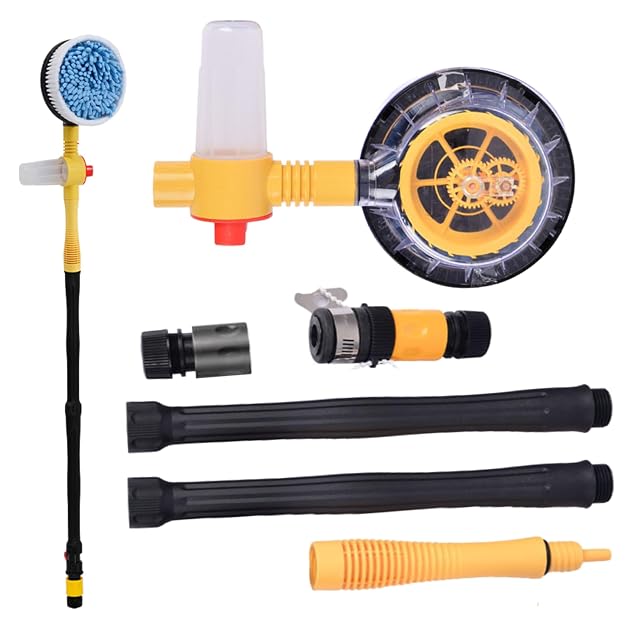
- “Flow Through Wash! Brush Easy to be attached to a 1/2 inch garden hose. An ON/OFF switch on the adapter helps to control the water flow through when you use the car scrub brush.”
- “360 Degree Rotate Automatically! No Extra Electricity Needed. Pushed by powerful water flow, the brush can spin automatically to wash car.”
- “Spray Foam! Simply adding car shampoo into soap dispenser, and adjusting the knob to desired foam level (3-gear adjustable), then the water flow will dilute and blaste the foam to car surfaces. No additional foam cannon required!”
- “High-pressure Washing! Removing the brush head to increase water pressure, it can be used as a garden hose nozzle to wash the car, clean the patio, water your garden, lawn, grass, plants and flower beds. It is also flexible to wash the dog and pet.”
- “No Scratch Soft Bristles! Come with super soft wash head - PVC filaments bristle on the edge and chenille in the middle; prevent the scrub brush from scratching cleaning surfaces, and will not be deformed.”
- Reference KB · Catalog: 454 g (16 oz)
“Brush Easy to be attached to a 1/2 inch garden hose.”
There is no pressure-washer fitting anywhere on this page. No 1/4 inch quick connect, no M22, no brand system.
So the water behind it is mains pressure — roughly 4 bar, about 60 PSI in a domestic supply. Every other item here runs off a machine, and two of them publish the ceiling: the Kärcher at $32.65 is rated for washers “up to 4000 PSI / 4.0 GPM”, the Sun Joe SPX-ACS-MAX at $49.97 “up to 3500-PSI”.
That is not a reason to dismiss it. It is a reason to read it correctly.
A rotary brush does its work by agitation, not by force — the bristles are doing most of the cleaning whatever is behind them, and sixty PSI is ample to spin a turbine. The claim in bullet two, “Pushed by powerful water flow, the brush can spin automatically”, is true of a tap.
What you lose is the rinse. Mains pressure will not strip a wheel arch or lift dried mud from a sill, so the last step of a car wash is slower and less thorough than with a machine.
And the same pattern appears on the lance shelf of this site, where the YunGuoGuo garden-hose wand says it outright in its own first bullet: “needs to be connected to a high-pressure cleaner to generate strong power; otherwise, it can only provide ordinary water pressure.”
This page never says it. The fitting says it for you.
The shelf, by what it attaches to:
1/4 inch quick connect, universal — the TUHUT at $15.99, the Kuuleyn at $27.39, the Hyuduo at $29.31, the Kärcher at $32.65
Worx Hydroshot only — the WA1820 and WA1821 at $44.99, the WA4042 at $22.79
Sun Joe SPX only — the SPX-RB1 at $25.99, the SPX-CCK at $54.97
Garden hose — this, alone
The soap dispenser, which is the best thing on the page
“Simply adding car shampoo into soap dispenser, and adjusting the knob to desired foam level (3-gear adjustable), then the water flow will dilute and blaste the foam to car surfaces. No additional foam cannon required!”
This solves on its own what every other brush here borrows from the machine.
Here is the context, and it runs through the detergent shelf of this site. A pressure washer draws soap by venturi, and a venturi only pulls at low pressure — which is why those detergent listings specify the wide black soap nozzle at around 65°, and why the Sun Joe concentrate there is the only one of eleven bottles to explain it.
A rotary brush is itself a low-pressure attachment, so it siphons soap for free. Two listings here say so: the Kärcher — “The brush automatically dispenses soap from the pressure washer, making it even more convenient to clean with detergents” — and the TUHUT — “Ideal for dispensing pressure washer detergent.”
This one has no machine to siphon from, so it carries its own reservoir. And the 3-gear knob is genuinely more control than a machine siphon gives, since a washer dispenses whatever its fixed orifice draws.
The foam-cannon claim is worth taking seriously too. Both Kärcher detergent bottles on that shelf name a foam cannon as a supported application — “Suitable for pressure washer or foam cannon” — and a cannon is a separate bottle-and-venturi attachment bought precisely to get thick clinging foam that stays on a vertical panel long enough to work. If this does that from a tap, it is replacing a purchase.
The honest limit: foam from sixty PSI will be thinner than foam from a cannon on a 2000 PSI machine. Expect lather rather than shaving foam.
“Removing the brush head to increase water pressure, it can be used as a garden hose nozzle to wash the car, clean the patio, water your garden, lawn, grass, plants and flower beds. It is also flexible to wash the dog and pet.”
That is a sensible piece of design, and nothing else on this shelf does it.
The reason the pressure rises is simple. The brush head is a restriction and a turbine; take it off and the same flow leaves through a smaller, unobstructed outlet, so velocity goes up. It is the same physics the garden-hose wands on the lance shelf rely on — narrowing the outlet raises velocity, not pressure, because there is no pump in the circuit.
Which makes the use list credible rather than padded. Watering a bed, rinsing a patio and washing a dog are all jobs for moderate water at a controllable rate, and the on-off switch at the handle is what makes them pleasant — you stop the water where you are standing rather than walking back to the tap.
And it is the honest ceiling on the “High-pressure Washing!” heading. With the head off, this is a hose nozzle. It is not a pressure washer, and nothing in the bullet claims to be.
PVC filaments and chenille, which is an unusual combination
“super soft wash head - PVC filaments bristle on the edge and chenille in the middle; prevent the scrub brush from scratching cleaning surfaces, and will not be deformed.”
Two materials in two zones, and the division makes sense.
PVC filament at the edge is the stiffer part, doing the work of a bristle — enough body to agitate, enough flex not to dig.
Chenille in the middle is a soft tufted yarn, which is what a good hand mitt is made of. It holds water and soap and lifts dirt by carrying it away in the pile rather than dragging it across the surface.
That is the arrangement that reduces swirl marks, and it is a different answer from everything else here: the Kuuleyn and Hyuduo use PP throughout; the Sun Joe SPX-RB1 “fine” bristles, the SPX-CCK “soft”, the SPX-ACS-MAX “feathered”; the WORX WA4042 “soft”; the Kärcher and TUHUT name nothing.
“Will not be deformed” is the claim to watch. Chenille mats down with use and with soap residue, and a matted pile stops lifting dirt. Rinse the head thoroughly after each wash and let it dry rather than leaving it wet in a bucket.
And the caution that applies to every soft brush on this shelf: the risk is grit, not bristles. Road grit trapped between a fiber and clear coat is what leaves marks. Rinse the panel before you brush it, and rinse the head when you move from a wheel arch to a door.
No electricity is the other shared point: “No Extra Electricity Needed”, as on the Kuuleyn, the Hyuduo, the Sun Joe SPX-RB1 (“pressure powered”) and the WORX WA4042 (“water-powered”). The water is already moving, and a turbine takes some of that flow — nothing to charge and nothing to keep dry.
What is not published
No pressure rating, and here it genuinely does not apply — but no maximum supply pressure either, which would matter if you fed it from a booster pump or a low-pressure washer with a garden-hose outlet.
No 3/4 inch adaptor. The American garden tap standard is 3/4 inch GHT, and this names 1/2 inch. The POOPLE wand on the lance shelf of this site ships both sizes in the box, which removes the commonest reason a tool gets returned. Measure your tap, or budget for a two-dollar brass adaptor.
No dimensions of any kind, on a product whose title sells a “Long Handle”. The catalog gives 454 g and no sizes at all. The Kuuleyn publishes “22.5 x 11.5 x 15cm / 8.9 x 4.5 x 5.9in”, correctly converted; the Sun Joe SPX-ACS-MAX publishes a 5.7 inch brush diameter; the WORX WA1820 “6.5 inches long”.
No handle length, for the same reason — and on a tool meant to reach a roof panel that is the figure that decides whether it does.
No soap dispenser capacity, which governs how often you stop to refill it.
No hose length or supplied hose, though the title mentions a “Car Wash Hose”.
No angle adjustment, where three listings here have one: the WORX WA1820 and WA1821 with “dual articulating points” and a locking knob, and the Sun Joe SPX-ACS-MAX with a head adjustable 0° to 180°.
No replaceable head, and the reference — KB — is not a part number you could order one with.
No warranty.
Availability
Read on the day this page was built: $27 at the American Amazon shop.
Read from Keepa on the day this page was last revised; stock and price both move without notice.
Prices quoted in this text were read on 2026-10-05. The live price is at the top of the page.