What the maker puts in writing
- “Deep-clean patio furniture, cars, windows, siding & more”
- “Cleaning & maintaining auto yard garden equipment”
- “Pressure powered for maximum results with minimum effort”
- “Fine bristles scrub away stubborn residue”
- “Can be used for automotive purposes”
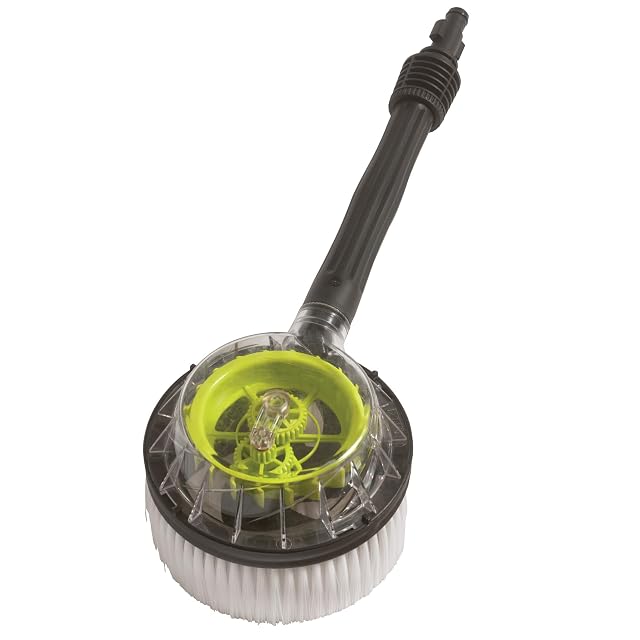
- Description: “Spins & scrubs away stubborn dirt, debris, gunk + grime! Compatible with all SPX series pressure washers.”
- Reference SPX-RB1 · Catalog: 417 g (14.7 oz), 349 × 147 × 103 mm (13.7 × 5.79 × 4.06 in)
The two Sun Joe kits are the wrong way round
This is the cheapest way into the Sun Joe system, and the pricing above it is worth setting out, because it does not work the way you would expect.
This brush alone — $25.99.
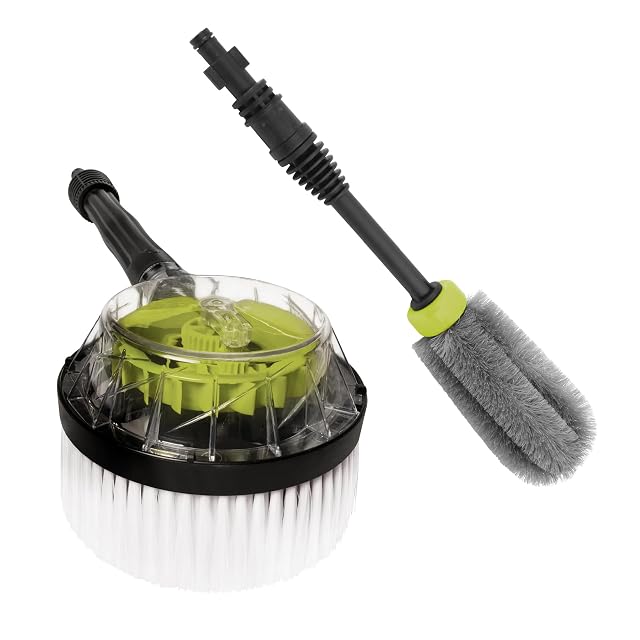
Sun Joe SPX-CCK — $54.97. Three items: “SPX-RB1 Rotary Wash Brush & SPX-WB1 Wheel Rim Brush”, plus a transfer adapter. The brush inside it is this one.
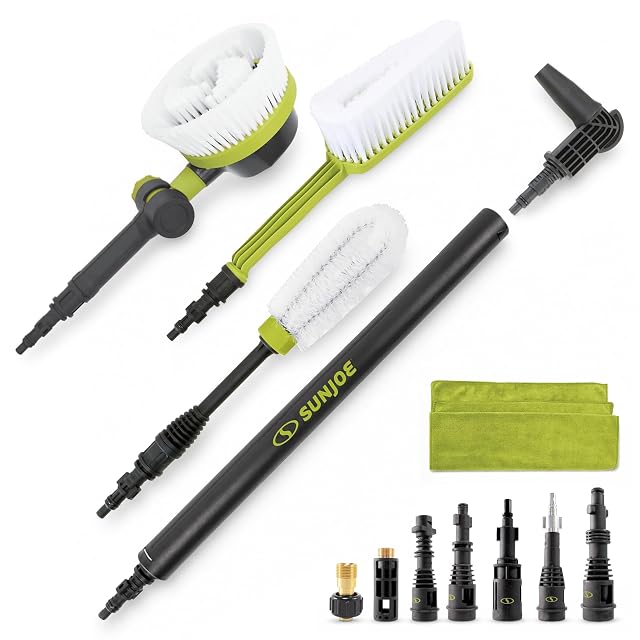
Sun Joe SPX-ACS-MAX — $49.97. Five items: a “ROTARY WASH BRUSH” with a 5.7 inch head adjustable 0° to 180°; a “UTILITY BRISTLE BRUSH” with feathered bristles; a “WHEEL + RIM BRUSH”; a “TURBO NOZZLE + 20” ROD” with a 90° angled nozzle for under a car; and a 16” × 16” washable microfibre cloth. Rated for washers “up to 3500-PSI”.
The bigger kit costs five dollars less than the smaller one.
So the order is simple. One brush: this, at $25.99. More than one: the SPX-ACS-MAX at $49.97, which also publishes a brush diameter, an angle range and a pressure ceiling, none of which this page does.
There is no published reason to buy the SPX-CCK.
SPX only, and three of eleven items here have a restriction like it
“Compatible with all SPX series pressure washers.”
SPX is Sun Joe’s own electric washer line, so this is a closed-system accessory. The shelf divides four ways by fitting:
Sun Joe SPX only — this and the SPX-CCK at $54.97
Worx Hydroshot only — the WA1820 and WA1821 at $44.99, and the WA4042 at $22.79, which is the only listing here to name its five compatible models outright: “WG625, WG629, WG630, WG640, and WG644”
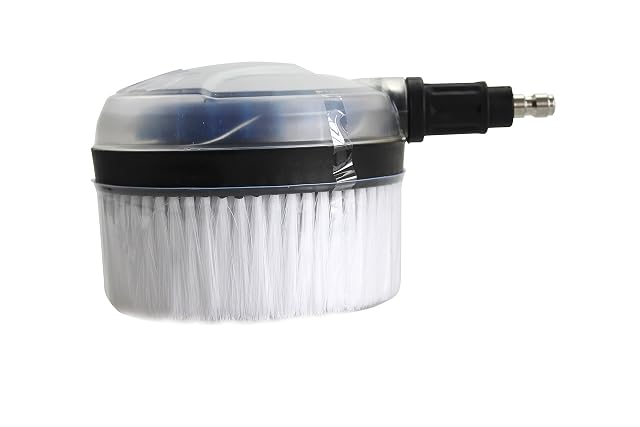
Universal 1/4 inch quick connect — the TUHUT at $15.99, the Kuuleyn at $27.39, the Hyuduo at $29.31, the Kärcher at $32.65
Garden hose, 1/2 inch — the KUJOBUY at $27.99, which fits no pressure washer at all
If you do not own a Sun Joe, the Kärcher is the one to look at. It is “compatible with most Karcher & most non-Karcher gas power pressure washers rated up to 4000 PSI/4.0 GPM”, and it “includes adaptors for Karcher bayonet and threaded connections” — a universal fitting and adaptors for its own proprietary ones, which is the most complete compatibility statement on this shelf.
And note the gap in this page: “all SPX series” tells you the brand and not the limit. The SPX-ACS-MAX publishes “up to 3500-PSI”; this publishes no figure at all. Nine of eleven listings here are the same.
Pressure powered, which is the appeal of the shelf
“Pressure powered for maximum results with minimum effort.” And, in the description, “Spins & scrubs away stubborn dirt, debris, gunk + grime!”
The mechanism is the whole point of the category. The water is already moving, and a turbine in the head converts some of that flow into rotation — so there is nothing to charge, nothing to plug in, and nothing to keep out of the water. Beside a car on a wet drive, that beats a cordless drill brush on both convenience and safety.
The others say the same in their own words: the Kuuleyn and Hyuduo both lead with “without electricity”; the KUJOBUY says “No Extra Electricity Needed”; the WORX WA4042 calls itself “water-powered”.
What it costs is control. The speed is whatever your machine’s flow gives, with no setting — and the figure that governs it is GPM, not PSI. Only the Kärcher publishes one: “4.0 GPM”. So a low-flow washer spins any of these brushes more slowly, and nothing on this page tells you what an SPX delivers.
The WORX trio is honest about the consequence at the other end of the range: the WA1820 describes “a low-pressure water flow” making the brush “spin at a moderate speed”, because a Hydroshot is a battery machine.
Fine bristles, and the claim that sits beside them
“Fine bristles scrub away stubborn residue.”
“Fine” is the softest bristle description on this shelf, and no material is published.
Fine bristles bend easily, so they conform to a surface and reach into texture rather than standing up to it. That is right for the surfaces bullet one names — “patio furniture, cars, windows & siding” — and it sits oddly with “stubborn residue” in the same sentence.
WORX publishes the clearest version of this trade, by selling the same body in two hardnesses at the same $44.99:
WA1820, soft — “without damaging paint or chrome”, and it “spins at a moderate speed to prevent damage to your finish”
WA1821, hard — “for an intense cleaning of hard surfaces”, and the description then tells you where not to use it: “though keep this brush away from the paint job, we have a softer brush for that”
That is the sentence this whole shelf should be read against. A fine or soft brush is for paint and glass; a hard brush is for brick, decking and an undercarriage. No single brush does both well, and a page claiming both is describing the softer of the two jobs.
What the others declare: the Kuuleyn and Hyuduo specify PP — polypropylene, “soft and does not hurt the surface”; the KUJOBUY “PVC filaments bristle on the edge and chenille in the middle”; the Sun Joe SPX-CCK “soft”; the SPX-ACS-MAX “feathered”; the WORX WA4042 “soft”; the Kärcher and TUHUT nothing at all.
Garden equipment, which is the unusual entry
“Cleaning & maintaining auto yard garden equipment.”
That is a job nothing else on this shelf names, and it is a sensible one for a rotary brush.
A mower deck, a tiller, a wheelbarrow and a garden trolley all accumulate the kind of soil a jet alone will not shift — dried grass and mud bonded to paint and plastic — and they are exactly the surfaces where you want agitation at low pressure rather than a 25° tip at two thousand PSI.
It is also the one application where a brush beats a nozzle outright. The turbo nozzle in the SPX-ACS-MAX kit, and the AURORA CAR rotary nozzle on the lance shelf of this site, do the same spinning trick with water instead of bristles — which is far more aggressive, and wrong for a painted mower deck.
The rest of the surface list is the shelf’s standard set: “patio furniture, cars, windows, siding”. For comparison, the Kuuleyn, TUHUT and Hyuduo all name “painted surfaces such as vehicles and boats” plus “window glass and stucco”; the Kärcher names “RVs, cars, boats, patio furniture”; the SPX-CCK “cars, RVs, siding, windows, and outdoor furniture”.
What is not published
No pressure rating, as above.
No brush diameter. Only the Sun Joe SPX-ACS-MAX publishes one — 5.7 inches — which is the figure that decides how long a panel takes. The catalog box here is 349 × 147 × 103 mm, so the head is in the same region.
No angle adjustment. Three listings here have one: the WORX WA1820 and WA1821 with “dual articulating points” and, on the WA1820, a knob that locks it; and the SPX-ACS-MAX, whose brush adjusts 0° to 180°. That matters because of the limitation the TUHUT is the only listing candid enough to publish: a quick-connect coupler gives a brush “360 degree freedom”, so a free head rolls off square under its own weight.
No bristle material, as above.
No detergent function. Two listings name it: the Kärcher (“The brush automatically dispenses soap from the pressure washer”) and the TUHUT (“Ideal for dispensing pressure washer detergent”). A rotary brush is a low-pressure attachment, which is exactly the condition a washer needs in order to siphon soap — the detergent shelf of this site explains why, and the Sun Joe concentrate there is the only one of eleven bottles to spell out the soap nozzle requirement. So this brush very likely dispenses detergent, and the page does not say.
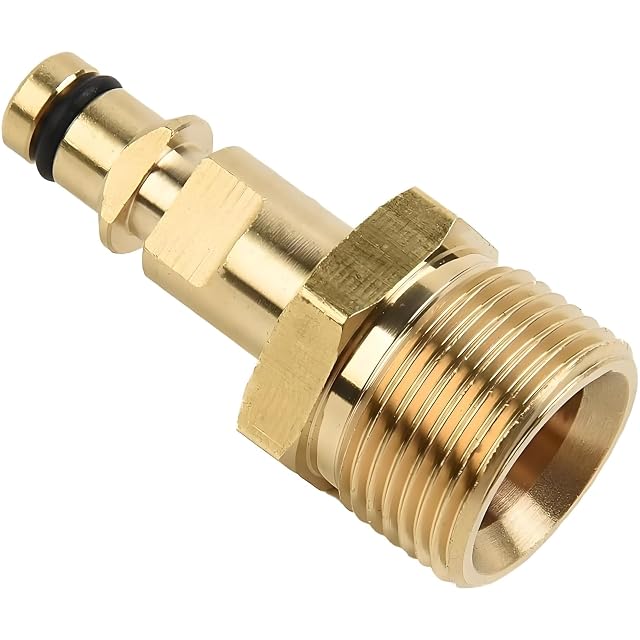
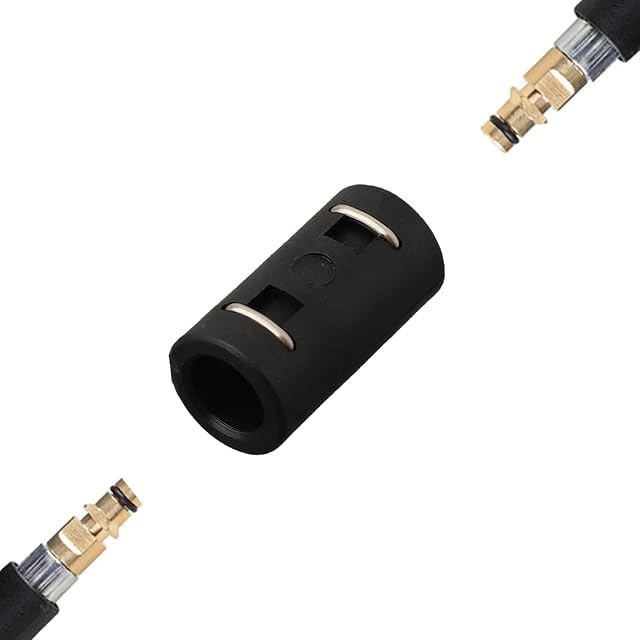
No adapter, where the SPX-CCK includes a “transfer adapter for simple connection to compatible pressure washers and quick tool swapping” and the Kärcher includes two.
No warranty.
Availability
Read on the day this page was built: $26 at the American Amazon shop.
Read from Keepa on the day this page was last revised; stock and price both move without notice.
Prices quoted in this text were read on 2026-10-05. The live price is at the top of the page.