What the maker puts in writing
- “This RainBello power washer hose features M22-14mm fittings and is capable of handling up to 3200 MAX PSI… Please check your connection size before purchasing. Will not work with AR Blue Clean, Sun Joe & other electric pressure washers with M22-15mm twist connect fittings.”
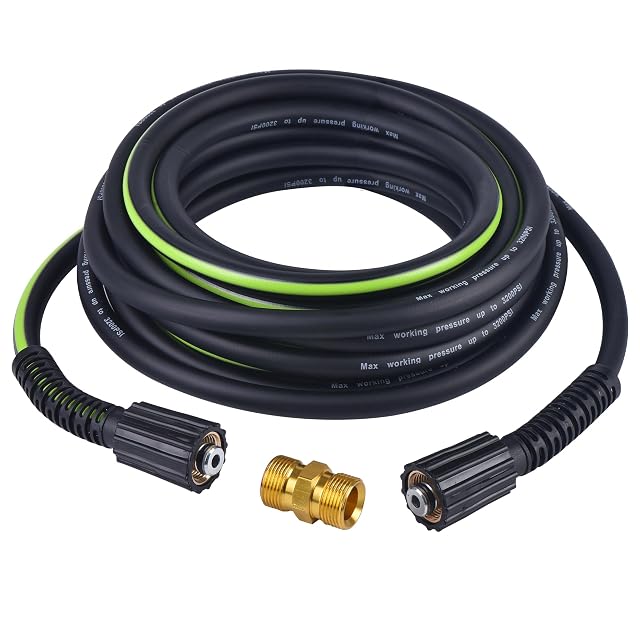
- “Constructed with a premium hybrid rubber inner tube and outer cover, reinforced by a high-strength braided polyester layer… designed for excellent flexibility, abrasion resistance, and durability.”
- “Our power washer hose resists kinking to maintain consistent water flow… allows for easy coiling and storage.”
- “Equipped with solid aluminum M22 connectors for a shake-free, leak-proof seal… The black hose with a distinctive green stripe is used for quick identification on the job site, reducing tripping hazards and tangles.”
- “Used for house washing, car washing, wood rinsing, stone washing, and more.”
- Title: “1/4” × 25FT - 3200 PSI… M22-14mm Aluminum Fittings” · Reference RB202001 · Catalog: 7620 × 6 × 1 mm (300 × 0.24 × 0.04 in)
It tells you what it will not fit, first
“Please check your connection size before purchasing. Will not work with AR Blue Clean, Sun Joe & other electric pressure washers with M22-15mm twist connect fittings.”
That is the end of bullet one, before the material, before the kink resistance, before anything else on the page — and it is the right place for it.
M22 comes in two sizes that share one name. M22-14mm and M22-15mm differ in the diameter of the inner nipple. They screw together and then either refuse to seal or seal and let go under pressure. This hose is 14mm.
At least three of the eight listings here name names, which makes this the best-documented question on the shelf:
this — AR Blue Clean, Sun Joe
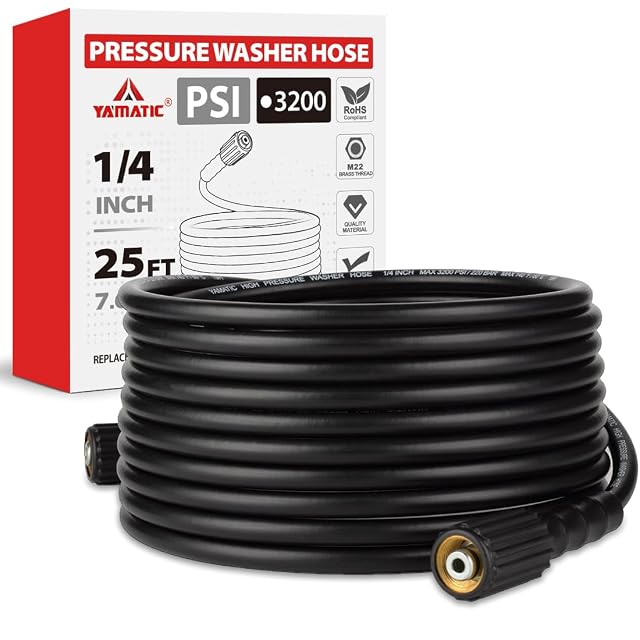
YAMATIC 25 FT — “certain Karcher, Stanley, Husky models”, plus 3/4” garden hose thread and 3/8” quick-connect
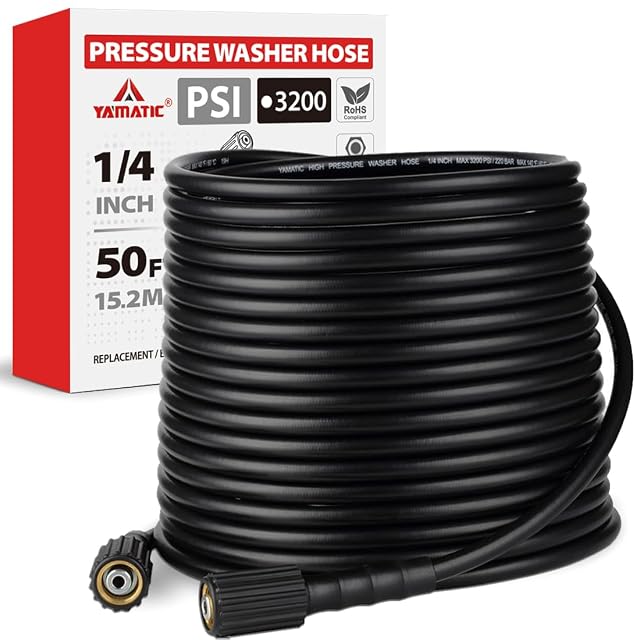
YAMATIC 50 FT — “Sunjoe, AR Blue Clean, Karcher, Stanly”, plus 3/8 inch quick-connect and garden hose thread
Two are less help. The LULUW at $16.99 says “M22 14mm (0.55 in)” in its title and then claims in bullet three that it suits “most brands of cleaning machines on the market”. And the Flexzilla at $53.92 — the most expensive hose here — says “M22 Fittings” with no size at all, then warns that its own range comes “with M22 or Integrated Quick Connect fittings on select hoses”.
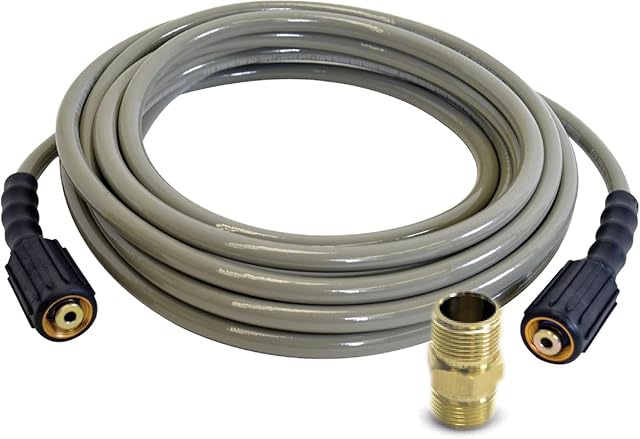
One avoids the question entirely: the Simpson at $25.71 fits both sizes, with a “dual o-ring design to fit both 14mm (0.55 in) and 15mm (0.59 in) connections” and a 14/15mm connector in the box. If you do not know what your outlet is, buy that one.
Thirty-two hundred MAX PSI, which is a different word from the rest of the shelf
The title and bullet one both say “3200 MAX PSI” — “capable of handling up to 3200 MAX PSI”.
Everyone else says working: the YAMATIC pair “rated up to 3200 PSI working pressure”, the LULUW “3600 PSI rated working pressure”, the Simpson “can be used with pressure washers up to 3300 PSI”.
A maximum and a working pressure are not the same claim. Working pressure is the figure you may run continuously; a maximum is the ceiling. Without a burst figure to anchor it, there is no way to tell which this is.
And no burst figure is given. Two hoses here do publish one, and it is instructive:
LULUW — 3600 working, 9000 burst, a ratio of 2.50
YAMATIC 50 FT — 3200 working, 8700 burst, a ratio of 2.72
Those bursts are within 3.4 per cent of each other while the working figures differ by 12.5 per cent — which shows that the headline number is a choice of safety factor, not a measure of strength. Without either figure from RainBello, there is nothing to compare.
For most buyers it is moot. Domestic electric washers rarely exceed 2000 PSI, so 3200 is headroom. The figure that matters is your machine’s.
Hybrid rubber over braided polyester, which is the best material story here
“a premium hybrid rubber inner tube and outer cover, reinforced by a high-strength braided polyester layer.”
This is a proper three-layer construction and the listing describes it correctly: a rubber tube to hold the water, a braid to take the pressure, a rubber cover to take the abrasion.
The braid is the part doing the work. Rubber alone would balloon; the polyester sheath is what resists the hoop stress, and “high-strength braided polyester” is the same principle the Simpson uses (“lightweight polyester braid”).
Where it beats the cheap end of the shelf is in handling. The LULUW and the YAMATIC 50 FT are PVC, which is cheaper, stiffer, and holds the shape it was wound in. Bullet two makes the right claim about the alternative: “the hybrid rubber construction helps the hose stay flexible during everyday use while making it easier to handle and coil after cleaning.”
Where it does not reach is the cold. The Flexzilla is the only hose on this shelf that puts a number on the lower end — “from brutal subzero cold to scorching 140 degrees F heat” — and that claim is the main thing its price buys.
The shelf’s materials: hybrid rubber + braided polyester here · polyester braid + polyurethane jacket on the Simpson · flexible hybrid polymer on the Flexzilla · PVC on the LULUW and YAMATIC 50 FT · nothing named on the YAMATIC 25 FT.
The aluminum fittings, which is where it falls behind
“Equipped with solid aluminum M22 connectors for a shake-free, leak-proof seal.”
Under pressure, aluminum holds. The sealing claim is not in doubt, and aluminum is lighter and cheaper than the alternative.
The problem is the thread, over time.
A pressure-washer fitting is a wet threaded joint that gets screwed on and off, often cross-threaded, and then left outdoors. Brass is soft enough to seat against a seal without cutting it, and it does not corrode in that service. Aluminum galls — it picks up and tears against a steel or brass male thread — and in contact with brass or steel in water it is the metal that corrodes, galvanically.
After a season the joint can seize, and an aluminum collar seized onto a brass outlet is a worse outcome than a leak.
Every other listing here that names a material says brass: both YAMATIC hoses (“high-quality brass… anti-rust, leak-resistant design to stay tight under vibration and pressure pulses”) and the LULUW (“high-quality brass, resistant to high temperature and corrosion”).
The mitigation is free: do not over-tighten, and take the hose off the machine between jobs rather than leaving it threaded on all season.
The green stripe, which is the only safety thought on the shelf
“The black hose with a distinctive green stripe is used for quick identification on the job site, reducing tripping hazards and tangles.”
Consider where a pressure hose lives: twenty-five feet of dark hose across a wet driveway or a dark deck, while you walk backwards holding a gun and watching the surface rather than your feet. And the hose does not stay where you put it — it follows you in loops.
A black hose on wet asphalt is genuinely hard to see. A visible marking is the difference between stepping over it and standing on it.
The others treat color as styling: the LULUW is “Blue”, the Flexzilla “ZillaGreen”, the Simpson “Natural”. Both YAMATIC listings publish no color at all.
The honest limit: a stripe is less visible than a fully colored hose, and the Flexzilla’s bright green body wins on that measure. But this is the only listing here that has identified the problem, and it costs nothing.
What is not published
No burst pressure, as above, which is what would make the 3200 MAX comparable.
No temperature limit, where three rivals publish 140 °F — the LULUW (“140 ℉/60 ℃”, and the conversion is exact), the Simpson (“up to 140 degrees Fahrenheit”, with “Cold Water Use” in the title) and the Flexzilla (“scorching 140 degrees F heat”). The YAMATIC 25 FT says “(cold water only)” without a figure. Worth stating: the steam cleaners on this site’s neighboring shelf run between 212 and 293 °F, and nothing on this shelf is rated to pass that.
No weight, where the LULUW publishes 862 g for the same 25 feet and the Simpson 998 g.
No bend protectors. Kink resistance is claimed — “resists kinking to maintain consistent water flow” — as a property of the material. Only two hoses here have hardware at the ends, which is where hoses actually die: the Simpson’s “4-inch bend protectors at each end” and the Flexzilla’s “Integrated non-kink bend restrictor”.
No adapter, so this is a replacement rather than an extension. The Simpson ships a connector and can do both.
No warranty, where the Simpson’s 90 Day limited accessory is the only term on this shelf.
Availability
Read on the day this page was built: $20 at the American Amazon shop.
Read from Keepa on the day this page was last revised; stock and price both move without notice.
Prices quoted in this text were read on 2026-10-04. The live price is at the top of the page.