What the maker puts in writing
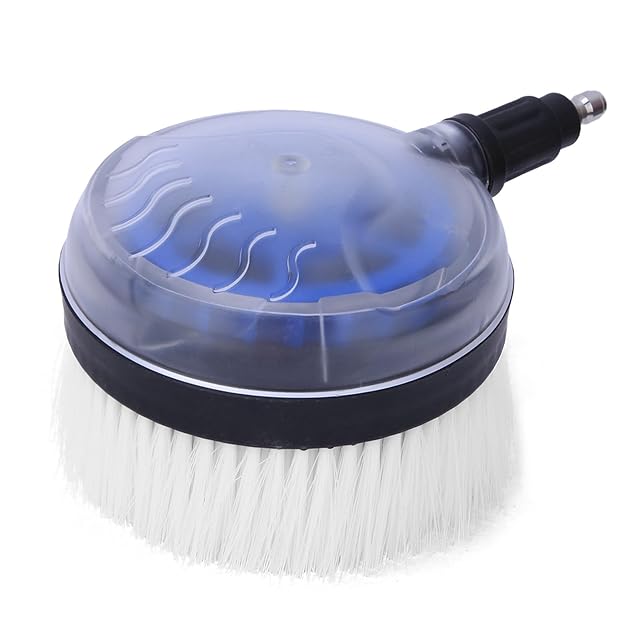
- “Rotary Wash Brush Adopt water flow technology to save energy without electricity. Size: Approx. 22.5 x 11.5 x 15cm (8.9 × 4.5 × 5.9 in) / 8.9 x 4.5 x 5.9in. Effortlessly clean various surfaces… without damaging paint or chrome.”
- “PP brush hair material, soft and does not hurt the surface… soft and non-abrasive, ensuring it won’t harm delicate surfaces.”
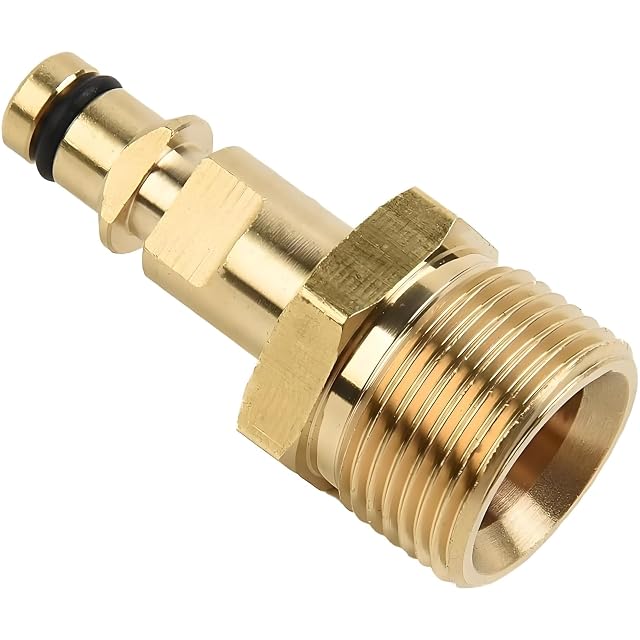
- “Rotary cleaning brush 1/4in quick disconnect connector, suitable for high pressure washer… Easy on, easy off, so you can switch between cleaning accessories quickly.”
- “Ideal for cleaning painted surfaces such as vehicles and boats, as well as other flat surfaces including window glass and stucco.”
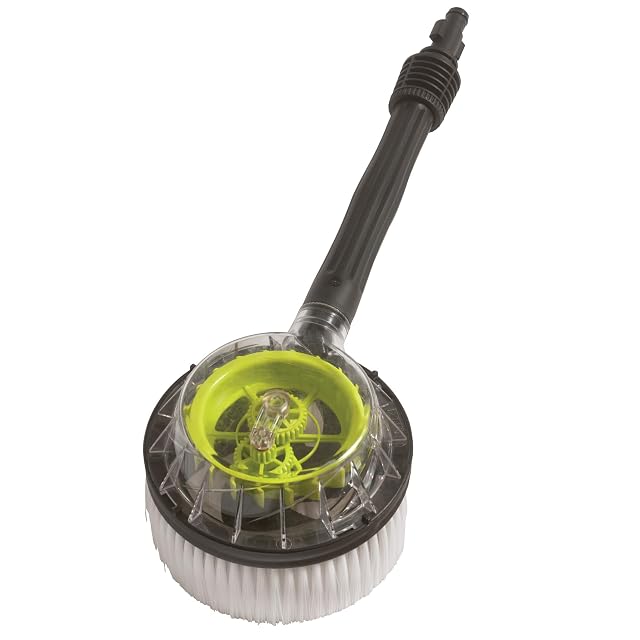
- “Gently rotate a set of internal brushes with water from a pressure washer for easier cleaning.”
- Reference Kuuleyn9wi3pmkzgf865 · Catalog: 403 g (14.2 oz), 10 × 10 × 10 mm (0.39 × 0.39 × 0.39 in)
Twenty-two and a half centimeters, and the conversions are right
“Size: Approx. 22.5 x 11.5 x 15cm / 8.9 x 4.5 x 5.9in.”
Check them: 22.5 cm (8.9 in) is 8.86 in, 11.5 cm (4.5 in) is 4.53 in, 15 cm (5.9 in) is 5.91 in. All three correct.
And this is the only one of the three near-identical cheap brushes on this shelf to publish a size at all.
What it means in use: a head roughly four and a half inches across and nine inches long overall. A face about the size of a hand — large enough to cover a car door in a reasonable number of passes, too large to get between the spokes of an alloy wheel.
The other dimensional figures on this shelf:
Sun Joe SPX-ACS-MAX, $49.97 — the only published brush diameter: 5.7 inches, on a head adjustable 0° to 180°
WORX WA1820, $44.99 — “the attachment is 6.5 inches long”
Everything else — nothing, except carton sizes
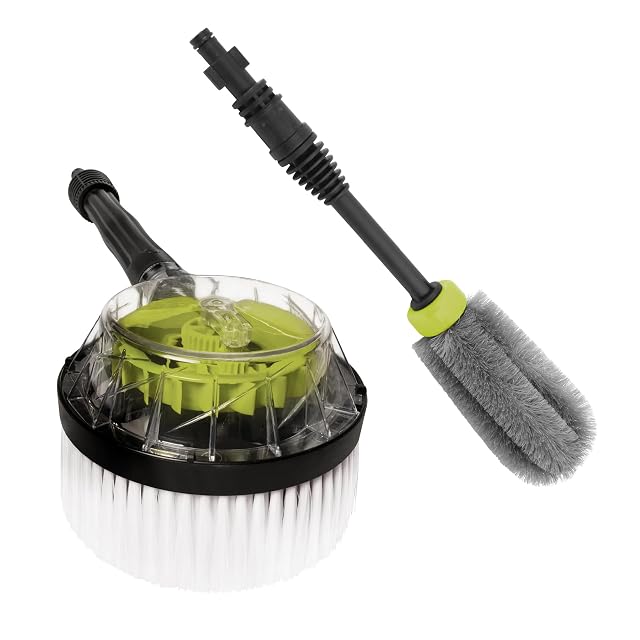
For the gap between spokes you want a different shape, and the WORX WA4042 at $22.79 is the one on this shelf built for it: “it may look fluffy, but this brush collapses down and really gets in there.”
One figure to ignore. The catalog records this item’s dimensions as 10 × 10 × 10 mm — a one-centimeter cube, which is a placeholder rather than a measurement. The bullet is the number to use, and the published 403 g is plausible for a head that size.
Three brushes, one set of bullets
Set the three cheap brushes here side by side.
this: “Ideal for cleaning painted surfaces such as vehicles and boats, as well as other flat surfaces including window glass and stucco.”
TUHUT, $15.99: “Perfect for cleaning painted surfaces, such as vehicles and boats, and other flat surfaces including window panes and stucco.”
Hyuduo, $29.31: “ideal for cleaning painted surfaces, such as vehicles and boats, and other flat surfaces, including window glass and stucco.”
And all three describe the drive identically — “gently rotate a set of internal brushes” with water from the machine.
The weights diverge, though: TUHUT 200 g, this 403 g, Hyuduo 412 g. Twice the mass is not trivial on a plastic head, so either the figures describe different products, or different packing, or one is wrong. Nothing on any of the three pages resolves it, so this review will not claim they are the same object.
What this page has that the other two do not is the dimensions above.
What the TUHUT has is $11.40 off, plus two things this page lacks: a statement that it dispenses pressure washer detergent, and the candid note that a quick-connect coupler gives it “360 degree freedom” — which is a limitation rather than a feature, and the only mention of it on the shelf.
On the published information the TUHUT is the better buy. On published information, this is the better page.
And the reference is worth a glance: Kuuleyn9wi3pmkzgf865 — a brand name plus a random string. The Hyuduo does the same with Hyuduoh96g5rne73; the TUHUT carries 01. None of the three gives you anything to quote if you need a replacement head. For contrast, the Kärcher carries 8.923-682.0, the WORX items WA1820, WA1821 and WA4042, and the Sun Joe items SPX-RB1, SPX-CCK and SPX-ACS-MAX.
PP bristles, and the caution the page does not give
“PP brush hair material, soft and does not hurt the surface… soft and non-abrasive, ensuring it won’t harm delicate surfaces.” Plus, in bullet one, “without damaging paint or chrome”.
Polypropylene is the ordinary choice for a soft wash brush, and the claim holds as a material claim: PP is flexible, it does not absorb water, and at the diameters used here it bends rather than digging in.
The caution is grit, not bristles. Any brush dragged across a dirty panel carries whatever it picked up, and road grit trapped between a bristle and clear coat is what leaves swirl marks — not the plastic.
So: rinse the panel before you brush it, and rinse the brush when you move from a wheel arch to a door. That applies to every soft brush on this shelf.
For context on hardness, WORX publishes the clearest statement here, by selling the same body two ways at the same $44.99:
WA1820, soft — “without damaging paint or chrome”, spinning “at a moderate speed to prevent damage to your finish”
WA1821, hard — “for an intense cleaning of hard surfaces”, whose own description warns you off: “though keep this brush away from the paint job, we have a softer brush for that”
That is the division to read this shelf by. A soft or PP brush is for paint, chrome and glass; a hard brush is for brick, decking and an undercarriage.
What the others declare: the Hyuduo also specifies PP; the KUJOBUY at $27.99 uses “PVC filaments bristle on the edge and chenille in the middle”; the Sun Joe SPX-RB1 says “fine”, the SPX-CCK “soft”, the SPX-ACS-MAX “feathered”; the WORX WA4042 “soft”; the Kärcher and TUHUT nothing at all.
No electricity, and the internal brushes
“Adopt water flow technology to save energy without electricity.”
“Gently rotate a set of internal brushes with water from a pressure washer.”
The mechanism is the appeal of the whole shelf. The water is already moving, and a turbine in the head converts some of that flow into rotation — nothing to charge, nothing to plug in, nothing to keep out of the water. Beside a car on a wet drive that beats a cordless drill brush on convenience and on safety.
The others say it too: the Hyuduo — “water technology, which can save energy without electricity”; the KUJOBUY — “No Extra Electricity Needed”; the Sun Joe SPX-RB1 — “Pressure powered for maximum results with minimum effort”; the WORX WA4042 — “water-powered”.
And “a set of internal brushes” describes the architecture all of these share, which only one listing on this shelf explains. The WORX WA1821: “The outer, stationary bristles provide the first level of scrubbing, and then the rotating inner bristles do the hard work.”
So: a static outer ring to steady the head against the surface, a spinning inner disc to do the work. That is why the TUHUT’s free-spinning coupler matters less than it might — the outer ring is what holds the face square.
What the water drive costs is control. The speed is whatever your machine’s flow gives, with no setting, and the figure that governs it is GPM rather than PSI. Only the Kärcher at $32.65 publishes one: “4.0 GPM”.
Vehicles, boats, glass and stucco
Four surfaces, and the pairing is slightly odd on reflection.
Painted vehicles and boats is the soft-brush job, and it fits the PP bristles.
Window glass is the easiest surface here for a rotating soft brush, and the one where the water does most of the work.
Stucco — bullet four also calls it “mortar” — is the outlier. Stucco is hard, porous and abrasive, which is the opposite of what a soft PP brush is for. A soft brush on stucco will wear out faster than the stucco does, and the job really wants either a hard brush or more pressure. The WORX WA1821 is the item on this shelf aimed there: “Make your brickwork look like new.”
So read the list as the three surfaces it is good at plus one it is merely compatible with.
The 1/4 inch quick disconnect is the other thing right on this page: it is the universal pressure-washer fitting, shared here with the TUHUT, the Hyuduo and the Kärcher — and three items on this shelf fit one brand only (the WORX trio needs a Hydroshot, the two Sun Joe kits need an SPX), while the KUJOBUY fits a garden hose and no washer at all.
What is not published
No pressure rating. Two listings on this shelf publish one: the Kärcher — “up to 4000 PSI / 4.0 GPM”, with “adaptors for Karcher bayonet and threaded connections” as well, the most complete compatibility statement here — and the Sun Joe SPX-ACS-MAX, “up to 3500-PSI”. Nine publish none, and a plastic head on a high-pressure gun is a reasonable thing to want a ceiling for.
No angle adjustment. Three listings have one: the WORX WA1820 and WA1821 with “dual articulating points on the side” — and the WA1820 with a knob that locks the angle — and the SPX-ACS-MAX, adjustable 0° to 180°.
No brush diameter, though the overall size is given.
No detergent function, which two listings name: the Kärcher (“The brush automatically dispenses soap from the pressure washer, making it even more convenient to clean with detergents”) and the TUHUT (“Ideal for dispensing pressure washer detergent”). A rotary brush is a low-pressure attachment, which is exactly the condition a washer needs in order to siphon soap — the detergent shelf of this site explains why, where the Sun Joe concentrate is the only one of eleven bottles to spell out the soap nozzle requirement. So this brush very likely dispenses soap; the page does not say.
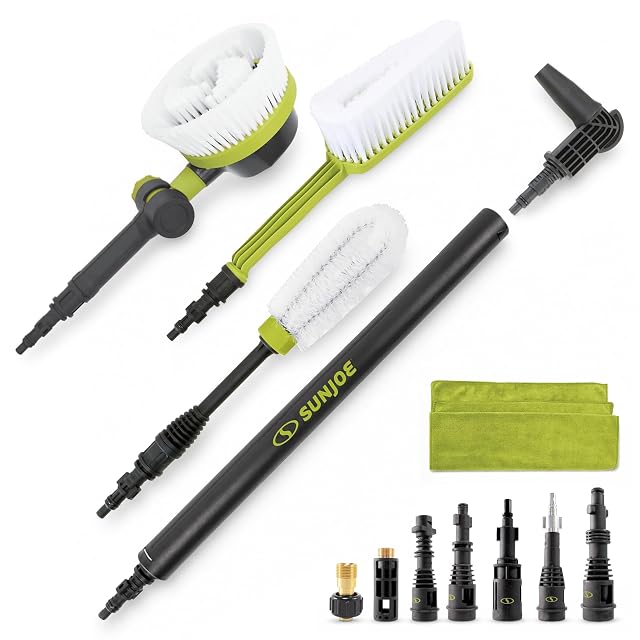
No adapter, where the Kärcher includes two and the Sun Joe SPX-CCK one.
No replaceable head, and no part number to order one with.
No warranty.
Availability
Read on the day this page was built: $27 at the American Amazon shop.
Read from Keepa on the day this page was last revised; stock and price both move without notice.
Prices quoted in this text were read on 2026-10-05. The live price is at the top of the page.