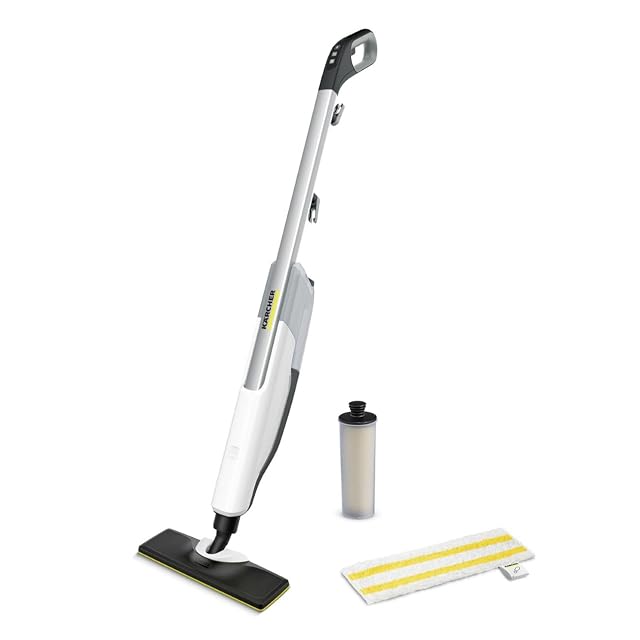
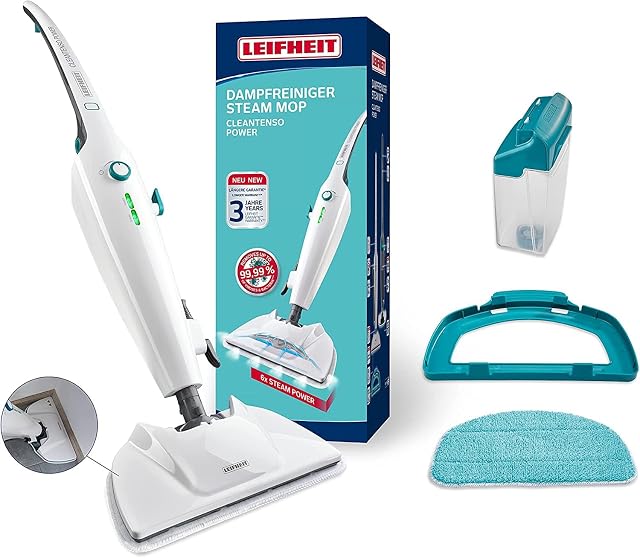
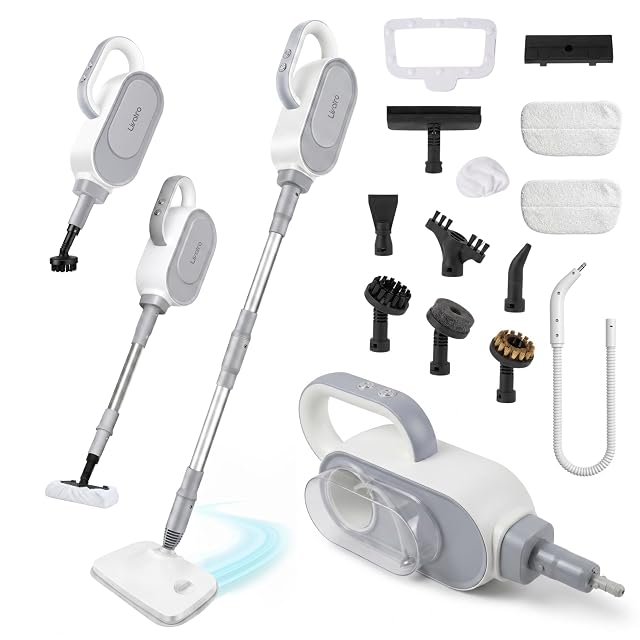
What the maker puts in writing
- “CHEMICAL-FREE SANITIZATION: With the power of steam, remove grease and grime using just water — no chemicals needed and no residue left behind.”*
- “REMOVABLE WATER TANK: The removable water tank allows easy fills and refills, helping more floors to be cleaned without interruption.”
- “LIGHTWEIGHT DESIGN: At under 5 lbs., the compact design makes it effortless to carry between rooms and conveniently store away after use.”
- “QUICK START CLEANING: Get on-demand steam ready in just 30 seconds”
- “EXTENDED REACH: The 18 ft. long power cord gives you a wide cleaning radius, so you can cover more floors without stopping to find a new outlet.”
- “USE ON SEALED HARD FLOORS: Designed to clean across all sealed hard floors including hardwood, marble, tile, stone, laminate, and vinyl.”
- “WHAT’S INCLUDED: 1 Shark Steam Mop and 2 machine washable Dirt Grip pads.”
- Reference S1000 · Catalog: 2087 g (73.6 oz)
The machine the rest of the range is measured against
The S8001 at $159.99 and the S8201 at $159 both claim “up to 2x better stuck-on stain removal vs. traditional steam mops”.
And their footnote names the benchmark: “based on IEC/TC SC 59F (Mustard), tested against S1000.”
So the “traditional steam mop” in that comparison is this machine, ninety dollars below them on the same shelf. Which is unusually transparent, and it makes the upgrade decision a real one rather than a guess.
What the ninety dollars buys, by their own bullets: an automatic scrubbing head with rotating pads at “over 150 scrubs per minute”, three steam modes instead of one, LED headlights, and four pads instead of two. And on Shark’s stated mustard measurement, twice the stuck-on stain removal.
What it costs: weight. This records 2087 g; the S8001 3130 g and the S8201 4042 g — 50 and 94 per cent heavier.
Which is the trade, and it is not obvious either way. A light machine that heats in thirty seconds gets used twice a week; a heavy one gets used when the floor is bad. For routine floors this is the better tool. For a kitchen with baked-on spills, the rotating head earns its money.
Two thousand and eighty-seven grams, the lightest American machine here
“At under 5 lbs.” The catalog records 2087 g, which is 4.6 lb, so the claim holds with room to spare.
The shelf, by catalog weight:
this — 2087 g · Shark S3501 — 2209 g · NEWBULIG — 2341 g · Shark S8001 — 3130 g · Phueut — 3447 g · Schenley — 3629 g · Shark S8201 — 4042 g · HJGJYWLQ — 11489 g gross
So this is the lightest American machine on the shelf, and the three canisters are 65 to 75 per cent heavier before you count the hose.
Weight is the specification that decides whether a mop gets used. Four and a half pounds goes up a staircase one-handed and lives in a cupboard without being a project. The HJGJYWLQ at twenty-five pounds gross is something you wheel.
And “conveniently store away after use” is the half of the sentence that matters at this size: a mop that has to be dismantled or leaned somewhere does not get picked up on a Tuesday.
Eighteen feet, and it is the only Shark here that says so
“The 18 ft. long power cord gives you a wide cleaning radius, so you can cover more floors without stopping to find a new outlet.”
Eighteen feet from a socket is a working radius of about eighteen feet, which covers most domestic rooms end to end. A kitchen, a hall or a bathroom becomes one plug-in rather than two.
this — 18 ft
NEWBULIG — 16.4 ft, which is 5 meters exactly
HJGJYWLQ — 3.5 m, about 11.5 ft
Phueut — 9.8 ft, which is 3 meters, plus an “extra-long hose”
Shark S3501, S8001, S8201, Schenley, Keenstone — nothing
The S3501 is the instructive comparison: “The long power cord gives you a wide cleaning radius” — the same sentence with the number taken out.
Why it matters on this machine specifically: it reaches steam in 30 seconds, so there is nothing else to interrupt you. Unplugging is the interruption, and eighteen feet removes most of it.
Thirty seconds, and the division this shelf is built on
“Get on-demand steam ready in just 30 seconds.”
It can, because it is not heating a tank. A steam mop holds cold water and drips it onto a hot block at the head, flashing it to vapor as it passes — so there is almost nothing to warm up. The S3501 publishes the same figure.
The other architecture here publishes very different ones:
Schenley, $139.99 — “Fast 8-Minute Heat-Up” for a 45.5 fl. oz. tank. The arithmetic supports it: about 1.35 liters to the boil needs roughly 0.45 megajoules, which at 1500 W is about five minutes. Eight is conservative.
Keenstone, $139.99 — no heat-up figure, and the sentence nobody else writes: “allow the unit to cool for 20 minutes before adding water.”
Phueut, $119.64 — “heats up quickly”, no figure.
HJGJYWLQ, $591.99 — “Fast Heating”, no figure.
What you give up for the thirty seconds is pressure. An unpressurized mop cannot drive steam into a grout line the way the Keenstone claims to at 58 psi.
“On-demand” is the other word worth noticing. This produces steam while you ask for it rather than holding a pressurized charge — which is also why no pressure figure appears anywhere on any of the four Sharks here.
Sealed hard floors, in capitals, as on all four Sharks
“USE ON SEALED HARD FLOORS: Designed to clean across all sealed hard floors including hardwood, marble, tile, stone, laminate, and vinyl.”
Every Shark on this shelf carries that bullet, and the word that carries it is sealed.
On unsealed or waxed timber, steam swells the fiber and raises the grain, and it strips wax.
On unglazed stone or terracotta, it soaks in.
On laminate with open seams, it gets under the surface layer and lifts it.
On unsealed grout, it erodes.
Steam does all of that faster than a wet mop, because it carries far more energy per gram. That is the point of the tool and also its one risk.
And the cheapest machine here says the opposite. The NEWBULIG at $37.89: “Safe for all floors: hardwood, tile, laminate, stone & grout lines.” The same list of materials, without the word — and nothing about that machine makes it gentler, since it publishes 212 °F of unpressurized steam, which is the same kind of heat this produces.
The Schenley, Keenstone, Phueut and HJGJYWLQ do not raise the question at all.
The cheap test before steaming a whole room: a drop of water on an inconspicuous joint, and watch whether it beads or soaks in.
Chemical-free, which is the real argument for steam
“remove grease and grime using just water — no chemicals needed and no residue left behind.”
That is the strongest case the category has, and this listing puts it first.
There is no consumable. No bottle to replace, nothing with a shelf life, nothing to shop for again. A spray mop ties you to a refill; this needs a tap.
And it works differently from a detergent. Heat melts grease rather than dissolving it, and it leaves nothing behind — which matters most on the surfaces a child crawls on or a dog lies on. The Phueut makes the same point about “kids and pets”; the Schenley calls it “the power of purified water”; the NEWBULIG says “safe for… loved ones”.
The asterisk on “sanitization” leads to Shark’s standard note about controlled test conditions. Worth setting beside the two Sharks here that go further: the S3501 and the S8201 both claim “99.9% of common household bacteria” and name five organisms in the footnote — “Pseudomonas aeruginosa, Staphylococcus aureus, Escherichia coli, Salmonella enterica (typhi), and Klebsiella pneumoniae when used as directed.”
This page claims sanitization without the percentage, as does the S8001. The practical requirement behind all of them is the same: dwell time. Heat has to stay on the surface to do the work, which means moving slowly.
Two pads, and the comparison with the cheaper Shark
“2 machine washable Dirt Grip pads”, single-sided — so two cleaning surfaces.
The S3501 at $58.99 ships two double-sided pads, which is four surfaces: “Flip the mop head to clean using both sides… extending your cleaning session with fewer washes.” The S8001 and S8201 ship four single-sided pads each.
That is the real trade between this and the cheaper Shark, and it is worth stating plainly:
this — removable tank, 18 ft cord, 2 cleaning surfaces
S3501 — filling flask, cord length unstated, 4 cleaning surfaces
Which matters because a steam mop pad stops working before the floor is done. It fills with the dirt it has lifted, and a saturated pad starts spreading what it was collecting — the usual cause of a streaked finish.
So on a small floor, the removable tank and the long cord are the better buy. On a large floor, the extra pad surfaces matter more, because you run out of clean pad before you run out of patience.
Dirt-Grip textured microfibre is the pad on all four Sharks here: “outstanding absorption and added scrubbing power”. And all of them are machine washable, which is the other reason the pad count is the figure to watch — they all go in one load.
What is not published
No temperature and no pressure, as on all four Sharks here. For reference, the only consistent pair on this shelf is the Keenstone’s 300 °F at 58 psi — 58 psi is about 5 bar absolute, where saturated steam sits near 306 °F. The Schenley’s 248 °F at 3.5 bar and the HJGJYWLQ’s 110 °C at 4.0–5.0 bar are each internally inconsistent. The NEWBULIG’s 212 °F with no pressure claim is correct for an unpressurized mop — and this is the same kind of machine, so 212 °F is the sensible expectation.
No tank capacity, where the Keenstone publishes 51 oz and 50 minutes, the Schenley 45.5 fl. oz. and 45 minutes, the Phueut 1.5 L, the HJGJYWLQ 3.5 L. “Removable” is the only thing said about the tank here.
No wattage.
No steam modes. One setting, where the S8001 and S8201 have three — “Light, Normal, Deep” — the Schenley two trigger settings, and the Phueut an adjustable control on the handle with a lock.
No LED light, which both $159 Sharks have: “reveal hidden debris”, “so you don’t miss hidden debris in corners, crevices, and under furniture”.
No attachments. It is a floor machine. The Phueut ships 28 accessories, the Schenley 21, the Keenstone 17, the NEWBULIG 14 plus a detachable handheld.
No safety features published, where the NEWBULIG has anti-dry-burn with a sound, an auto-shutoff and a red light, and the Keenstone a steam child lock and a cap that stays locked while the tank is hot or pressurized.
No spare pads sold with it, on a machine that ships the smallest number on this shelf.
No warranty. The Keenstone’s two years is the only term here, and its UL499 the only certification.
Availability
Read on the day this page was built: $60 at the American Amazon shop.
Read from Keepa on the day this page was last revised; stock and price both move without notice.
Prices quoted in this text were read on 2026-10-05. The live price is at the top of the page.