What the maker puts in writing
- “Rapidly heats to 212°F, releasing consistent steam to remove 99.9% tough stains. Safe for floors, furniture & loved ones”
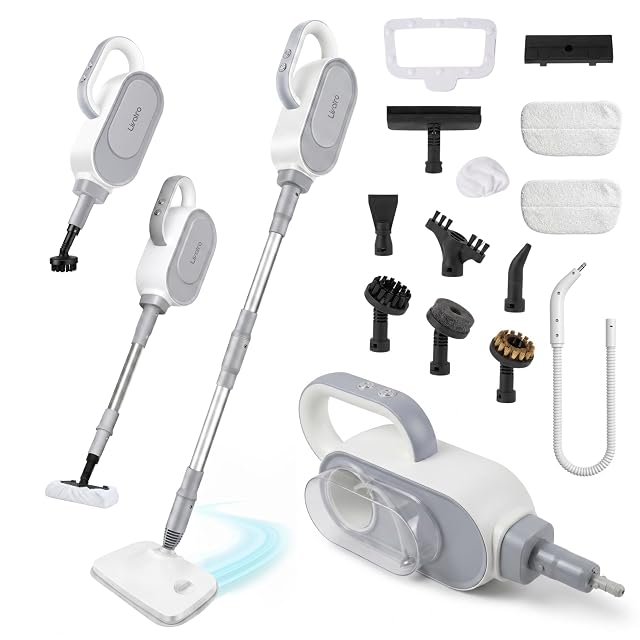
- “Features adjustable height & a flexible swivel head (180° left/right, 90° forward/backward) to reach corners. With a 16.4 FT cord & lightweight design, it glides room to room—no bending or straining”
- “Comes with 14 versatile attachments to tackle sticky spills, grease & tough stains on multiple surfaces—kitchen stoves, bathroom sinks, hardwood floors, windows & more”
- “Safe for all floors: hardwood, tile, laminate, stone & grout lines… Tips: Use the included carpet glider only on carpets”
- “Built-in anti-dry burn tech ensures safety & consistent performance. When the tank runs empty, a gentle pump sound reminds you to refill. The heating function auto-shuts off, with the steam indicator light staying red until refilled”
- Title: “14-in-1 Steam Mop, Powerful Detachable Handheld Steam Cleaner” · Reference AS-ZTB24SC-BKPK-SY · Catalog: 2341 g (82.6 oz)
This shelf holds two different machines. Four Shark uprights that clean floors and nothing else, with pads and no attachments; and four canisters — the Phueut, Schenley, Keenstone and HJGJYWLQ — that sit on the floor on wheels and come with a bag of tools.
This is the only one that is both. A steam mop with a detachable handheld steam cleaner and fourteen attachments, at $37.89.
What that actually means day to day: you mop the kitchen floor, then take the handle off and do the hob, the sink, the window and the grout with the same water and the same heat. The Sharks cannot do the second half at all — the S1000 at $69.39 and the S3501 at $58.99 are floor machines with pads. The canisters cannot comfortably do the first half, because a sled on a hose is a worse floor tool than an upright.
By accessory count: Phueut 28 · Schenley 21 · Keenstone 17 · this 14 · HJGJYWLQ “multiple” with no number · Shark S8001 and S8201 four pads each · Shark S1000 and S3501 two pads each.
So it is the smallest kit of the canisters and the only mop with a kit at all, for a quarter the price of the next one up.
Two hundred and twelve degrees, and the one claim on this shelf that fits its own machine
212 °F is 100 °C, the boiling point of water at atmospheric pressure.
Which tells you what this is: unpressurized steam. Water dripped onto a hot block and flashed to vapor at the head, with nothing holding pressure behind it.
And note what the listing therefore does not claim: any pressure figure at all. That is the right decision, and it puts this page ahead of two far more expensive ones.
The Schenley at $139.99 publishes 248 °F at 3.5 bar. But 248 °F is 120 °C, which corresponds to roughly 2 bar absolute — while 3.5 bar gauge would put saturated steam near 298 °F. The two figures describe different machines.
The HJGJYWLQ at $591.99 publishes “Steam temperature: 110 °C” alongside “Steam pressure: 4.0–5.0 Bar”. At 4.5 bar, saturated steam sits between 144 and 152 °C. One hundred and ten is impossible there.
The Phueut at $119.64 publishes “high heat and pressure” and no number of either kind.
And the four Sharks publish neither — no temperature, no pressure, on any of the four.
What 212 °F buys: enough heat to soften grease and melt sugar residue on contact, and enough to deal with most of what is living on a floor. What it does not buy is penetration — the pressure that drives steam into grout lines and crevices. That is the real gap between this and the Keenstone at $139.99, whose 300 °F at 58 psi is the one temperature-and-pressure pair on this shelf that agrees with itself.
And then it says “safe for all floors”
“Safe for all floors: hardwood, tile, laminate, stone & grout lines.”
All four Shark machines on this shelf carry a dedicated capitalized bullet saying something slightly different:
“SEALED HARD FLOORS: Designed to clean across all sealed hard floors including hardwood, marble, tile, stone, laminate, and vinyl.”
The same list of materials, one word added. And that word is the caution.
On unsealed or waxed timber, steam swells the fiber and raises the grain, and it takes the wax off.
On unglazed stone or terracotta, it soaks in.
On laminate with open seams, it gets under the surface layer and lifts it.
On unsealed grout, it erodes.
Steam does all of that faster than a wet mop, because it carries far more energy per gram — which is the point of the tool and also its one risk.
So read bullet four as a list of materials rather than a promise about finishes. Nothing about this machine makes it gentler on an unsealed floor than a Shark: it is the same unpressurized steam at the same temperature.
The cheap test before steaming a whole room: put a drop of water on an inconspicuous joint and watch whether it beads or soaks in.
Ninety-nine point nine per cent of stains, which is not the usual claim
“releasing consistent steam to remove 99.9% tough stains.”
Three other machines here use that number, and they use it for something else.
Shark S3501, S8201 and S1000 — “99.9% of common household bacteria”, and the footnote names the five organisms: “Pseudomonas aeruginosa, Staphylococcus aureus, Escherichia coli, Salmonella enterica (typhi), and Klebsiella pneumoniae when used as directed.”
Schenley — “up to 99.9% of common household bacteria”, no organisms named, “compliant with EPA standards”.
Shark S8001 — sanitizes, with a long footnote about controlled test conditions, and no percentage and no organisms at all.
Keenstone, Phueut, HJGJYWLQ — no figure.
99.9 per cent of bacteria is a measurable thing: you count colonies before and after. 99.9 per cent of stains is not — there is no unit of stain and nothing to count, so the figure cannot mean anything particular.
Which is not a statement about how well the machine cleans. It is a statement about the number: it has been borrowed from a different kind of claim.
If disinfection is the reason you are buying, the Shark footnote is the specific one on this shelf, and the Keenstone carries the only institutional certification here — UL499, which is an electrical safety standard rather than a hygiene one.
The dry-run protection, which is the best-described safety system here
“Built-in anti-dry burn tech… When the tank runs empty, a gentle pump sound reminds you to refill. The heating function auto-shuts off, with the steam indicator light staying red until refilled.”
Three signals for one condition: an audible one, an automatic cut-off, and a visual one that persists.
That matters because running a steam machine dry is how it dies. A heating element with no water to carry the heat away reaches its own limit in seconds, and on a cheap machine nothing stops it.
Across the shelf: the Keenstone has a “steam child lock” and a safety cap that “stays locked while the tank is hot or pressurized”; the Schenley “built-in overheat protection”; the Phueut a “safety cap” that “ensures a tight seal”; the HJGJYWLQ “temperature monitoring and automatic shutoff”. The four Sharks publish no safety feature at all.
And the three-signal arrangement here is the most explicit, which on the cheapest machine on the shelf is worth noting.
One honest limitation: no tank capacity is published anywhere on this page, so you cannot tell how often the warning will fire. The Keenstone publishes 51 oz and 50 minutes; the Schenley 45.5 fl. oz. and 45 minutes; the Phueut 1.5 L; the HJGJYWLQ 3.5 L. The Sharks say “large” and “XL” and give nothing.
Sixteen point four feet, and a head that turns four ways
16.4 ft is 5 meters exactly, which is a decent cord and the second longest published figure on this shelf.
Shark S1000 — 18 ft, the only Shark to give a number
this — 16.4 ft
HJGJYWLQ — 3.5 m, about 11.5 ft
Phueut — 9.8 ft, which is 3 meters, plus an “extra-long hose”
Schenley, Keenstone, Shark S3501, S8001, S8201 — nothing
On a corded floor machine the cord is the thing that decides whether you do a room in one go, and sixteen feet covers most domestic rooms from one socket.
The swivel is specified more precisely than anywhere else here: “180° left/right, 90° forward/backward”. Both Shark uprights at the cheap end claim “swivel steering” without a figure. Ninety degrees of fore-and-aft travel is what lets the head go flat under a kickboard or a sofa.
And adjustable height, which no other machine on this shelf publishes — useful because the right handle length is a function of who is pushing it, and bullet two makes the correct claim about it: “no bending or straining.”
2341 g at the catalog, which is 5.2 lb — slightly above the two cheap Sharks, which both declare “under 5 lbs.” and record 2087 g and 2209 g. For a machine that is also a handheld, that is a fair weight.
The carpet glider, and the caution attached to it
“Tips: Use the included carpet glider only on carpets.”
A carpet glider is a plate that clips over the head so the pad can refresh a pile without the fabric dragging. The instruction is right, and it is right in both directions: a glider on hard floor lifts the pad off the surface so nothing gets cleaned, and a bare pad on carpet snags.
Worth noting that no Shark on this shelf claims carpet capability at all — all four are “sealed hard floors” machines. So this is a function the cheapest item here has and the $159 ones do not.
The sensible expectation: a glider refreshes a carpet with heat and a little moisture. It does not extract, and it is not a substitute for a carpet cleaner.
What is not published
No tank capacity, as above — the figure that governs how long you clean.
No runtime.
No wattage, where the HJGJYWLQ claims 2500 W (and 3000 W in its own description), the Phueut 1800 W and the Keenstone 1500 W. On a 212 °F mop the wattage matters less than on a pressure machine, but it is the figure behind “rapidly heats”, and two Sharks put a number on that instead — “30 seconds”.
No heat-up time, which the Shark S1000 and S3501 both give as 30 seconds and the Schenley as 8 minutes. Those two figures describe the two architectures on this shelf: a mop flashes water at the head and a pressurized tank has to come up to temperature.
No pad size, and no statement about buying more. Two pads is the minimum on this shelf — the S8001 and S8201 ship four, and the S3501 ships two double-sided ones, which is four cleaning surfaces.
No warranty. The Keenstone’s two years is the only term on this shelf.
No itemized accessory list. Fourteen are claimed and none is named except the carpet glider, where the Keenstone names “floor brushes, microfiber pads, nylon and brass brushes, a window tool, detail nozzle” — and brass matters, because it is softer than most of what you clean and will not score it the way a steel brush does.
Availability
Read on the day this page was built: $38 at the American Amazon shop.
Read from Keepa on the day this page was last revised; stock and price both move without notice.
Prices quoted in this text were read on 2026-10-05. The live price is at the top of the page.