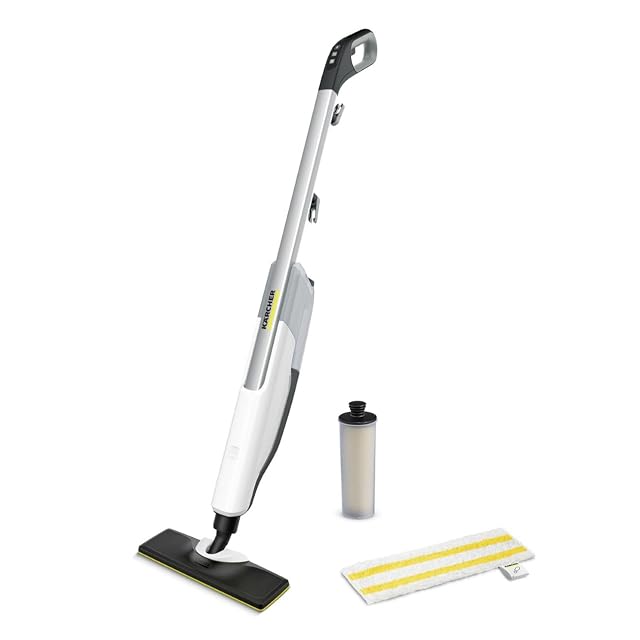
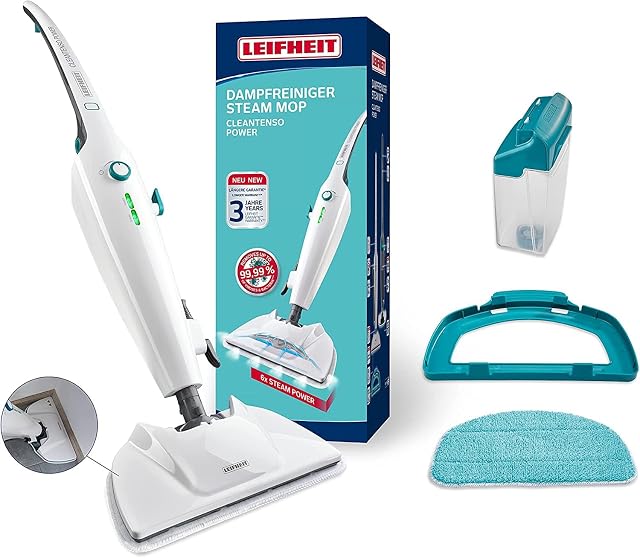
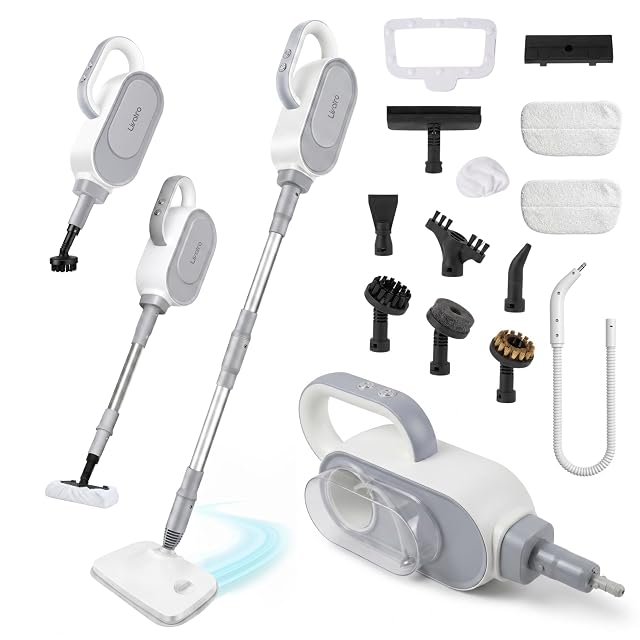
What the maker puts in writing
- “STEAM SANITIZATION: Removes 99.9% of common household bacteria* with the power of steam, using just water.”
- “DUAL-SIDED CLEANING: Flip the mop head to clean using both sides of our double-sided pads, extending your cleaning session with fewer washes.”
- “LIGHTWEIGHT DESIGN: At under 5 lbs., the compact design makes it effortless to carry between rooms”
- “QUICK START CLEANING: Starts steaming in as little as 30 seconds”
- “USE ON ALL SEALED HARD FLOORS: Designed to clean across all sealed hard floors including hardwood, marble, tile, stone, laminate, and vinyl.”
- “WHAT’S INCLUDED: 1x Shark Steam Pocket Mop, 1x Filling Flask, 2x Washable Double-Sided Microfiber Pads”
- Footnote: “Demonstrated to be effective against Pseudomonas aeruginosa, Staphylococcus aureus, Escherichia coli, Salmonella enterica (typhi), and Klebsiella pneumoniae when used as directed.”
- Reference S3501 · Catalog: 2209 g (77.9 oz)
Four cleaning surfaces from two pads
“Flip the mop head to clean using both sides of our double-sided pads, extending your cleaning session with fewer washes.”
Two pads with two faces each is four cleaning surfaces, and nothing else on this shelf works that way.
this — 2 double-sided pads = 4 surfaces, 2 things to wash
Shark S8001 and S8201, $159 each — 4 single-sided pads = 4 surfaces, 4 things to wash
Shark S1000, $69.39 — 2 single-sided pads = 2 surfaces
NEWBULIG, $37.89 — 2 pads
Why it matters more than it sounds: a steam mop pad stops working long before the floor is done. It fills with the dirt it has lifted, and a saturated pad begins spreading what it was collecting — which is the commonest reason a steam-mopped floor dries streaked.
Being able to flip the head halfway across a room, without going to find a clean pad, is the difference between finishing properly and finishing with a grey pad.
The pads are Dirt Grip microfibre, “that lift and lock in dirt and grime”, and machine washable. The honest limit: four surfaces is still four, and they all go in the same wash. A large house wants more pads whatever machine you buy.
Thirty seconds, and the division this shelf is built on
“Starts steaming in as little as 30 seconds.”
It can do that because it is not heating a tank. A steam mop holds cold water in a reservoir and drips it onto a hot block at the head, flashing it to vapor as it passes. There is almost nothing to warm up.
The Shark S1000 publishes the same figure. The other architecture on this shelf publishes very different ones:
Schenley, $139.99 — “Fast 8-Minute Heat-Up” for a 45.5 fl. oz. tank. And the arithmetic supports it: bringing about 1.35 liters to the boil takes roughly 0.45 megajoules, which at 1500 W is about five minutes. Eight is conservative, not slow.
Keenstone, $139.99 — no heat-up figure, but the sentence nobody else writes: “when refilling, allow the unit to cool for 20 minutes before adding water.”
Phueut, $119.64 — “heats up quickly”, no figure.
HJGJYWLQ, $591.99 — “Fast Heating”, no figure.
What you give up for the thirty seconds is pressure. An unpressurized mop cannot drive steam into a grout line the way the Keenstone claims to at 58 psi.
So the choice is thirty seconds and no pressure, or eight minutes of heating and twenty minutes of cooling before a refill. For a kitchen floor on a weekday evening, thirty seconds is the right trade — and it is why this machine and the S1000 are the two on this shelf you would actually use twice a week.
Sealed hard floors, in capitals
“USE ON ALL SEALED HARD FLOORS: Designed to clean across all sealed hard floors including hardwood, marble, tile, stone, laminate, and vinyl.”
All four Shark machines on this shelf carry that bullet, capitalized, and the word that matters is sealed.
On unsealed or waxed timber, steam swells the fiber and raises the grain, and it strips wax.
On unglazed stone or terracotta, it soaks in.
On laminate with open seams, it gets under the surface layer and lifts it.
On unsealed grout, it erodes.
Steam does all of that faster than a wet mop, because it carries far more energy per gram.
And the cheapest machine on this shelf says the opposite. The NEWBULIG at $37.89: “Safe for all floors: hardwood, tile, laminate, stone & grout lines.” The same list of materials, without the word. Nothing about that machine makes it gentler — it is unpressurized steam at a published 212 °F, the same kind of heat this produces.
The Schenley, Keenstone, Phueut and HJGJYWLQ do not raise the question at all.
The cheap test before steaming a whole room: a drop of water on an inconspicuous joint, and watch whether it beads or soaks in.
“Removes 99.9% of common household bacteria with the power of steam, using just water” — and in the small print, “Demonstrated to be effective against Pseudomonas aeruginosa, Staphylococcus aureus, Escherichia coli, Salmonella enterica (typhi), and Klebsiella pneumoniae when used as directed.”
Naming five organisms is a much stronger statement than the number on its own, because it says what was counted.
The same footnote appears on the Shark S8201, and the S1000 carries the same chemical-free sanitization claim.
The rest of the shelf:
Schenley — “compliant with EPA standards… up to 99.9% of common household bacteria”, no organism named
Shark S8001, $159.99 — sanitizes, with a long footnote about controlled test conditions, and no percentage at all
NEWBULIG — “remove 99.9% tough stains” — the same number applied to stains, which have no unit and nothing to count
Keenstone, Phueut, HJGJYWLQ — no figure
Two qualifications the footnote makes itself, and they are fair: “when used as directed”, and “Sanitization studies were conducted under controlled test conditions”. Both point at the same practical requirement — dwell time. Heat has to stay on the surface long enough to do the work, which means moving slowly rather than briskly.
“Using just water” is the other half of the argument, and it is the genuine case for steam over a spray. There is no consumable: no bottle to replace, nothing to rinse off, and nothing left behind on a floor a child or a dog is going to be on. The Phueut and Schenley both lead on the same point; the NEWBULIG calls it “safe for… loved ones”.
Under five pounds, and a swivel
“At under 5 lbs.” The catalog records 2209 g, which is 4.9 lb — so the claim holds.
Against the shelf:
Shark S1000 — 2087 g, also “under 5 lbs.”
this — 2209 g
NEWBULIG — 2341 g
Shark S8001 — 3130 g
Phueut — 3447 g
Schenley — 3629 g
Shark S8201 — 4042 g
HJGJYWLQ — 11489 g gross
So this and the S1000 are the two lightest machines here, and the two $159 Sharks are 40 to 80 per cent heavier for the rotating head and the bigger tank.
Weight is the specification that decides whether a mop gets used. Five pounds carries up a staircase one-handed; nine pounds is a decision.
“Swivel steering” is claimed without a figure — the NEWBULIG publishes “180° left/right, 90° forward/backward”, which is the only numbered swivel on this shelf. What swivel buys is the ability to put the head flat under a kickboard or around a chair leg without turning your whole body.
The filling flask, which tells you the tank does not come off
“1x Filling Flask” in the box, and no removable tank claimed anywhere on this page.
That is the real difference between this and the Shark S1000 at $69.39, which makes a bullet of it: “REMOVABLE WATER TANK: The removable water tank allows easy fills and refills.” Both $159 Sharks have one too.
A flask means you fill a jug at the tap and pour it into the machine. A removable tank means you take the tank to the tap. The second is less messy and faster, and it is most of what the extra ten dollars buys.
“XL Water Capacity” is claimed in the feature list with no figure — which is the case on all four Sharks here. The canisters publish theirs: the Keenstone 51 oz, the Schenley 45.5 fl. oz., the Phueut 1.5 L, the HJGJYWLQ 3.5 L.
What is not published
No temperature, and no pressure, on any of the four Sharks here. The Keenstone publishes 300 °F at 58 psi, which is the only consistent pair on this shelf: 58 psi is about 5 bar absolute, where saturated steam sits near 306 °F. The Schenley’s 248 °F at 3.5 bar and the HJGJYWLQ’s 110 °C at 4.0–5.0 bar are each internally inconsistent. The NEWBULIG’s 212 °F with no pressure is correct for an unpressurized mop — and this machine is the same kind, so 212 °F is the sensible expectation here too.
No tank capacity, as above.
No cord length. The S1000 publishes 18 ft, the NEWBULIG 16.4 ft, the Phueut 9.8 ft. “The long power cord gives you a wide cleaning radius” is the whole of what is said, and cord length is what decides whether a room is done from one socket.
No wattage.
No steam modes, where the S8001 and S8201 have three — “Light, Normal, Deep” — and the Schenley two trigger settings, and the Phueut an adjustable control on the handle with a lock. This has one setting.
No attachments. It is a floor machine. The Phueut ships 28 accessories, the Schenley 21, the Keenstone 17, the NEWBULIG 14 plus a detachable handheld.
No safety features published, where the NEWBULIG has anti-dry-burn with a sound, an auto-shutoff and a red light, and the Keenstone a steam child lock and a cap that stays locked while pressurized.
No warranty. The Keenstone’s two years is the only term on this shelf, and its UL499 the only certification.
Availability
Read on the day this page was built: $59 at the American Amazon shop.
Read from Keepa on the day this page was last revised; stock and price both move without notice.
Prices quoted in this text were read on 2026-10-05. The live price is at the top of the page.