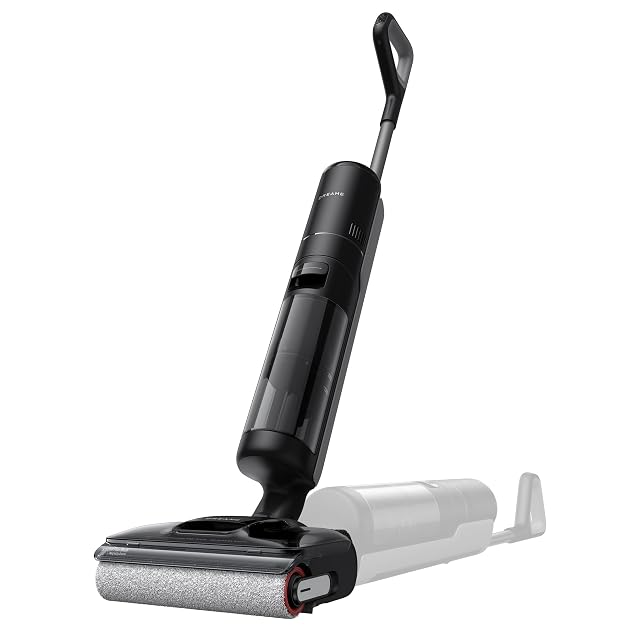
What the maker puts in writing
- “features smart dirt detect senor, automatically adjusting suction power based on dirt levels”
- “an impressive suction power of 20,000 PA”
- “With rapid drying at 194℉ and two drying modes—fast in five minutes or quiet in 20 minutes”
- “our revolutionary dual scrapers system… with a sleek flat blade for perfect water control and a clever comb design that captures hair effortlessly… with SGS and TUV certifications”
- “Triple Edge Cleaning… cleans right up to edges with less than 0.03 inches clearance, perfect for baseboards, stairs, and corners. It even dispenses cleaning solution automatically”
- “The head of our wet dry mop rotates a full 70 degrees… the strategically lower water tank shifts the weight for effortless handling. With AI-assisted wheels”
- Title: “APP Control”
- Catalog: 4672 g (164.8 oz) · 262 × 241 × 1100 mm (10.3 × 9.49 × 43.3 in)
The machine decides, and that is what the money buys
Two automations here that nothing else on this shelf has.
Dirt detection. “Smart dirt detect senor, automatically adjusting suction power based on dirt levels.” A sensor reads what is coming off the floor — turbidity in the dirty water, or load on the roller — and raises power where the floor is worse. A kitchen gets more than a hallway without you choosing.
Solution dosing. “It even dispenses cleaning solution automatically.” Detergent is metered into the water as it is used, instead of being poured into the tank by guess.
The second matters more than it sounds, because both ways of getting it wrong are common: too little does nothing, and too much leaves a film that collects dirt faster than the floor did in the first place.
What the rivals offer instead is manual modes, named honestly: the OLIXIS has “ECO… Turbo”, the Ultenic has “Smart, Max, and Water Suction”.
The most sophisticated competitor is the Tineco S5, whose “iLoop Smart Sensor Technology… automatically adjusts suction, water flow, and brush roller speed” — three variables against this machine’s one.
And the Tineco listing also documents what sensors cost: “please clean the detection pin of dirty water tank when you pour out the dirty water, so that make sure the dirt water tank will not happens false alerm”. A sensor is a component that can be wrong, and that one is wrong on the sales page.
One question this listing leaves open: automatic dosing usually implies a proprietary cartridge, which is a running cost. It does not say. The only other machine here with a consumable is the Shark VACMOP at $69.99, whose pads and solution are both “designed for use with the cleaner”; everything else runs on tap water and any detergent.
Fifty dollars above a sibling with identical numbers
All three roborocks here publish 20,000 Pa and 194 °F drying. So suction and sanitizing are constant across the range, and the price buys other things:
F25 GT, $169.99 — lightest at 3992 g, states “just 9 lbs”, the only one publishing a roller speed at 450 rpm, plus assistant wheels
F25 LT, $199.99 — 4173 g, thinnest at a published 4.92 inches, cites SGS and TUV, drying at 5 or 30 minutes
F25 XT, $249.99 — heaviest at 4672 g, adds app control, dirt detection, automatic dosing, triple edge cleaning, AI-assisted wheels, drying at 5 or 20 minutes
So this is the most capable and the heaviest, and the F25 LT is the same core machine in a slimmer body for thirty dollars less.
Not one of them publishes a runtime, which on a cordless machine is the figure that matters most. The dreame FloorX and Ultenic publish 60 minutes; the dreame G10 Pro, OLIXIS and DREAME H12 PRO publish 35.
A hundred and ninety-four degrees, and twenty minutes of quiet
“rapid drying at 194℉ and two drying modes—fast in five minutes or quiet in 20 minutes.”
The roller is what goes wrong with these machines: a damp fabric sleeve holding grease and hair, which grows mold and smells within days if merely dried.
194 °F is 90 °C — the sibling F25 LT publishes the conversion — and that is above what most household bacteria survive.
The shelf:
roborock ×3 — 194 °F (90 °C)
dreame FloorX 110 Plus — 149 °F, which is 65 °C: warm, not sanitizing
DREAME H12 PRO — “hot air”, no figure, but it names mildew as the target
Tineco S5 — centrifugal, spinning water out: fast, sanitizes nothing
Bissell ×2, OLIXIS, Ultenic, dreame G10 Pro, Tineco iFLOOR 2 — nothing published
The two-mode choice is the practical half. A drying cycle runs on the dock in a kitchen, and twenty minutes of quiet is usable in a flat where thirty is noticeable — this has the shortest quiet mode of the three siblings.
Triple edge, within a hundredth of an inch
“cleans right up to edges with less than 0.03 inches clearance, perfect for baseboards, stairs, and corners.”
Three edges rather than two, and 0.03 inches is 0.76 mm (0.03 in).
Worth setting against the rest of the shelf, because the numbers here are slippery:
this — “less than 0.03 inches” (0.76 mm)
roborock F25 LT — “1 mm (<0.03 inches)”, and 1 mm is actually 0.039 inches, so that conversion does not work
Ultenic — “0-inch”, which cannot be literal: a roller turns inside a housing, and the housing has thickness
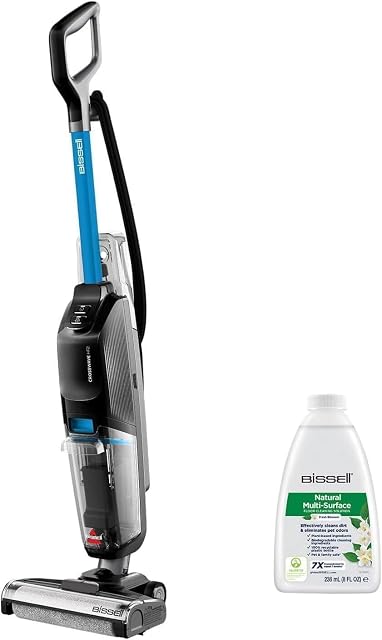
Bissell CrossWave Edge — “ZeroGap Technology on the right side”, one side only and stated as such, which is the most honest claim on the shelf
DREAME H12 PRO — “full-length roller brush design”, describing construction instead of quoting a gap
And stairs in the surface list is the useful part: a thick head fails on a stair riser, and a thin one with a flexible neck does not.
Scrapers verified from outside
“our revolutionary dual scrapers system… with a sleek flat blade for perfect water control and a clever comb design that captures hair… with SGS and TUV certifications.”
Two parts, two jobs, and the clearest description of either on this shelf.
The blade squeezes water out of the roller so it goes into the dirty tank instead of back onto the floor — which is what decides whether you leave a dry floor or a streaked one. Only the Tineco iFLOOR 2 quantifies that outcome anywhere here: “up to 90% water recovery rate”.
The comb strips hair continuously, because hair wraps a spinning roller and then nothing else comes off it.
SGS and TUV are independent testing houses, and what they are cited for is unusual: most appliance certifications cover electrical safety, and these are cited against a performance claim. Every machine on this shelf promises anti-tangle in its own words — “high-density comb teeth” (Ultenic), “tangle-free brush roller technology” (OLIXIS), “Tangle-Free Technology” (Bissell CrossWave Edge), a “pet hair strainer” (Tineco S5) — and only this and the F25 LT point at anyone outside the company who checked.
Weight managed rather than reduced
4672 g, the heaviest of the three roborocks, with three things done about it: a 70° rotating head, “the strategically lower water tank shifts the weight”, and AI-assisted wheels.
Putting the water low in the body is the real engineering — water is the heaviest thing in these machines and it moves as it drains, so mounting it at the base keeps the handling consistent from full to empty.
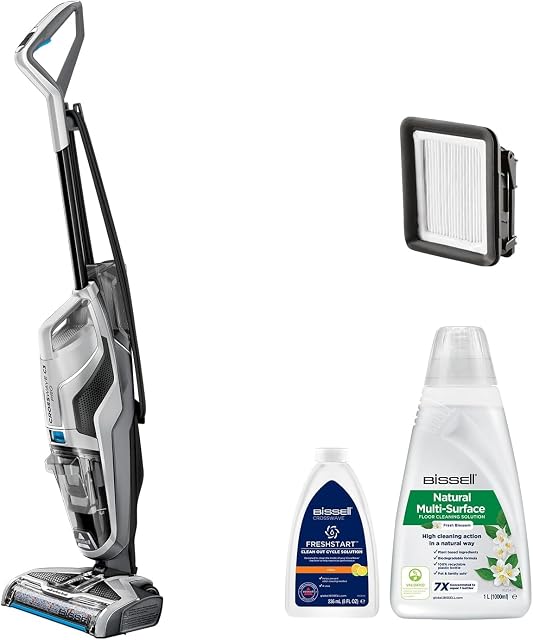
Across the shelf: Shark 1515 g (53.4 oz) · Tineco iFLOOR 2 3801 g (134.1 oz) · roborock F25 GT 3992 g (140.8 oz) · F25 LT 4173 g (147.2 oz) · this 4672 g (164.8 oz) · OLIXIS 4708 g (166.1 oz) · DREAME H12 PRO 4808 g (169.6 oz) · Bissell Turbo 4990 g (176 oz) · dreame G10 Pro 5080 g (179.2 oz) · dreame FloorX 5262 g (185.6 oz) · Tineco S5 7879 g (277.9 oz)
Three other listings help you push: the Tineco iFLOOR 2 with a “self-propulsion system”, the Ultenic with a “self-propelled motor”, the F25 GT with “assistant wheels”.
What is not published
No runtime, as above — and it is the figure a cordless machine should lead with.
No roller speed. Only three listings here publish one: the corded Bissell CrossWave Turbo at 3000 rpm, the dreame FloorX at 600, the roborock F25 GT at 450. Roller speed is what removes anything dried on, and suction at any pressure does not.
No tank volumes, where the OLIXIS publishes both at 0.35 L clean and 0.5 L dirty.
No battery capacity or replaceability, which is true of all twelve cordless machines on this shelf. Only the Ultenic publishes a warranty, at 24 months.
No water recovery rate.
No area rugs. Only the two Bissells here claim them.
And no price for the solution it dispenses, which on an automatic doser is the question worth asking first.
Availability
Read on the day this page was built: $250 at the American Amazon shop.
Read from Keepa on the day this page was last revised; stock and price both move without notice.
Prices quoted in this text were read on 2026-10-04. The live price is at the top of the page.