What the maker puts in writing
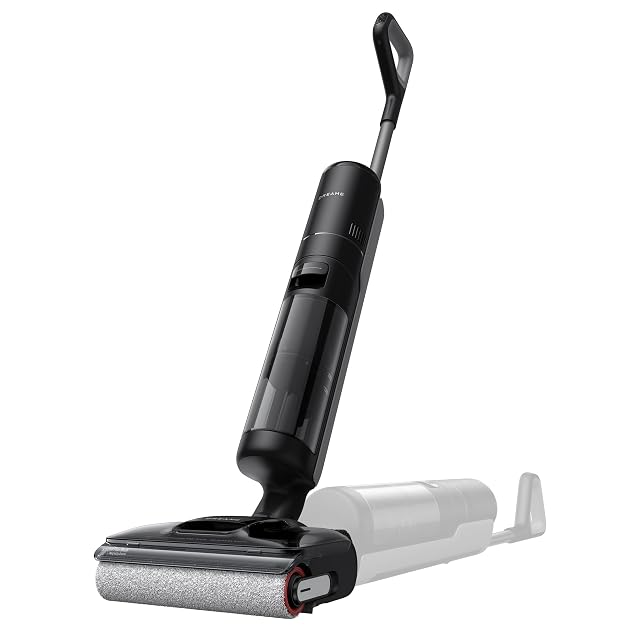
- “Extensively tested and refined, dreame G10 wet dry vacuum mop is perfectly matched with a wide range of North American flooring, including hardwood, marble, and rare wood, but not limited to these”
- “Designed to vacuum and mop simultaneously, this wet dry vacuum cleaner handles all types of messes in one go - from dry debris like hair, crumbs, and dust to wet spills such as drinks and sauces”
- “Dual water-tank design separates clean and dirty water… No reusing dirty water means absolute cleanliness”
- “Just place it back on the base and activate the self-cleaning, and this mop vacuum cleaner cleans itself”
- “a single charge provides up to 35 minutes of extended use”
- *“For proper operation, please install the handle with the self-cleaning button facing toward your body.”
- Catalog: 5080 g (179.2 oz) · 333 × 307 × 1135 mm (13.1 × 12.1 × 44.7 in)
The only listing that says it tested the floors
“Extensively tested and refined… perfectly matched with a wide range of North American flooring, including hardwood, marble, and rare wood.”
Every machine on this shelf lists surfaces. None of the others claims to have tested them.
The lists themselves are similar — “tile, vinyl, hardwood, luxury vinyl plank (LVP), laminate, and linoleum” on the roborock F25 GT, “hardwood, tile, laminate, vinyl, and marble” on the Tineco iFLOOR 2, a longer one on the Bissell CrossWave Turbo that reaches “rubber floor mats, pressed wood floors, area rugs”.
What is different here is the framing, and two specifics inside it: rare wood, and North American flooring as a category. Both are claims a maker could be held to.
Why it matters: the danger a wet machine poses to an expensive timber floor is not water in general but standing water, plus the mechanical action of a roller on a soft or oiled surface. A tested compatibility claim speaks to exactly that.
The caution, and it applies to this listing as much as any: it does not say sealed. Both Bissells and the Shark do — “sealed wood floors”, “all sealed hard floors” — and that distinction decides whether any machine on this shelf should go near a timber floor at all. An unsealed or oiled board absorbs, and no amount of testing changes that.
“For proper operation, please install the handle with the self-cleaning button facing toward your body.”
The button has to reach the dock contacts. Fitted the other way round, the machine will not self-clean, and the owner concludes it is faulty.
This shelf has two makers candid enough to publish notes like this, and both are more useful than the marketing around them.
The Tineco S5 carries three. One on assembly — “please assemble the machine according to the user’s guide… and fix the handle in the designated position”. One on maintenance — clean the filter and HEPA once a month. And the most revealing: “Please clean the detection pin of dirty water tank when you pour out the dirty water, so that make sure the dirt water tank will not happens false alerm” — a sensor that reports a full tank when it is not, documented on the sales page.
A listing that tells you how its product goes wrong is giving you something the silent ones are not.
Thirty-five minutes, and what that is worth
The published runtimes on this shelf:
60 minutes — dreame FloorX 110 Plus, Ultenic
35 minutes — this, OLIXIS, DREAME H12 PRO
nothing — both Tinecos, all three roborocks, both Bissells, the Shark
Though the Bissell CrossWave Turbo is corded, so its runtime is unlimited and its roller runs at 3000 rpm — five times the fastest battery machine here.
How far 35 minutes goes is best judged from the only credible coverage figure on the shelf. The OLIXIS, also 35 minutes, claims 560 square feet — 16 square feet a minute, which is a real pace with overlapping passes and pauses.
The larger claims do not survive division: the dreame FloorX offers 3600 sq ft in 60 minutes, which is 60 a minute, or one square foot every second for an hour without stopping, overlapping or going back. The Ultenic’s 2700 in 60 is 45 a minute — the same problem, smaller.
So: about five hundred square feet of actual cleaning. And the machine charges on its dock between uses, which in practice matters more than the number.
Dual tanks and one-press cleaning, done properly
“Dual water-tank design separates clean and dirty water… No reusing dirty water.”
That sentence is the whole case for this category against a mop and bucket, and it is worth stating plainly: a mop returns the dirty water to the floor. A two-tank washer never does.
“Just place it back on the base and activate the self-cleaning, and this mop vacuum cleaner cleans itself.”
And that is the feature that decides whether you keep using it. A roller that has washed a kitchen floor is a damp sleeve full of grease and hair; rinsed by hand it takes five minutes and the enthusiasm fades quickly.
Eleven of the twelve roller machines here have a self-cleaning dock. The exception is the Bissell CrossWave Turbo, which publishes none — its roller is rinsed by hand.
Where this listing stops is drying, and that is the gap. It describes washing the roller and nothing about what happens next, where a damp roller grows mold and smells within days.
The rivals: the three roborock listings dry at 194 °F (90 °C), above what most household bacteria survive. The dreame FloorX 110 Plus dries at 149 °F — 65 °C (149 °F), warm rather than sanitizing. The DREAME H12 PRO, from the same maker as this, says “the roller brush is automatically cleaned and dried in hot air, preventing odors and mildew”. The Tineco S5 spins the water out centrifugally.
So two of the three dreames on this shelf dry the roller and this one does not say.
What is not published
No suction figure, where the three roborock listings publish 20,000 Pa and the sibling DREAME H12 PRO publishes 16 kPa.
No roller speed, where the Bissell CrossWave Turbo publishes 3000 rpm, the sibling dreame FloorX 600 rpm and the roborock F25 GT 450 rpm. This is the figure that removes anything dried on.
No drying temperature or method, as above.
No tank volumes. The OLIXIS alone publishes both, at 0.35 L clean and 0.5 L dirty; the sibling H12 PRO publishes a 900 ml tank without saying which.
No edge-cleaning figure, where both roborocks publish 1 mm, the Ultenic claims “0-inch” and the Bissell CrossWave Edge publishes ZeroGap on the right side only — the most specific of the three.
No self-propulsion, on a 5080 g machine. The Tineco iFLOOR 2 has it at 3801 g, the Ultenic at a claimed 3.65 kg, and the roborock pair have assisted wheels. Nine of thirteen listings say nothing, and this is among the heavier of them.
No area rugs. Only the two Bissells claim them.
Availability
Read on the day this page was built: $230 at the American Amazon shop.
Read from Keepa on the day this page was last revised; stock and price both move without notice.
Prices quoted in this text were read on 2026-10-04. The live price is at the top of the page.