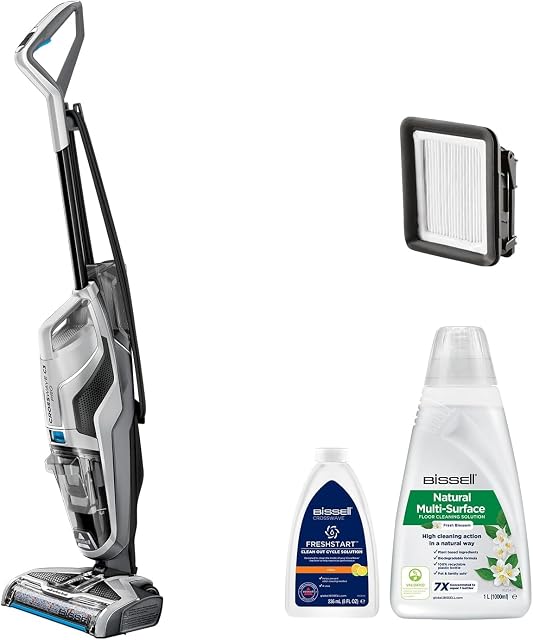
What the maker puts in writing
- “Simplify your routine — vacuum and mop together to tackle wet and dry messes at the same time on multiple hard surfaces like tile, sealed wood floors, laminate, and more; it even refreshes area rugs”
- “Collect more crumbs, dust, and hair with ZeroGap Technology on the right side of the brush roll. Engineered to clean wet and dry messes all the way to the edge of walls and baseboards”
- “CORDLESS FREEDOM: Tackle life’s everyday messes with cordless convenience”
- “Tangle-Free Technology reduces hair on the brush roll, manages pet hair, saves time… while the Self-Cleaning mode flushes debris”
- “The CrossWave Edge Cordless multi-surface cleaner vacuums and washes in one step—no mop or bucket needed”
- Catalog: 279 × 267 × 1105 mm (11 × 10.5 × 43.5 in) · no weight published
The most honest edge claim on the shelf
“ZeroGap Technology on the right side of the brush roll.”
Four words that no other maker here is willing to write: on the right side.
One end of the roller runs hard against its housing and the other does not. So the instruction that follows is practical — keep the right side of the machine against the skirting, which means working in one direction along a wall rather than in whichever direction you happen to be facing.
Now compare the rivals:
Ultenic — “0-inch edge cleaning”, which cannot be literal. A roller turns inside a housing, and the housing wall has thickness.
roborock F25 XT — “less than 0.03 inches”
roborock F25 LT — “1 mm (<0.03 inches)”, where 1 mm is actually 0.039 inches
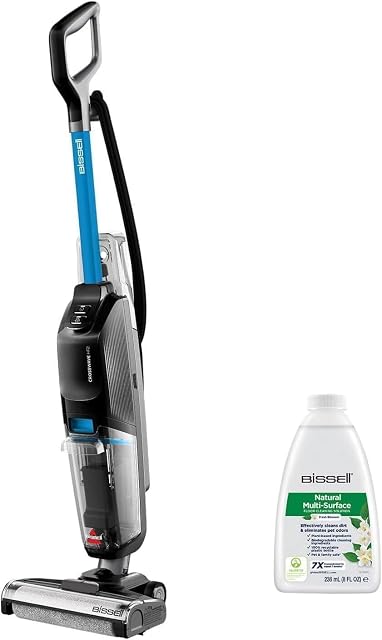
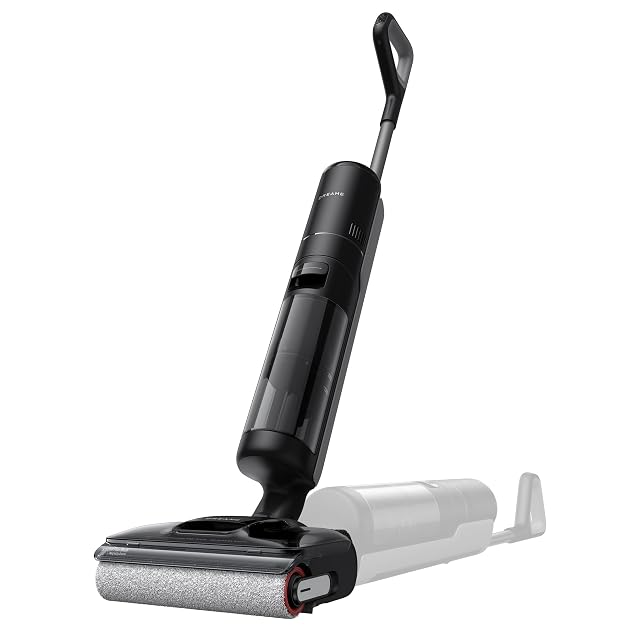
DREAME H12 PRO — “gap-free cleaning… with the full-length roller brush design”, which describes the construction instead of quoting a number, and is the honest way to claim both sides
OLIXIS — “dual-edge cleaning”, no figure
A stated limit on one side is worth more than an impossible figure on both, because it tells you how to use the machine.
One of two machines here that will wash a rug
“it even refreshes area rugs” and “Effortlessly transitions from hard floors to area rugs.”
The only other listing on this shelf making the claim is the corded CrossWave Turbo, titled “Hard Floor & Area Rug Cleaner”.
Everything else is hard floors, explicitly: the roborock F25 GT lists “tile, vinyl, hardwood, luxury vinyl plank (LVP), laminate, and linoleum”; the dreame FloorX, the Shark and both Tinecos say sealed hard floors.
The reason is physics. On tile, water sits on the surface and a squeezed roller lifts most of it back — the Tineco iFLOOR 2 publishes “up to 90% water recovery rate” for exactly that case. On a rug, the water goes into the pile, and a machine not designed to pull it back leaves the rug damp for a day.
And note the word: refreshes. Not deep-cleans, not extracts. This is a surface clean on a rug, not a carpet extraction, and the careful verb is the listing being accurate rather than evasive.
Fifty dollars for a battery, and what it costs
The corded CrossWave Turbo is $169.99. This is $219.99.
What the battery buys is obvious and real: no cable round a chair leg, no unplugging between rooms, and a machine you carry upstairs.
What it costs is the strongest published figure on this shelf. The corded sibling publishes a “Dual-Action Brush Roll (that rotates at 3000 RPM)” — five times the dreame FloorX’s 600 and nearly seven times the roborock F25 GT’s 450.
Roller speed is what removes anything dried on. Suction lifts water and loose debris; the roller breaks the bond between the mark and the tile. Three thousand revolutions needs continuous power, and every battery machine here rations exactly that to reach its runtime.
This listing publishes no roller speed.
The second cost is slower. A sealed lithium pack loses capacity with age whether used or not: the 35-minute machines on this shelf become 20-minute machines, then live on the dock, then get replaced with a working motor and a perfectly good roller. A corded machine in year eight runs as it did in year one.
Not one listing on this shelf publishes a battery capacity, a cycle rating or whether the pack can be changed. Only the Ultenic publishes a warranty, at 24 months.
Tangle-free, and a self-cleaning mode
“Tangle-Free Technology reduces hair on the brush roll, manages pet hair… while the Self-Cleaning mode flushes debris.”
Both are the baseline of this shelf, done without figures.
On tangling, the claim is universal and the wording varies: “high-density comb teeth” (Ultenic), “tangle-free brush roller technology” (OLIXIS), a “curved comb” (roborock F25 GT), “dual scrapers” (F25 XT), a “pet hair strainer” (Tineco S5). Two listings have it verified from outside — the roborock F25 XT and F25 LT both cite “SGS and TUV certifications” for the anti-tangle design specifically, which is a third-party test of a marketing claim and rarer than the claim.
On self-cleaning, this flushes debris. Both Tineco listings go further and name the part that actually smells: “automatically flushes the inner tubing and brush roller” — the duct between roller and tank, which nothing reaches by hand and which is why these machines develop an odor that cleaning the roller does not fix.
And this listing publishes no drying step at all, which is the real gap. A washed roller left damp grows mold within days. The three roborock listings dry at 194 °F (90 °C), the dreame FloorX at 149 °F, the DREAME H12 PRO with “hot air” against “odors and mildew”, the Tineco S5 by spinning the water out centrifugally. Five listings here, including both Bissells, have nothing.
What is not published
No roller speed, as above — and its own sibling publishes the best figure on the shelf.
No runtime. On a cordless machine this is the figure you most need. The dreame FloorX and Ultenic publish 60 minutes; the dreame G10 Pro, OLIXIS and DREAME H12 PRO publish 35; the three roborocks and both Tinecos publish none, and nor does this.
No weight, not even in the catalog. The shelf’s published figures run from 1515 g (the disposable-pad Shark) to 7879 g (Tineco S5), with the corded sibling at 4990 g.
No suction figure, where the three roborocks publish 20,000 Pa and the DREAME H12 PRO 16 kPa.
No tank volumes, where the OLIXIS publishes both at 0.35 L clean and 0.5 L dirty.
No drying arrangement, as above.
No water recovery rate, which only the Tineco iFLOOR 2 gives.
So the case for this machine rests on two things it says plainly — rugs, and which side the edge cleaning works on — rather than on any number.
Availability
Read on the day this page was built: $220 at the American Amazon shop.
Read from Keepa on the day this page was last revised; stock and price both move without notice.
Prices quoted in this text were read on 2026-10-04. The live price is at the top of the page.