What the maker puts in writing
- “the separate 0.35L clean and 0.5L dirty water tanks ensure you always mop with fresh solution”
- “up to 35 minutes of runtime—enough to clean 560 sq ft”
- “ECO mode delivers powerful suction for surface messes, while Turbo mode activates deep cleaning to root out embedded dirt”
- “Place this vacuum mop on its charging dock and press a button for a fully automatic self-clean”
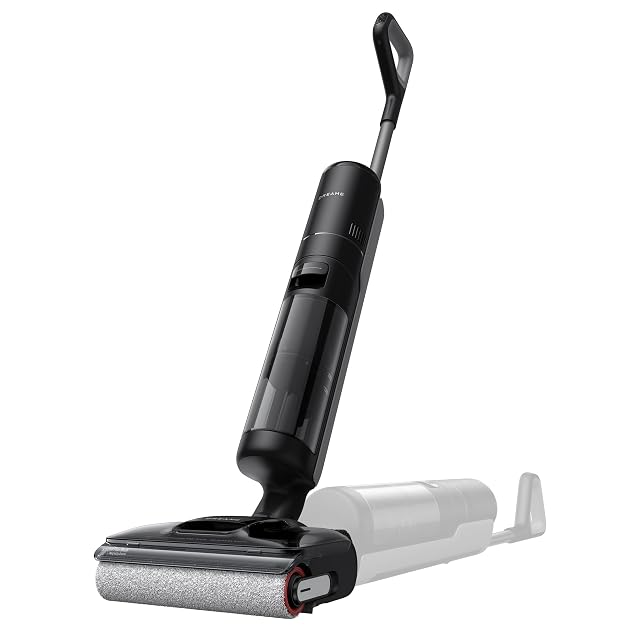
- “With a 140° pivoting head, 60° handle tilt, and dual-edge cleaning, it easily glides under furniture and into tight corners”
- “tangle-free brush roller technology. The intuitive LCD screen shows real-time status—low clean water, full dirty tank, and more”
- “effortlessly cleans marble, tile, hardwood, and laminate”
- Catalog: 4708 g (166.1 oz) · 331 × 289 × 1108 mm (13 × 11.4 × 43.6 in)
Three listings here publish an area. Divide each by its own runtime:
OLIXIS — 560 sq ft / 35 min = 16 sq ft per minute
Ultenic — 2700 sq ft / 60 min = 45 sq ft per minute
dreame FloorX 110 Plus — 3600 sq ft / 60 min = 60 sq ft per minute
Sixty square feet a minute is one square foot every second, continuously, for an hour.
With a cleaning head about ten inches wide, that requires walking at roughly seven inches a second and never stopping, never overlapping a pass, and never going back over a mark. It is head width multiplied by walking speed — a geometric maximum, not a cleaning rate.
Sixteen square feet a minute is what cleaning looks like: overlapping passes, a pause at the skirting, a second go at the sticky patch by the bin.
So the machine that appears to offer a sixth of the coverage is the one describing itself accurately. All three are cordless roller washers with comparable heads and comparable tanks; the difference is in the prose.
Worth knowing that the remaining ten listings publish no coverage at all, which avoids the problem rather than solving it.
Both tanks, with the right asymmetry
0.35 L clean. 0.5 L dirty.
The only listing on this shelf that publishes both, and the proportions are correct: the dirty tank has to be larger than the clean one, because it receives the water plus everything the water lifted, plus enough margin that it does not overflow into the motor.
What a third of a liter means: a wet roller lays a thin film, so 0.35 L genuinely covers a few hundred square feet — which supports the 560 sq ft claim rather than undermining it. A larger floor means one refill.
The rest of the shelf, on capacity:
DREAME H12 PRO — “900ml”, without saying which tank
Tineco S5 — “the clean water tank is 30% larger than the last gen”, a relative figure with no absolute
the other ten — nothing
So this is the only machine here whose refill interval you can calculate before you own it.
Two modes, named for what they do
ECO for surface messes. Turbo for embedded dirt.
Two modes is the right number, and the naming is honest about the trade: Turbo spends battery and water to scrub harder, ECO stretches the 35 minutes.
What is missing is the figure that would quantify either. No suction is published here, where the three roborock listings all publish 20,000 Pa and the DREAME H12 PRO publishes 16 kPa. And no roller speed, where the Bissell CrossWave Turbo publishes 3000 rpm, the dreame FloorX 600 rpm and the roborock F25 GT 450 rpm.
Roller speed is what scrubs. Suction is what lifts the water back off the floor. Without either, “Turbo” is a label rather than a measurement — and this listing’s strength is elsewhere, in the figures it does give.
A head that lies down and reaches the edge
140° pivoting head, 60° handle tilt, dual-edge cleaning.
The articulation figures matter more than they look, because the real obstacle on a hard floor is furniture: a head that pivots far enough goes under a sofa without lifting the machine.
Across the shelf, the claims take different forms. The Ultenic and dreame FloorX publish a 180° lay-flat body, which is the most extreme version. The roborock F25 LT publishes 180° plus a thickness of 4.92 inches. The roborock F25 XT publishes a 70° rotating head.
On edges, the numbers get slippery. The roborock F25 XT claims “less than 0.03 inches” and the F25 LT “1 mm (0.04 in) (<0.03 inches)” — though 1 mm (0.04 in) is 0.039 inches, not 0.03. The Ultenic claims “0-inch edge cleaning”, which cannot be literal for a roller turning inside a housing.
The Bissell CrossWave Edge is the most honest of them: ZeroGap Technology on the right side of the brush roll, one side only. Which means working in one direction along a wall — and is a specific claim rather than a round number.
“Dual-edge” here sits between those: both sides, no figure.
Self-cleaning, which is what makes these machines usable
“Place this vacuum mop on its charging dock and press a button for a fully automatic self-clean.”
Every machine on this shelf except the Shark does this, and it is the feature that decides whether you keep using the thing.
A roller that has washed a kitchen floor is a damp fabric sleeve full of grease and hair. Rinsed by hand it takes five minutes and the enthusiasm goes quickly. Flushed automatically on the dock, it happens because you put the machine away.
Where this listing stops short is drying. It describes washing, not drying — and a washed roller left damp grows mold and smells, which is the actual failure mode of this category.
The rivals that address it: all three roborock listings dry at 194 °F (90 °C), with the F25 XT offering 5 or 20 minutes and the F25 LT 5 or 30. The dreame FloorX 110 Plus dries at 149 °F in 20 minutes. The DREAME H12 PRO says “hot air” without a figure. The Tineco S5 spins the water out instead — “centrifugal drying effectively removes water from the roller” — which is fast and does not sanitize.
Ninety degrees against sixty-five is a real difference: 90 °C is above what most bacteria survive, and 65 °C is warm.
What is not published
No drying temperature or method, as above.
No suction figure. Nine of thirteen listings here are silent on this, including both Tinecos, both Bissells and two of the three dreames.
No roller speed.
No water recovery rate, which only the Tineco iFLOOR 2 publishes, at “up to 90%” — the figure that decides whether the floor is dry or damp behind you.
No area rugs. Only the two Bissells on this shelf claim them; everything else, including this, is sealed hard floors.
No certification. The roborock F25 XT and F25 LT publish SGS and TUV marks, and notably those certify the anti-tangle claim rather than electrical safety — a third-party test of a marketing promise, which is rarer than the promise.
Availability
Read on the day this page was built: $96 at the American Amazon shop.
Read from Keepa on the day this page was last revised; stock and price both move without notice.
Prices quoted in this text were read on 2026-10-04. The live price is at the top of the page.