What the maker puts in writing
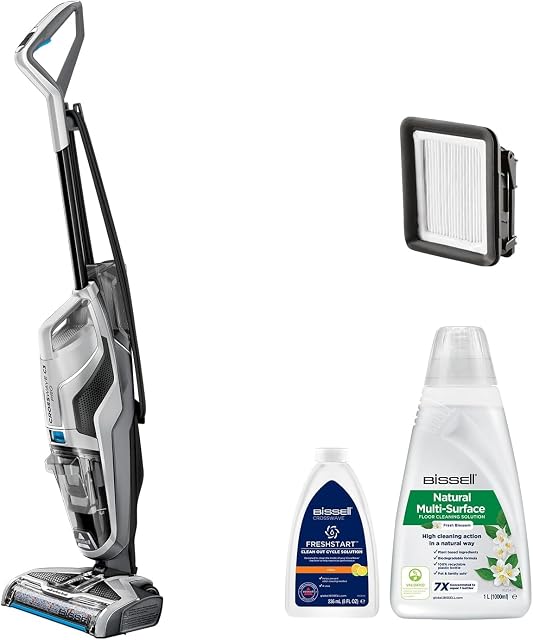
- “BISSELL CrossWave multi-surface floor cleaner cleans better than a sponge mop and bucket, and in less time”
- “Safe and effective for use on tile, sealed wood floors, laminate, linoleum, rubber floor mats, pressed wood floors, area rugs, and more”
- “TWO-TANK TECHNOLOGY. Keep clean water and formula separate from dirt”
- “ANTIMICROBIAL TREATED FRESHSTART FILTER. Designed to protect your filter against odors”
- “The combination of the Dual-Action Brush Roll (that rotates at 3000 RPM)”
- “EVERY PURCHASE SAVES PETS. BISSELL proudly supports BISSELL Pet Foundation”
- Catalog: 4990 g (176 oz) · 279 × 330 × 660 mm (11 × 13 × 26 in)
Three thousand revolutions a minute
Only three listings on this shelf publish a roller speed, and the spread is not subtle:
Bissell CrossWave Turbo — 3000 rpm
dreame FloorX 110 Plus — 600 rpm
roborock F25 GT — 450 rpm
Five times the dreame. Nearly seven times the roborock.
Roller speed is the figure that decides whether a dried-on mess comes up. Suction lifts the water back off the floor; the roller breaks the bond between the mark and the tile. Everything else on this shelf competes on suction — three roborock listings at 20,000 Pa, the DREAME H12 PRO at 16 kPa — and suction is the wrong tool for anything set hard.
The reason this machine can do it is the reason it is unfashionable: it runs from the wall. Spinning a wet roller at three thousand revolutions takes continuous power, and a battery machine has to ration exactly that to reach the 35 to 60 minutes its listing advertises.
So the division across this shelf is clear. Fresh spills, crumbs, pet hair: everything here works, and the cordless machines are nicer to use. Dried-on: this one has the mechanical advantage and the figure to prove it.
The only cord here, and the two things it buys
Twelve of thirteen listings on this shelf are cordless. This is not.
The cost is the obvious one: tethered to a socket, unplugging between rooms, cable round a chair leg. And the published height tells you it is a different shape too — 660 mm (26 in), where every cordless rival is around 1100 mm (43.3 in).
What the cord buys:
The 3000 rpm roller, which no battery here supports.
No battery to degrade. Every other machine on this shelf carries a sealed lithium pack that loses capacity with age whether used or not. The 35-minute machines become 20-minute machines, then live on the dock, and then the product is finished with a working motor and a perfectly good roller. A corded machine in year eight runs as it did in year one.
Not one listing on this shelf publishes a battery capacity or a cycle rating, which makes that comparison impossible to draw from the documents — and is itself worth noticing.
One of two machines here that will touch a rug
“Safe and effective for use on tile, sealed wood floors, laminate, linoleum, rubber floor mats, pressed wood floors, area rugs, and more.”
The title says the same: “Hard Floor & Area Rug Cleaner”.
The only other listing on this shelf making the claim is the Bissell CrossWave Edge at $219.99 — “it even refreshes area rugs”.
Everything else is hard floors, explicitly. The roborock F25 GT lists “tile, vinyl, hardwood, luxury vinyl plank (LVP), laminate, and linoleum” and stops. The dreame FloorX, the Shark and both Tinecos all say sealed hard floors.
That is not a marketing distinction. Washing a rug means wetting a pile that holds water, and getting the water back out needs a roller and an airflow designed for it. A machine built for tile will leave a rug damp.
The surface list here is also the longest on the shelf, and the inclusion of rubber floor mats and pressed wood is unusually specific.
Two tanks, and a filter treated against its own smell
Two-tank technology is the standard across this shelf and the reason these machines beat a mop: a mop returns dirty water to the floor, and a two-tank washer never does.
What is particular here is the antimicrobial treated FreshStart filter, “designed to protect your filter against odors”.
That addresses a real and specific failure. A filter inside a wet machine lives in humid air, and a damp filter goes sour — which is the complaint people actually have about this whole category after a few months.
The shelf handles it three ways. This treats the filter chemically. The dreame FloorX 110 Plus removes the problem by having a “filter-free design”. Both Tineco listings leave it to you: “clean the filter and HEPA once a month”.
Of those, filter-free is the cleanest answer and an antimicrobial treatment is the next best, because both survive being forgotten.
What is not published, and one absence that matters
No self-cleaning dock. This is the significant omission, because eleven of the twelve rivals here have one — “Place this vacuum mop on its charging dock and press a button for a fully automatic self-clean” (OLIXIS), “the hands-free, self-cleaning function automatically flushes the inner tubing and brush roller” (Tineco S5), a “2-minute self-washing cycle” (Ultenic).
Without it, the roller is rinsed by hand under a tap after it has washed a kitchen floor. That is the task people stop doing, and it is why the cordless machines put a dock in the box.
No drying arrangement either. Three roborock listings dry at 194 °F (90 °C), the dreame FloorX at 149 °F, the Tineco S5 spins the water out centrifugally. A roller left damp grows mold, and this listing has nothing to say about it.
No suction figure, where four rivals publish one.
No tank volumes. The OLIXIS is the only listing here giving both, at 0.35 L clean and 0.5 L dirty.
No water recovery rate, which only the Tineco iFLOOR 2 publishes, at “up to 90%”.
No weight in the bullets, though the catalog gives 4990 g — mid-shelf, between the Shark’s 1515 g and the Tineco S5’s 7879 g.
Availability
Read on the day this page was built: $170 at the American Amazon shop.
Read from Keepa on the day this page was last revised; stock and price both move without notice.
Prices quoted in this text were read on 2026-10-04. The live price is at the top of the page.