What the maker puts in writing
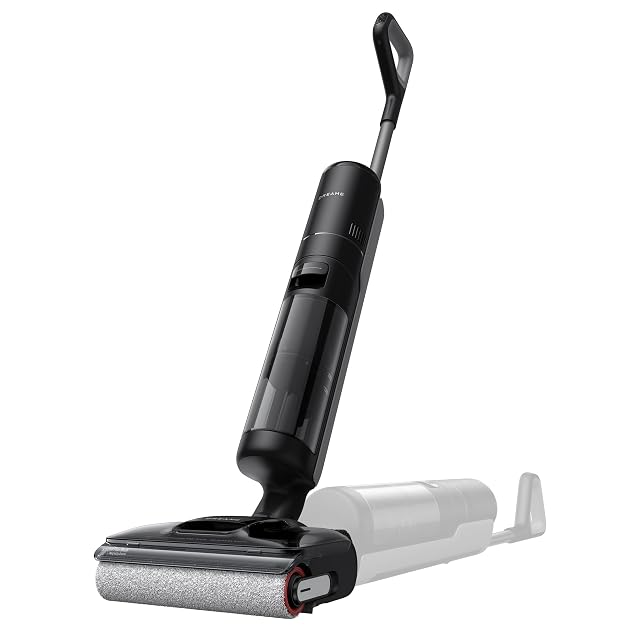
- “removable water tanks, a filter-free design, and a side-release debris container make emptying, rinsing, and everyday upkeep quick, simple, and hygienic”
- “the 600 RPM high-speed roller helps scrub away sticky messes and dried stains”
- “60-Min Runtime, 3,600 Sq Ft Coverage”
- “With one tap, dreame FloorX 110 Plus electric mop cleans the roller and dries it with 149°F hot air in just 20 minutes”
- “a slim 3.5-inch profile, and 180° lie-flat reach”
- “dual-tank system keeps clean and used water separate”
- Catalog: 5262 g (185.6 oz) · 307 × 277 × 1107 mm (12.1 × 10.9 × 43.6 in)
No filter, which is the quiet argument for this machine
“a filter-free design.”
It sounds like an omission and it is a design decision, and the reason is worth understanding.
In a wet-dry roller washer, dirt and air are separated by the dirty water tank itself. Debris arrives wet, drops into the tank, and the air leaving is already clean. A dry filter is only needed where fine airborne dust can reach the motor.
Which is why both Tineco listings on this shelf carry the same instruction — “please follow the instructions and operation video to clean the filter and HEPA once a month” — and this one does not.
What you avoid is specific: a HEPA element living in humid air inside a wet machine. It clogs, it smells, and eventually it passes what it was fitted to catch. Monthly cleaning is a genuine chore and the first thing anybody stops doing.
The companions are right too: removable tanks and a side-release debris container, so emptying is a hand movement rather than a procedure.
The trade, stated honestly: with no filter, the tank seal is the whole filtration. A tank clipped back carelessly is not a degraded filter — it is none.
Six hundred revolutions a minute, and what that is for
“the 600 RPM high-speed roller helps scrub away sticky messes and dried stains.”
Only three listings on this shelf publish a roller speed:
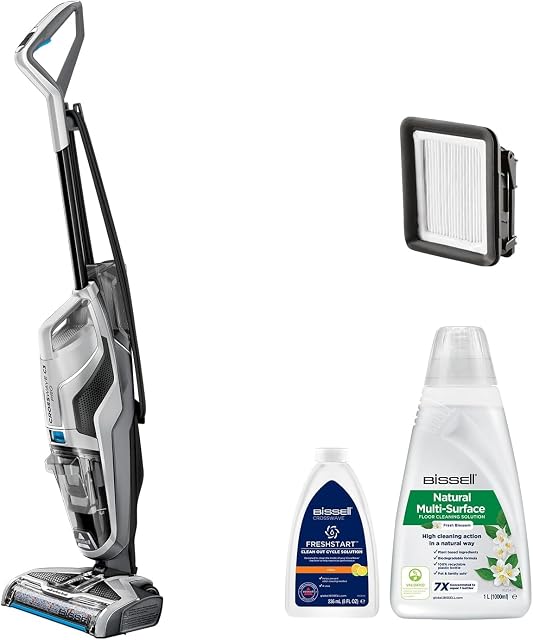
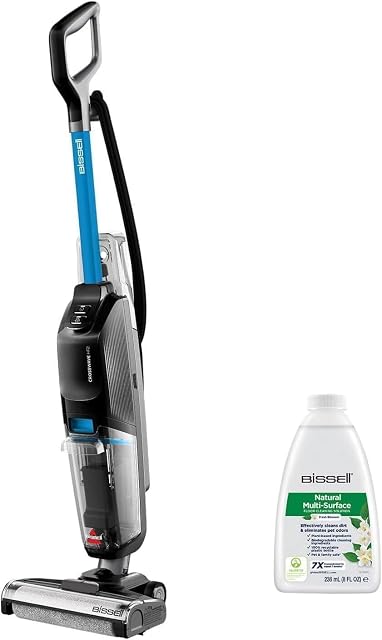
Bissell CrossWave Turbo — 3000 rpm (and it is the corded machine)
dreame FloorX 110 Plus — 600 rpm
roborock F25 GT — 450 rpm
Roller speed is what scrubs. Suction lifts the water back off the floor; the roller is what breaks the bond between a dried splash and the tile.
So the three-thousand figure on the Bissell is not a rounding difference — it is five times this and the reason a corded machine still exists on this shelf. A mains cable supplies unlimited power; a battery trades roller speed for the sixty minutes this listing advertises.
Against the other cordless machines, 600 rpm is the strongest published figure here, and a third more than the roborock’s 450.
Sixty minutes, and a coverage claim that is not a cleaning rate
60 minutes of runtime is real and is the top of this shelf, alongside the Ultenic. The 35-minute machines — dreame G10 Pro, OLIXIS, DREAME H12 PRO — are not in the same bracket.
3600 square feet is the same number with optimism applied.
Divide: 3600 / 60 = 60 square feet a minute, which is one square foot every second for an hour. With a head about ten inches wide, that is walking at seven inches a second without pausing, without overlapping a pass and without a second go at anything.
The shelf’s three published rates:
dreame FloorX — 60 sq ft/min
Ultenic — 2700 sq ft in 60 min = 45
OLIXIS — 560 sq ft in 35 min = 16
Only the OLIXIS figure describes cleaning, with overlap, pauses and a second pass where it is needed. Which means the listing that looks sixfold worse is the accurate one.
Take the 60 minutes here as the number that matters, and read the area as marketing.
A hundred and forty-nine degrees, where the roborocks use a hundred and ninety-four
“cleans the roller and dries it with 149°F hot air in just 20 minutes.”
A hundred and forty-nine Fahrenheit is 65 °C (149 °F). The three roborock listings publish 194 °F, and the F25 LT spells it out: “194℉ (90℃)”.
The gap matters because of what the roller is after use: a damp fabric sleeve that has washed a kitchen floor, which grows mold and smells within days if it is merely dried.
Ninety degrees is above what most household bacteria survive. Sixty-five is warm. Both deal with the water; only one deals with the biology.
The rest of the shelf: the DREAME H12 PRO says “dried in hot air” with no figure. The Tineco S5 does something else entirely — “centrifugal drying effectively removes water from the roller” — spinning the water out mechanically, which is quick and sanitizes nothing. The remaining listings, including the OLIXIS and both Bissells, describe washing the roller and not drying it.
Twenty minutes at 149 °F is a defensible middle. What the roborock pair add is a choice — 5 minutes fast or 20 to 30 quiet — and this listing offers one cycle.
Three and a half inches, lying flat
3.5 inch profile, 180° lie-flat reach.
The real obstacle on a hard floor is furniture, and these two figures describe getting under it. Three and a half inches clears most sofa bases and bed frames; a body that reclines to flat means the handle goes down rather than the machine going round.
The roborock F25 LT publishes the same 180° with a thickness of 4.92 inches, so this is the slimmer of the two. The Ultenic publishes “180° fully reclining” without a profile figure. The roborock F25 XT and GT publish 180° and 70° head swivel respectively.
At 5262 g (185.6 oz) this is one of the heavier machines here — the shelf runs from the Shark’s 1515 g (53.4 oz) to the Tineco S5’s 7879 g (277.9 oz) — and unlike the Tineco iFLOOR 2 and the Ultenic, it publishes no self-propulsion. On a slim machine at five kilos that is a noticeable omission over an hour of use.
What is not published
No suction figure, where the three roborock listings publish 20,000 Pa and the DREAME H12 PRO publishes 16 kPa.
No tank volumes. The OLIXIS is the only listing here giving both — 0.35 L clean, 0.5 L dirty — and the DREAME H12 PRO publishes “900ml” without saying which. “Dual-tank” tells you the architecture and not the refill interval, which on a sixty-minute machine is the figure you would want most.
No water recovery rate, which only the Tineco iFLOOR 2 publishes, at “up to 90%”.
No area rugs. Only the two Bissells claim them; this is “sealed hard floors”.
No certification, where the roborock F25 XT and F25 LT publish SGS and TUV against their anti-tangle claim.
No edge-clearance figure, where the roborock pair publish 1 mm, the Ultenic claims “0-inch”, and the Bissell CrossWave Edge publishes ZeroGap on the right side only — the most specific and most honest of the three.
Availability
Read on the day this page was built: $120 at the American Amazon shop.
Read from Keepa on the day this page was last revised; stock and price both move without notice.
Prices quoted in this text were read on 2026-10-04. The live price is at the top of the page.