What the maker puts in writing
- “With an astounding 20,000 PA suction power, it gobbles up everything from dirt to pet hair”
- “With a powerful 194℉ (90℃) high temperature feature, stubborn grease and grime are effortlessly eliminated… Choose from a rapid 5 min drying mode for those quick clean-ups or a tranquil 30 min option”
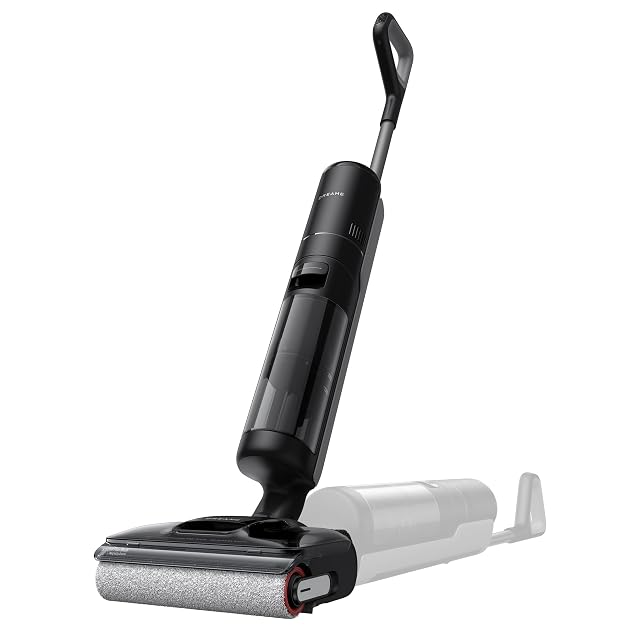
- “a 180-degree lay-flat design that reaches effortlessly under furniture without sacrificing suction. At a mere 4.92 inches in thickness”
- “our innovative dual-scrapers system… Certified by SGS and TUV, you can clean confidently”
- “edge-to-edge cleaning within a mere 1 mm (0.04 in) (<0.03 inches) of baseboards, staircases, and couches”
- “The 70-degree flexible head and strategically positioned water tank provide optimal balance”
- “a high-quality soft-pack battery”
- Catalog: 4173 g (147.2 oz) · 262 × 221 × 1100 mm (10.3 × 8.70 × 43.3 in)
Ninety degrees, and a choice of how long
“194℉ (90℃)… a rapid 5 min drying mode… or a tranquil 30 min option.”
Two things worth having, and this is the only listing on the shelf that spells out both the temperature and its conversion.
The temperature first. The roller is what goes wrong with these machines: after washing a floor it is a damp fabric sleeve holding grease and hair, and merely dried it grows mold and smells within days.
Ninety degrees is above what most household bacteria survive. The shelf’s spread:
roborock F25 GT, XT, LT — 194 °F (90 °C)
dreame FloorX 110 Plus — 149 °F, which is 65 °C: warm, not sanitizing
DREAME H12 PRO — “hot air”, no figure, though it does name mildew as what it prevents
Tineco S5 — centrifugal, spinning the water out: fast, sanitizes nothing
Bissell ×2, OLIXIS, Ultenic, dreame G10 Pro, Tineco iFLOOR 2 — no drying step published
The choice of duration is the practical part. A thirty-minute drying cycle is audible across a flat; five minutes is not, but uses more power to get there. Its sibling the F25 XT offers 5 or 20; the F25 GT publishes no time at all.
Four point nine two inches, which is the thinnest here
4.92 inches of thickness with a 180° lay-flat body.
The obstacle on a hard floor is furniture, and these two figures describe getting under it. Just under five inches clears most sofa bases and bed frames; lying flat means the handle goes down rather than the machine going round.
Only two listings here publish an actual thickness: this 4.92 inches, and the dreame FloorX 110 Plus at a “slim 3.5-inch profile”, which is slimmer. The Ultenic publishes “180° fully reclining” with no figure; the roborock F25 GT publishes 180° plus 70° swivel; the F25 XT publishes a 70° rotating head.
The qualifier in this bullet is the honest bit: lying flat “without sacrificing suction”. A machine folded flat has a kinked air path, and losing suction at full stretch is the normal consequence — so claiming otherwise is at least addressing the right problem.
At 4173 g (147.2 oz) this sits between the F25 GT at 3992 g (140.8 oz) and the F25 XT at 4672 g (164.8 oz), and it publishes no self-propulsion where the Tineco iFLOOR 2 and Ultenic do. It relies instead on the “strategically positioned water tank” low in the body for balance, which is the passive version of the same idea.
“our innovative dual-scrapers system… Certified by SGS and TUV.”
SGS and TUV are independent testing houses, and what they are cited for here is unusual.
Most certifications on appliances cover electrical safety — that the thing will not electrocute you or catch fire. These are cited against a performance claim: that the scrapers keep hair off the roller.
Every machine on this shelf makes that promise in its own words. “High-density comb teeth” (Ultenic). “Tangle-free brush roller technology” (OLIXIS). “Tangle-Free Technology” (Bissell CrossWave Edge). A “pet hair strainer” (Tineco S5). A “curved comb” (F25 GT).
Only this listing and the F25 XT point at anybody outside the company who checked.
The mechanism is two parts doing two jobs, which the F25 GT describes more clearly: “a sleek flat blade for perfect water control and a clever comb design that captures hair”. The blade squeezes water out of the roller so it goes into the tank instead of back onto the floor; the comb strips hair continuously, because hair wraps a spinning roller and then nothing else comes off it.
What the certification does not cover: suction, runtime, drying.
A millimeter, and a conversion that does not work
“edge-to-edge cleaning within a mere 1 mm (<0.03 inches).”
One millimeter is 0.039 inches, not under 0.03. The sibling F25 XT publishes the inch figure alone — “less than 0.03 inches” — which would be 0.76 mm.
So the honest reading is about a millimeter, which is roughly as close as a roller inside a housing can get.
Worth comparing. The Ultenic claims “0-inch edge cleaning”, which cannot be literal: the housing wall has thickness. And the Bissell CrossWave Edge makes the most honest claim on the shelf by admitting a limit — “ZeroGap Technology on the right side of the brush roll” — one side only, which means working in one direction along a wall.
A millimeter on both sides is better than zero on one side described as zero.
The surfaces named are the right ones too: baseboards, staircases and couches. Stairs in particular are where a bulky head fails, and a thin one with a flexible neck does not.
Twenty thousand pascals, and what suction does not do
20,000 Pa, identical to both siblings, and the joint highest on this shelf. The DREAME H12 PRO publishes 16 kPa — the same unit, 20 per cent less. Nine of thirteen listings publish nothing at all.
Suction lifts water, hair and loose debris back off the floor. It is why “dirt to pet hair” is a credible claim and why the water recovery works — though only the Tineco iFLOOR 2 quantifies that outcome anywhere here, at “up to 90% water recovery rate”.
What suction does not do is remove anything dried on. That is roller speed, and this listing publishes none. The three figures on the shelf: the corded Bissell CrossWave Turbo at 3000 rpm, the dreame FloorX at 600, the roborock F25 GT at 450.
So the corded Bissell, at $30 less than this, has nearly seven times the published roller speed — and also does area rugs, which no roborock claims.
What is not published
No runtime, which on a cordless machine is the figure that matters most. All three roborocks here describe “a high-quality soft-pack battery” and none gives minutes. The dreame FloorX and Ultenic publish 60; the dreame G10 Pro, OLIXIS and DREAME H12 PRO publish 35.
No battery capacity and no indication whether the pack is replaceable — which is true of all twelve cordless machines here.
No roller speed, as above.
No tank volumes, where the OLIXIS publishes both, at 0.35 L clean and 0.5 L dirty.
No coverage figure — and no loss, since the three published on this shelf do not survive division: dreame FloorX 60 sq ft a minute, Ultenic 45, OLIXIS 16, where only the last describes cleaning rather than head width times walking speed.
No warranty term, which only the Ultenic gives, at 24 months.
No area rugs. Only the two Bissells on this shelf claim them.
Availability
Read on the day this page was built: $200 at the American Amazon shop.
Read from Keepa on the day this page was last revised; stock and price both move without notice.
Prices quoted in this text were read on 2026-10-04. The live price is at the top of the page.