What the maker puts in writing
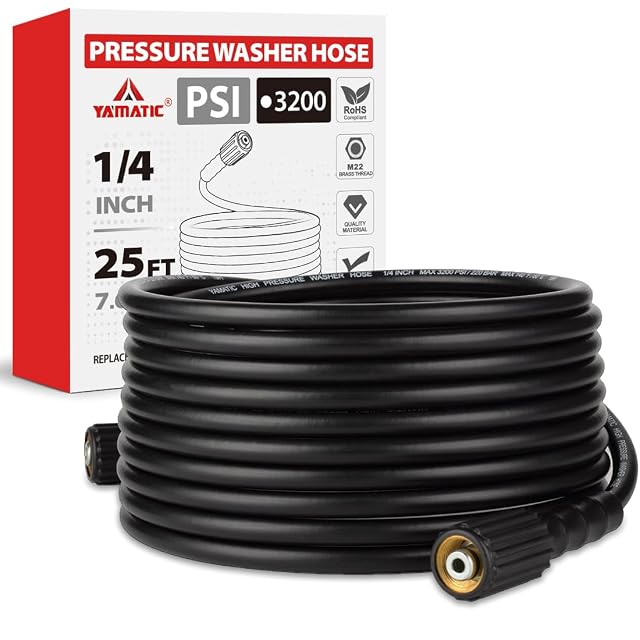
- “Standard M22-14mm female × M22-14mm female brass fittings work with M22 male accessories on Ryobi, Troy Bilt, Greenworks, CRAFTSMAN, PowerStroke, Simpson and many other M22-thread power washers. Not compatible with 3/4” GHT garden hose, 3/8” quick-connect/NPT fittings, or certain Karcher, Stanley, Husky models”
- “25FT pressure washer hose with 1/4 inch inner diameter, rated up to 3200 PSI working pressure for most residential car, driveway and patio cleaning jobs (cold water only)”
- “Upgraded inner tube and outer jacket reduce kinks and coil memory, helping the hose lay flatter, keep a more stable water flow, and roll up quickly after use… without constantly stopping to unkink the hose”
- “Lightweight yet durable construction is easier to pull and maneuver than standard rubber hoses while maintaining strong abrasion and weather resistance”
- “All fittings are made from high-quality brass and new materials that meet American industrial standards, with anti-rust, leak-resistant design to stay tight under vibration and pressure pulses”
- Reference PD-34647
Six brands in, three out, and two fitting families ruled out
This is the fullest compatibility statement on the shelf, and it is useful in both directions.
Fits: “M22 male accessories on Ryobi, Troy Bilt, Greenworks, CRAFTSMAN, PowerStroke, Simpson and many other M22-thread power washers.”
Does not fit: “3/4” GHT garden hose, 3/8” quick-connect/NPT fittings, or certain Karcher, Stanley, Husky models that use non-M22 connections — please confirm the thread size before ordering.”
Why it matters: M22 comes in two sizes that share one name. M22-14mm and M22-15mm differ in the diameter of the inner nipple the seal rides on, and they screw together and then either refuse to seal or let go under pressure.
Three of the six hoses here name excluded machines. This one; the RainBello at $19.99, which puts it in bullet one — “will not work with AR Blue Clean, Sun Joe”; and the YAMATIC 50 FT, which rules out “Sunjoe, AR Blue Clean, Karcher, Stanly”.
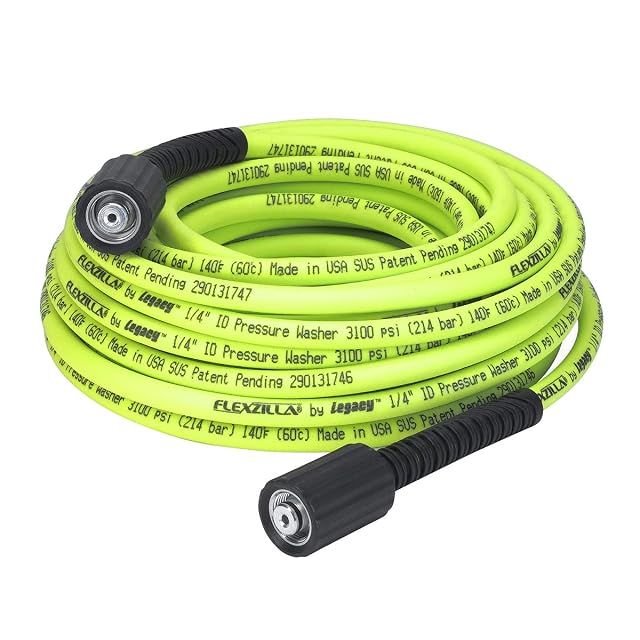
The two that do not are less help. The LULUW says “M22 14mm (0.55 in)” once, in its title, while claiming to suit “most brands of cleaning machines on the market”. And the Flexzilla at $53.92 gives no size at all — “M22 Fittings” — and then warns that its own range ships “with M22 or Integrated Quick Connect fittings on select hoses”.
And one hose avoids the question: the Simpson at $25.71 fits both sizes, with a “dual o-ring design” and a 14/15mm connector in the box. If you own a Karcher, a Stanley or a Husky, that is the hose on this shelf to look at.
Note what the “two females” means. Both ends are female, which is how every pressure hose is made — the machine outlet and the gun inlet are both male. It also means two of these cannot be joined without a male-to-male coupler, which is the piece the Simpson includes and nothing else here does.
Coil memory, which is the real daily annoyance
“Upgraded inner tube and outer jacket reduce kinks and coil memory, helping the hose lay flatter, keep a more stable water flow, and roll up quickly after use… without constantly stopping to unkink the hose.”
This is the clearest account of it on the shelf, and it is a more honest selling point than a pressure rating.
A hose spends its life wound on a reel or in a coil, and the material takes a set. Unrolled, it wants to go back to those loops — so it lies on the drive in circles, snags on corners, and folds on itself when you pull against it.
Every fold is a restriction, which is why the bullet ties it to flow: a kinked hose starves the gun and the jet pulses. And the failure is self-reinforcing, because a hose that has kinked once kinks in the same place again.
Three listings here address it. This, the YAMATIC 50 FT (“Hose coil memory can affect water flow”), and the Flexzilla, which makes the strongest version — “stays flexible when pressurized during use and offers minimal memory when depressurized. It also lays flat.”
Worth noting the tension on the other YAMATIC: the 50-footer makes the same claim on a “polyvinyl body”, and PVC is the stiffest material on this shelf and holds its coil hardest.
Which brings up this listing’s own gap, in the next section.
And it never says what it is made of
“Upgraded inner tube and outer jacket.” “Lightweight yet durable construction.”
That is the whole of it. No material anywhere — the only hose on this shelf that does not name one.
The comparison that is being invited is in bullet three: “easier to pull and maneuver than standard rubber hoses while maintaining strong abrasion and weather resistance”. So it is positioning itself against rubber, which suggests a polymer body.
What the others declare:
RainBello — hybrid rubber inner tube and cover over braided polyester
Simpson — polyester braid under a polyurethane jacket, “MorFlex”
Flexzilla — flexible hybrid polymer
LULUW — PVC
YAMATIC 50 FT — polyvinyl, which is PVC
Given that its own sibling is polyvinyl at the same rating and the same fittings, PVC is the likely answer here too — but the page does not say, and the “upgraded” in bullet two has nothing to be upgraded from.
“OEM-QUALITY UPGRADE REPLACEMENT” in bullet three is the same kind of claim: a comparison with no stated reference.
Brass fittings, specified more carefully than anywhere else here
“All fittings are made from high-quality brass and new materials that meet American industrial standards, with anti-rust, leak-resistant design to stay tight under vibration and pressure pulses.”
Brass is the right material at a wet threaded joint: soft enough to seat against a seal without cutting it, and it does not corrode in that service.
And the mechanism named is the real one. Pressure pulses are what loosen a fitting — a pump does not deliver smooth flow, it delivers a rapid series of pressure spikes, and over an hour of washing that works a joint loose. Staying tight under pulsation is a more meaningful claim than “leak-proof”.
The only hose here that goes the other way is the RainBello, with “solid aluminum M22 connectors”, offered as a feature. Aluminum holds pressure fine; it galls against a steel or brass male thread, and in water it corrodes galvanically against brass — so after a season the joint can seize rather than merely leak.
The LULUW is brass too; the Simpson and the Flexzilla do not say.
Cold water only, and no number to go with it
“(cold water only).”
Stated, but without a figure — where three hoses on this shelf publish 140 °F: the LULUW (“140 ℉/60 ℃”, and that conversion is exact), the Simpson (“up to 140 degrees Fahrenheit”, “Cold Water Use” in the title) and the Flexzilla (“scorching 140 degrees F heat”).
A number is better than a word, because “cold” is not a specification. What all of them are really ruling out: hot-water contractor machines, which run above 180 °F, and — the one people try — anything from a steam cleaner. The steam shelf on this site runs between 212 and 293 °F.
Water that has sat in a hose in the sun is well inside 140 °F, so in practice the limit bites only if you deliberately feed warm water.
Twenty-five feet at a dollar four, where the same brand is sixty-six cents
Same brand, same 3200 PSI, same M22-14mm female brass fittings, same 1/4 inch bore, same cold-water restriction — and the fifty-foot version costs 37 per cent less per foot.
YAMATIC 50 FT — 66¢ a foot · LULUW — 68¢ · RainBello — 80¢ · Simpson — $1.03 · this — $1.04 · Flexzilla — $1.08
So on price this loses to its own sibling outright, and the page gives no reason.
What argues for twenty-five feet is something none of the six listings mention: a longer hose costs pressure. Friction loss rises in proportion to length, and at a 1/4 inch bore the water moves fast enough that the loss per foot is real — fifty feet drops roughly twice what twenty-five does, and the shortfall shows at the nozzle. Fifty feet also weighs more to drag and holds more water to coil.
The middle path is the Simpson: it ships a male-to-male connector, so twenty-five feet becomes an extension to the hose your machine came with. Short when you want pressure, long when you need reach.
What is not published
No material, as above — the only hose here without one.
No burst pressure, where its own fifty-foot sibling publishes 8700 PSI against the same 3200 working, and the LULUW publishes 9000 against 3600. Those two bursts sit within 3.4 per cent of each other while the working figures differ by 12.5, which shows how much the headline depends on the safety factor chosen — and this page gives neither half.
No temperature figure, as above.
No weight, where the LULUW publishes 862 g for the same length, the Simpson 998 g, and both fifty-footers 1633 g.
No bend protectors. Kink resistance is claimed for the material, which addresses the length rather than the ends — and the ends are where hoses fail, as the fitting is rigid and the hose is not. Only the Simpson (“4-inch bend protectors at each end”) and the Flexzilla (“Integrated non-kink bend restrictor”) have hardware for it.
No adapter, so it is a replacement or an extension only if you already own the coupler. Its own fifty-foot sibling is admirably plain about this — “[Hose Only, No Adapters]” — and this page simply says it “works as a replacement or extension hose” without mentioning that joining two hoses needs a part.
No color.
No warranty. “Our professional team is ready to provide timely technical support” is support, not a term. The Simpson’s 90 Day limited accessory remains the only warranty on this shelf.
Availability
Read on the day this page was built: $26 at the American Amazon shop.
Read from Keepa on the day this page was last revised; stock and price both move without notice.
Prices quoted in this text were read on 2026-10-04. The live price is at the top of the page.