What the maker puts in writing
- “Powerful Cleaning Kit: Accessory bundle for SPX Series pressure washers cleans cars, RVs, siding, windows, and outdoor furniture”
- “Deep Scrub Brushes: Rotary and wheel rim brushes with soft bristles eliminate grime from rims, tires, siding, and glass”
- “Durable Brush Design: Long-lasting construction with pressure-powered operation delivers strong cleaning with every pass”
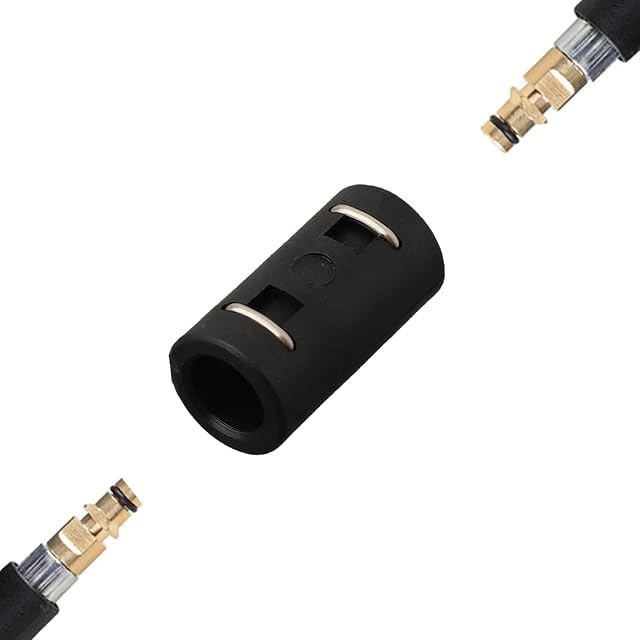
- “Versatile Adapter Use: Includes transfer adapter for simple connection to compatible pressure washers and quick tool swapping”
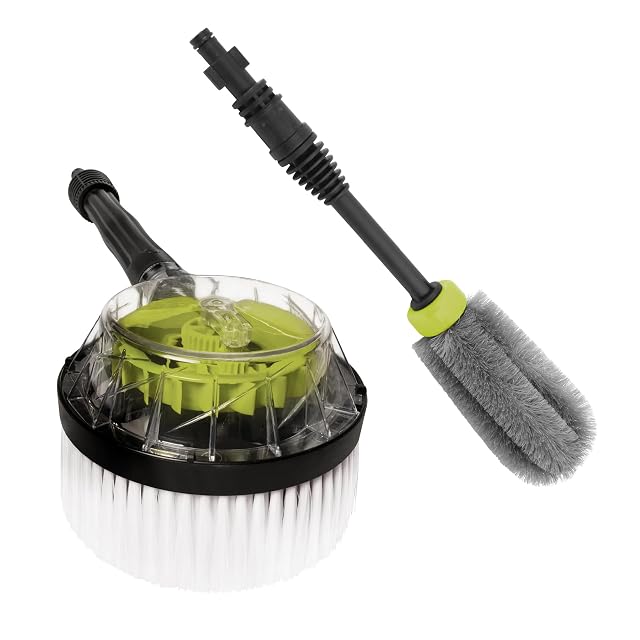
- Title: “Includes SPX-RB1 Rotary Wash Brush & SPX-WB1 Wheel Rim Brush” · Reference SPX-CCK · Catalog: 140 × 445 × 165 mm (5.51 × 17.5 × 6.50 in)
Three items for fifty-five dollars, where five cost fifty
This is the comparison that decides the page, and both products are Sun Joe car kits on the same shelf.
this — $54.97, three items: the SPX-RB1 rotary wash brush · the SPX-WB1 wheel rim brush · a transfer adapter
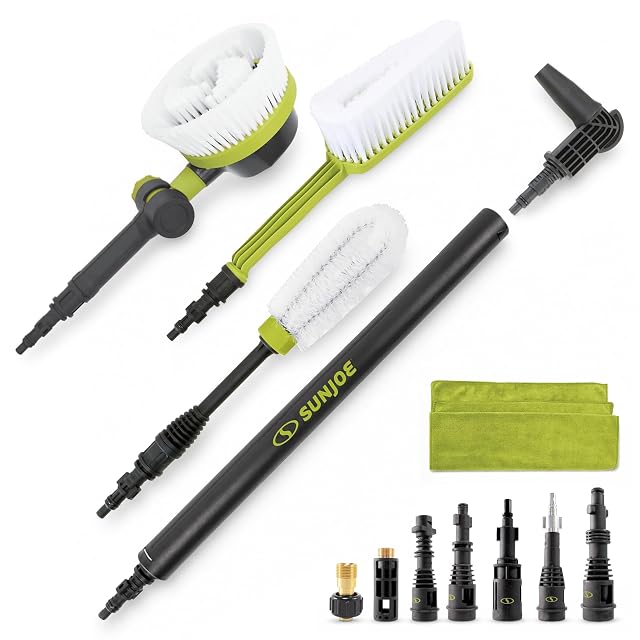
Sun Joe SPX-ACS-MAX — $49.97, five items: a 5.7 inch rotary wash brush with a 0° to 180° adjustable head · a feathered utility brush · a wheel and rim brush · a turbo nozzle with a 20 inch rod and a 90° angled head for under a car · a 16” × 16” washable microfibre cloth. Rated for washers “up to 3500-PSI”.
The larger kit covers both of this kit’s jobs, adds three tools, and costs five dollars less.
It also publishes two figures this page does not: a brush diameter and an angle range.
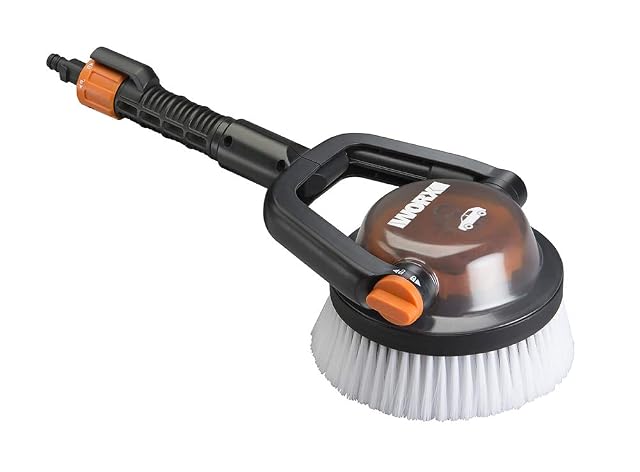
And there is a third comparison. The SPX-RB1 sells alone on this shelf for $25.99. So the wheel brush and the adapter in this box come to $28.98 — more than the entire Kärcher universal brush at $32.65 less four dollars, and more than the WORX WA4042 at $22.79, which is a dedicated rim brush with five named compatible machines.
The only published advantage here is the transfer adapter, and the ACS-MAX does not appear to need one.
What the two brushes are for
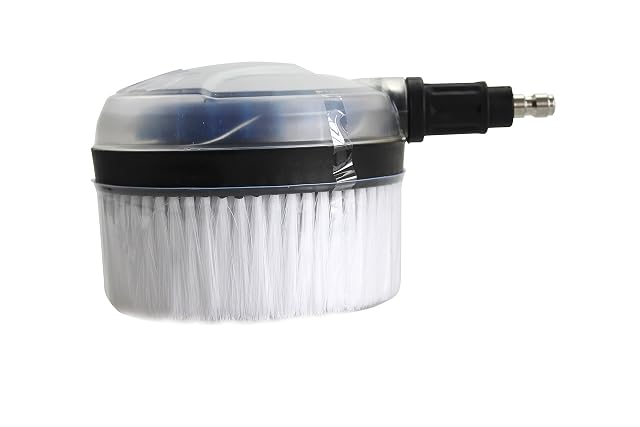
The rotary wash brush — the SPX-RB1 — is the body tool. Its own page on this shelf adds what this one leaves out: “Fine bristles scrub away stubborn residue”, “Pressure powered for maximum results with minimum effort”, and a surface list of “patio furniture, cars, windows, siding” plus “auto yard garden equipment”.
The wheel rim brush — the SPX-WB1 — has its own geometry for a reason. A flat spinning face cleans the front of an alloy wheel and nothing behind it, and the space between the spokes is where brake dust bakes on.
That is the one job most of this shelf does badly. The dedicated alternative is the WORX WA4042 at $22.79, which is built around it: “it may look fluffy, but this brush collapses down and really gets in there”, “Not only does this brush clean in-between the rims, but it’ll also polish the chrome.” The SPX-ACS-MAX includes a wheel brush too — “Connect to your pressure washer to remove tough road grime on tires”.
Two brushes rather than one is the right instinct, because a car really is two surfaces: large flat panels, and wheels full of gaps. What the SPX-ACS-MAX adds on top is the third — a non-rotating utility brush for sills, grilles and window reveals, where a spinning head cannot sit square — plus the cloth for drying, which matters because a car left to air-dry spots.
Soft bristles, which is right for the finish and not for the deposit
“Rotary and wheel rim brushes with soft bristles eliminate grime from rims, tires, siding, and glass.”
Soft is the correct choice, and it is more than this shelf usually says: the Kärcher at $32.65 names no bristle material at all, and neither does the TUHUT.
On a rim, soft is right because the risk is grit, not bristles. An alloy wheel is a painted or lacquered surface, brake dust is abrasive, and what scratches a wheel is the grit a brush carries across it. So rinse the wheel before you brush it, and rinse the brush between wheels.
What soft bristles will not do alone is shift baked-on brake dust, which is bonded rather than loose. That wants a detergent and dwell time — and the detergent shelf of this site is where that lives, with the one listing that publishes a method being Krud Kutter: “allow product to remain on the surface for 3–5 minutes to penetrate, then rinse clean.”
Which points straight at the gap in this page, below.
For context on hardness, WORX publishes the clearest statement on this shelf by selling the same body two ways at the same $44.99: the WA1820 soft, “without damaging paint or chrome”, and the WA1821 hard, whose own description warns you off — “though keep this brush away from the paint job, we have a softer brush for that.” Soft for anything with a finish; hard for brick, decking and an undercarriage. On a car kit, soft is the right call.
The others: the Kuuleyn at $27.39 and Hyuduo at $29.31 specify PP; the KUJOBUY at $27.99 “PVC filaments on the edge and chenille in the middle”, which is the most considered head here for paint; the SPX-RB1 “fine”; the SPX-ACS-MAX “feathered” for its utility brush.
The transfer adapter, and the one it is not
“Includes transfer adapter for simple connection to compatible pressure washers and quick tool swapping.”
On a two-brush kit that is the sensible arrangement: a single adapter stays on the wand while the heads change. A car wash alternates between body panels and wheels, and a fitting you have to unscrew each time is a fitting you stop using.
The other adapter on this shelf solves a bigger problem. The Kärcher at $32.65 “Includes adaptors for Karcher bayonet and threaded connections” on top of connecting “to wands with standard quick-connect fittings” — so it fits a Kärcher, which uses two proprietary families, and anything else. That is the most complete compatibility statement here.
What this page does not say is what the adapter adapts from or to. “Compatible pressure washers” and “SPX Series” is the whole of it: no 1/4 inch quick connect, no M22, no thread.
Worth checking before ordering, because the shelf divides four ways by fitting:
Universal 1/4 inch quick connect — the TUHUT at $15.99, Kuuleyn at $27.39, Hyuduo at $29.31, and the Kärcher, which goes further
Sun Joe SPX only — this and the SPX-RB1 at $25.99
Worx Hydroshot only — the WA1820 and WA1821 at $44.99, and the WA4042 at $22.79, which names its five models outright: “WG625, WG629, WG630, WG640, and WG644”
Garden hose, 1/2 inch — the KUJOBUY, which fits no washer at all
And note what the sibling kit does instead: the SPX-ACS-MAX publishes a PSI ceiling — “up to 3500-PSI” — and names no brand restriction, which is arguably more useful than an adapter plus a brand name.
Pressure powered, which is the appeal of the shelf
“Long-lasting construction with pressure-powered operation delivers strong cleaning with every pass.”
The mechanism is the whole point of the category. The water is already moving, and a turbine in the head converts some of that flow into rotation — nothing to charge, nothing to plug in, nothing to keep out of the water. Beside a car on a wet drive, that beats a cordless drill brush on convenience and on safety.
The others say the same: the SPX-RB1 “Pressure powered for maximum results with minimum effort”; the Kuuleyn and Hyuduo “without electricity”; the KUJOBUY “No Extra Electricity Needed”; the WORX WA4042 “water-powered”.
What it costs is control, and the figure that governs it is GPM, not PSI. Only the Kärcher publishes one — “4000 PSI / 4.0 GPM” — so on every other item here, including this, the spin speed is whatever your machine’s flow delivers.
And “long-lasting construction” is the claim with nothing behind it. No material, no warranty, no replaceable bristles. On a brush, the bristles are the wearing part, and nothing on this shelf addresses replacing them.
The underlying architecture is worth knowing, and only the WORX WA1821 explains it: “The outer, stationary bristles provide the first level of scrubbing, and then the rotating inner bristles do the hard work.” A static ring steadies the head while the center cuts — which is why these brushes hold a face square despite a coupler that, as the TUHUT admits, has “360 degree freedom”.
What is not published
No weight, the only item on this shelf without one. Everything else: TUHUT 200 g · Kärcher 340 g · Kuuleyn 403 g · Hyuduo 412 g · SPX-RB1,417 g · KUJOBUY 454 g · WORX ×3,454 g each · SPX-ACS-MAX 1089 g for five items. The catalog box here is 140 × 445 × 165 mm.
No brush diameters, where the SPX-ACS-MAX publishes 5.7 inches — the only diameter on this shelf — and the WORX WA1820 “6.5 inches long”.
No angle adjustment, where three listings have one: the WORX WA1820 and WA1821 with “dual articulating points” and a locking knob, and the SPX-ACS-MAX with a head adjustable 0° to 180°.
No pressure rating, where its own larger sibling publishes 3500 PSI and the Kärcher 4000 PSI / 4.0 GPM.
No wheel brush description beyond “soft”, and no statement of whether it reaches between spokes — which is the whole question on a wheel brush, and the thing the WORX WA4042 is explicit about.
No detergent function. Two listings on this shelf name it: the Kärcher — “The brush automatically dispenses soap from the pressure washer, making it even more convenient to clean with detergents” — and the TUHUT — “Ideal for dispensing pressure washer detergent.” A rotary brush is inherently a low-pressure attachment, which is the only condition under which a washer’s venturi will siphon soap: the detergent shelf of this site explains why, where the Sun Joe concentrate is the only one of eleven bottles to spell out the soap nozzle requirement. On a Sun Joe car kit, soap through the brush is the obvious thing to claim, and brake dust is the deposit that most needs it.
No cloth, where the SPX-ACS-MAX includes a 16” × 16” washable microfibre one.
No undercarriage tool, where the SPX-ACS-MAX includes a turbo nozzle on a 20 inch rod with a 90° head, and the WORX WA1821 offers hard bristles for the same job.
No warranty.
Availability
Read on the day this page was built: $55 at the American Amazon shop.
Read from Keepa on the day this page was last revised; stock and price both move without notice.
Prices quoted in this text were read on 2026-10-05. The live price is at the top of the page.