What the maker puts in writing
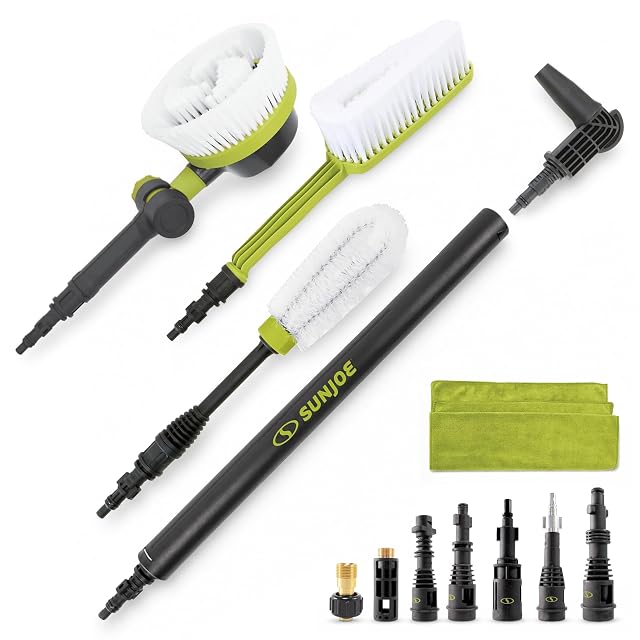
- “[ROTARY WASH BRUSH]: 5.7” diameter brush with 0° to 180° adjustable head spins away gunk + grime”
- “[UTILITY BRISTLE BRUSH]: Durable, feathered bristles provide gentle scrubbing action”
- “[WHEEL + RIM BRUSH]: Connect to your pressure washer to remove tough road grime on tires”
- “[TURBO NOZZLE + 20” ROD]: Extension rod + 90° angled nozzle are perfect for cleaning under cars and other hard-to-reach areas”
- “[MICROFIBER CLOTH]: 16” x 16” washable, reusable cloth”
- Title: “for Pressure Washers up to 3500-PSI” · Reference SPX-ACS-MAX · Catalog: 1089 g (38.4 oz), 592 × 132 × 175 mm (23.3 × 5.20 × 6.89 in)
The pricing on this shelf is the wrong way round, and it is worth setting out plainly.
this — $49.97, five items: a 5.7 inch rotary brush with a 0° to 180° adjustable head · a feathered utility brush · a wheel and rim brush · a turbo nozzle with a 20 inch rod and a 90° angled head · a 16” × 16” microfibre cloth. Rated to 3500 PSI.
Sun Joe SPX-CCK — $54.97, three items: the SPX-RB1 rotary brush, the SPX-WB1 wheel rim brush, and a transfer adapter.
And the SPX-RB1 sells alone on this shelf for $25.99.
So the smaller kit costs five dollars more for two brushes and an adapter. On the published information there is no case for the SPX-CCK.
The one thing it has that this does not is the transfer adapter and an explicit “all SPX series” compatibility line; this page gives a PSI ceiling instead and names no brand restriction — which, if anything, is the more useful of the two.
And if you want one brush rather than a kit, the SPX-RB1 at $25.99 is the cheapest way in.
“5.7” diameter” and “0° to 180° adjustable head”.
The diameter is the only one on this shelf. It is the figure that decides how many passes a panel takes, and five and a half inches is a sensible size — large enough to cover a car door quickly, small enough to follow a curved wing. The only comparable figures anywhere here are the WORX WA1820’s “the attachment is 6.5 inches long” and the Kuuleyn’s overall “22.5 x 11.5 x 15cm / 8.9 x 4.5 x 5.9in”, which is correctly converted.
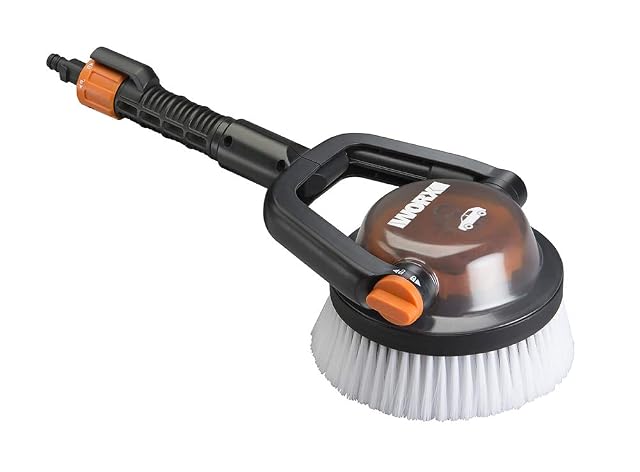
The angle range is one of two. The WORX WA1820 and WA1821 at $44.99 have “dual articulating points on the side”, and the WA1820 adds a knob that locks the angle. Nothing else on this shelf adjusts at all.
Why that matters is the limitation only the TUHUT at $15.99 is candid enough to publish: a quick-connect coupler gives a brush “360 degree freedom”, so a flat head rolls off square under its own weight. An adjustable head meets a roof or a bonnet flat from a standing position, which is where most of a car wash happens.
The page does not say whether the 180° adjustment locks, which the WORX knob does.
And the PSI ceiling is one of two on the shelf. “For Pressure Washers up to 3500-PSI” — against the Kärcher’s “up to 4000 PSI / 4.0 GPM”, which is the only listing here to publish a flow figure as well. Nine of eleven items publish neither, and a plastic head on a high-pressure gun is a reasonable thing to want a limit for.
Three brushes, three jobs
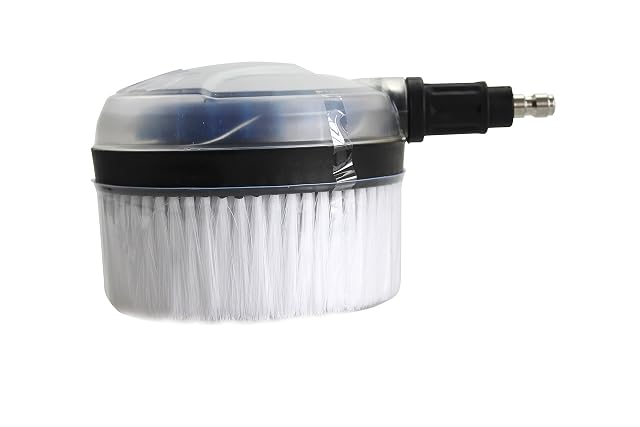
The rotary wash brush is the body tool: a spinning 5.7-inch face for doors, wings, bonnet and roof. The agitation does what pressure would otherwise have to, which on paint is the whole point — a rotary brush lets you clean at lower pressure.
The utility bristle brush — “feathered bristles provide gentle scrubbing action” — is the hand brush for the places a spinning head cannot sit square: a sill, a window reveal, a grille, the step of a pickup. Nothing else on this shelf includes a non-rotating brush, and it is the one that does the fiddly third of the job.
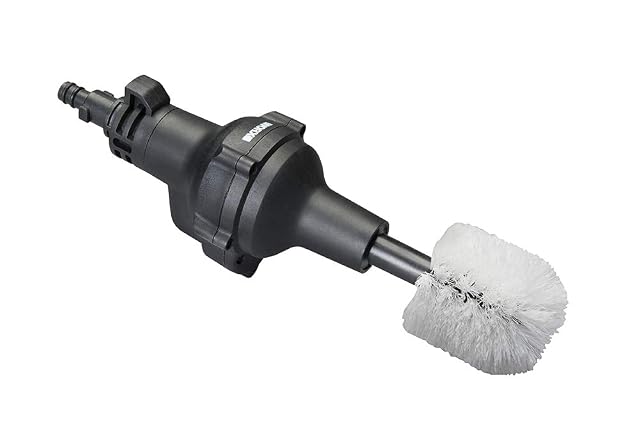
The wheel and rim brush has its own geometry for a reason. A flat face cleans the front of an alloy wheel and nothing behind it, and the space between spokes is where brake dust bakes on. The WORX WA4042 at $22.79 is the dedicated version — “it may look fluffy, but this brush collapses down”, built to “clean in-between the rims” and to “polish the chrome”.
And the 16” × 16” microfibre cloth is the only drying tool on this shelf, which is a better inclusion than it sounds: a car left to air-dry spots, especially in sun, and the last five minutes of a wash determine what it looks like. Washable and reusable, so it is not a consumable.
What none of the three publishes is a bristle material. “Feathered” and “durable” are the whole of it for the utility brush, and nothing at all for the rotary or the wheel brush.
Which matters because WORX publishes the clearest statement on this shelf, by selling the same body in two hardnesses at the same $44.99: the WA1820 soft, “without damaging paint or chrome”, and the WA1821 hard, whose own description warns you off — “though keep this brush away from the paint job, we have a softer brush for that.” On a kit sold for cars, soft is the necessary assumption, and the page should say so. Elsewhere: the Kuuleyn and Hyuduo specify PP, the KUJOBUY “PVC filaments on the edge and chenille in the middle”, the SPX-RB1 “fine”, the SPX-CCK “soft”.
The caution that applies to every soft brush here: the risk is grit, not bristles. Rinse the panel before you brush it, and rinse the brush when you move from a wheel arch to a door.
“Extension rod + 90° angled nozzle are perfect for cleaning under cars and other hard-to-reach areas.”
An undercarriage is a surface you cannot see and cannot reach, where road salt and baked grime do the damage that eventually matters.
A straight lance sprays past it. A 90° head on 20 inches of rod puts the jet upward from beside the car, so you work along a sill without lying on the ground.
The WORX WA1821 attacks the same job the other way, with hard bristles — and warns in the same breath that the brush must be kept off the paintwork.
The two approaches are genuinely different, and the difference is worth stating. A hard brush agitates at low pressure and is safe on a chassis. A turbo nozzle is a 0° jet spun in a circle — the most aggressive thing in this whole category, which keeps the impact of a pencil jet while covering the area of a fan.
On a chassis that is fine. Keep it off the paint, the trim and anything plastic. The AURORA CAR turbo nozzle on the lance shelf of this site names “stripping paint from wood exterior” among its uses, which tells you what a rotary jet does to a surface.
No caution to that effect appears on this page, and on a kit whose other four items are gentle, that is the omission that could cost you a bumper.
One more thing the lance shelf supplies that this page does not: a turbo nozzle’s orifice size must match your machine’s flow, or the pressure collapses. The AURORA CAR publishes “4.0 Orifice, 4.0 GPM”; nothing is published here.
One thousand and eighty-nine grams for the kit
1089 g for five items, in a 592 × 132 × 175 mm box.
The single brushes on this shelf: TUHUT 200 g (7.1 oz) · Kärcher 340 g (12 oz) · Kuuleyn 403 g (14.2 oz) · Hyuduo 412 g (14.5 oz) · SPX-RB1,417 g (14.7 oz) · KUJOBUY 454 g (16 oz) · WORX WA1820, WA1821, WA4042,454 g (16 oz) each
So the whole kit weighs about what two and a half single brushes do, which is a reasonable accounting for a rotary brush, a utility brush, a wheel brush, a rod and a cloth.
The 592 mm box is the clue to the rod, which at 20 inches is 508 mm — so it ships in one piece.
What is not published
No fitting specification. The title gives a PSI ceiling and no connection type: no 1/4 inch quick connect, no M22, no “SPX series” restriction. Which is odd in both directions — the SPX-RB1 and SPX-CCK both say “all SPX series”, so Sun Joe does restrict elsewhere, and this page leaves it open. Check the fitting before ordering, because three of eleven items on this shelf fit one brand only: the WORX trio needs a Hydroshot (the WA4042 naming “WG625, WG629, WG630, WG640, and WG644”), and the two other Sun Joe kits need an SPX. The Kärcher at $32.65 is the one that publishes the complete answer — universal quick-connect plus adaptors for its own bayonet and threaded fittings.
No bristle material for any of the three brushes, as above.
No turbo nozzle orifice or GPM, as above.
No paint caution for the turbo nozzle, as above — the most consequential omission on the page.
No statement of whether the 180° head locks.
No detergent function, which two listings here name: the Kärcher — “The brush automatically dispenses soap from the pressure washer” — and the TUHUT — “Ideal for dispensing pressure washer detergent.” A rotary brush is a low-pressure attachment, which is exactly the condition a washer needs in order to siphon soap; the detergent shelf of this site explains why, where the Sun Joe concentrate is the only one of eleven bottles to spell out the soap nozzle requirement. On a car-wash kit from the same brand, soap through the brush is the obvious feature to claim.
No wheel brush dimensions, and no statement of whether it reaches between spokes — which is the whole question on a wheel brush.
No warranty.
Availability
Read on the day this page was built: $50 at the American Amazon shop.
Read from Keepa on the day this page was last revised; stock and price both move without notice.
Prices quoted in this text were read on 2026-10-05. The live price is at the top of the page.