What the maker puts in writing
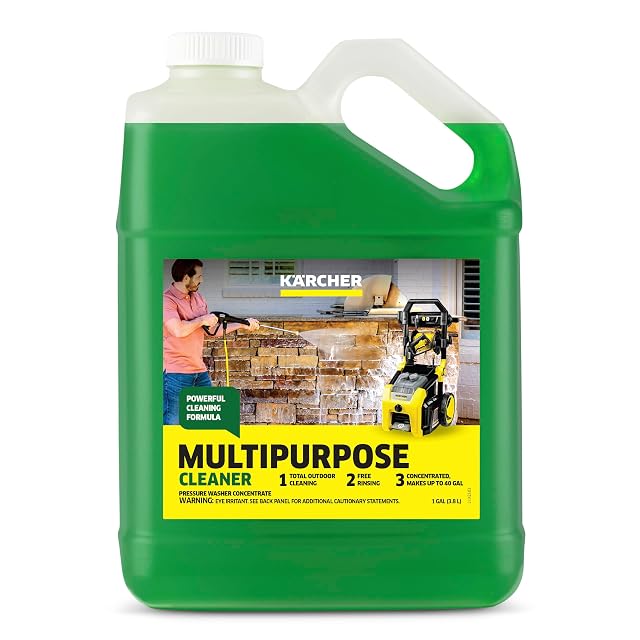
- “The Karcher Promise - Cleaner. Quicker: Karcher’s Multi-Purpose Pressure Washer Soap is perfect for cleaning concrete, pavement, driveways, patios, decks, sidewalks, RVs, cars, boats, homes, fencing, and more”
- “Highly Concentrated: Make up to 40 gallons of detergent from a single gallon”
- “Universal Compatibility: Formulated to work in tandem with your pressure washer, and compatible with most consumer gas & electric power pressure washers”
- “Check label for instructions: Suitable for pressure washer or foam cannon application, as well as manual use”
- “Made in the USA of domestic and imported materials”
- Description: “makes up to 20 gallons of ready to use detergent – you control the amount of dilution” · “compatible with all Karcher Home & Garden pressure washers, as well as consumer pressure washers made by other brands”
- Reference 9.558-144.0 · Catalog: 3742 g (132 oz)
Forty gallons, or twenty — again
Bullet three: “up to 40 gallons from a single gallon.”
Description: “makes up to 20 gallons of ready to use detergent – you control the amount of dilution.”
At $18.99 that is 47 cents a gallon of solution on the first figure and 95 cents on the second.
And the Kärcher Vehicle Wash & Wax at $14.39 on this same shelf does exactly the same thing: 40 in the bullet, 20 in the description. Same brand, same discrepancy, both products — which reads as a house style rather than a slip.
The description is the more cautious of the two and carries the honest qualifier, “you control the amount of dilution”. So 20 gallons is the figure to plan with.
The shelf, each at its own best published number:
Simpson Heavy Duty — 5.4¢ · Simpson Green Formula — 5.9¢ · Simpson Multi-Purpose — 7.6¢ · Kärcher Vehicle — 36¢ · this — 47¢ · Zep — 58¢ if its 26 gallons is per bottle, $2.31 if for the case · Krud Kutter — 80¢ · Briggs 1-gallon — $1.24 · Briggs 32 oz — $3.56 · Sun Joe and Simple Green — not calculable in gallons
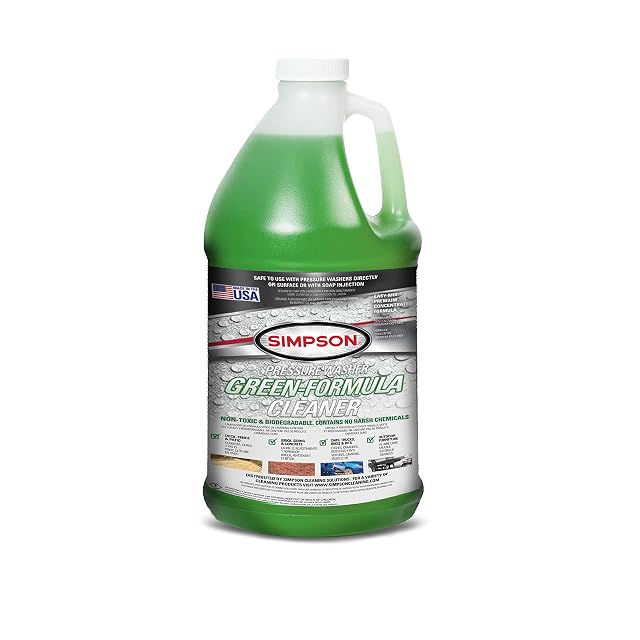
The three Simpsons are the outliers, and their claim is the only one here that verifies from its own figures: a US gallon is 128 fluid ounces, and half an ounce goes into it 256 times.
Four listings on this shelf publish two ratios for themselves — these two Kärchers, Krud Kutter (20 then 11) and Zep (26 on a case of four, per bottle or per case unstated). Sun Joe publishes none.
Eleven surfaces, which is why it costs more than its own sibling
“perfect for cleaning concrete, pavement, driveways, patios, decks, sidewalks, RVs, cars, boats, homes, fencing, and more.”
That is the difference between the two Kärcher bottles, and it is the only difference.
The Vehicle Wash & Wax at $14.39 names “car, truck, SUV, motorcycle”, calls itself a gentle soap and leaves a wax film. This covers the masonry and the vehicles.
Everything else on the two pages is shared word for word: the same universal-compatibility bullet, the same 40-and-20 contradiction, the same “pressure washer or foam cannon application, as well as manual use”, the same “Made in the USA of domestic and imported materials”, and the same catalog weight of 3742 g (132 oz).
So the reading is simple. If the job is a car, the cheaper bottle is gentler, waxes, and costs $4.60 less. If the job is a driveway and a deck as well, this is the one.
And if cost per gallon is what decides, the Simpson Green Formula at $15.18 names “vehicles, siding, decking, lawn furniture, garage floors, sidewalks, driveways”, adds non-toxic and biodegradable and non-butyl, and works out at 5.9 cents a gallon.
The surface lists across the shelf, for comparison: Krud Kutter names fifteen, including roofing shingles, gutters, pool areas and boat engines; Zep names thirteen; Simple Green names five plus composite; Sun Joe names five; both Briggs bottles name “siding, patios and more”; the Simpson Heavy Duty names no domestic surface at all.
The foam cannon, named here and almost nowhere else
“Suitable for pressure washer or foam cannon application, as well as manual use.”
Only this and its Kärcher stablemate say it.
A foam cannon is a bottle-and-venturi attachment that mixes soap with air and water and lays down thick clinging foam. The point is dwell time on a vertical surface: foam stays on siding or a car door where liquid runs straight off, so the detergent has time to work before the rinse.
For that to happen, the soap has to foam and hold. A thin degreaser will not — so naming a foam cannon is a genuine statement about the formulation, even though no chemistry is declared anywhere on the page.
It also sidesteps the commonest failure in this category. A foam cannon fits on the lance and feeds from its own reservoir, so it never touches the machine’s detergent siphon.
Which is the problem the Sun Joe at $25.97 is alone in explaining: “this power-washing detergent may require the use of a soap nozzle. Other models may need to use a soap-sprayer attachment.” A pressure washer will not draw detergent through a high-pressure tip — the siphon is a venturi and only pulls at low pressure, which is exactly what the wide black soap nozzle on the lance shelf of this site exists for. Fit a 25° green tip and nothing comes through, and most people blame the soap.
Manual use is the third route, and it matters practically: a detergent you can brush on reaches what a washer cannot. At least nine of the thirteen items here offer it; the two Briggs & Stratton bottles do not.
Made by the people who make the machines
“Formulated to work in tandem with your pressure washer”, and “compatible with all Karcher Home & Garden pressure washers, as well as consumer pressure washers made by other brands.”
Kärcher makes pressure washers, and that is a claim a chemical company cannot make.
What it ought to mean, and this is worth spelling out because one listing here does. When you use a washer’s detergent function, the soap is siphoned through the pump and the hose on its way out. A domestic pump contains aluminum castings, brass fittings, steel valves and rubber seals, and a strongly alkaline or chlorinated cleaner standing in that circuit between jobs attacks aluminum in particular.
So a company that makes the pump has a reason to formulate for it. Kärcher claims the intent and not the chemistry.
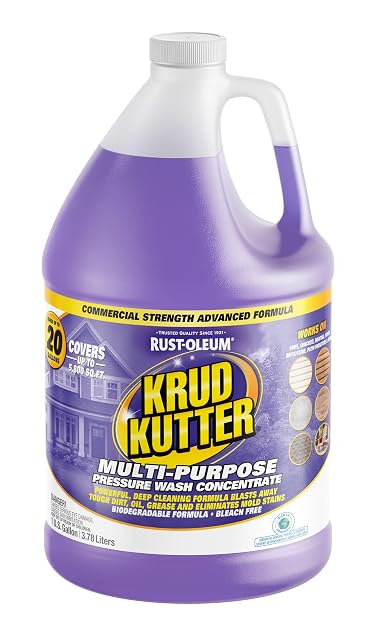
The one bottle on this shelf that puts it in writing is Krud Kutter at $15.98 — which is not from a machine maker: “the water-based formula contains anti-corrosive agents to help safeguard pressure washer components.”
At least seven of the thirteen items here come from machine manufacturers: these two Kärchers, three Simpsons, two Briggs & Stratton and the Sun Joe. Only Krud Kutter mentions the pump.
The habit that protects it whatever you buy: run clear water through the detergent circuit for a minute at the end of a job. That flushes the siphon line and leaves nothing standing.
“Made in the USA of domestic and imported materials” is an origin statement with its own qualifier built in — the same phrasing appears on the Flexzilla hose on this site’s pressure-hose shelf. It is not a warranty and not a certification.
Cleaner, quicker — and what the description actually claims
“Reduce the amount of time it takes to clean decks, driveways, sidewalks, home siding, patio furniture, fences and more, and clean more thoroughly to boot!”
That is the right claim for a detergent and worth stating plainly, because it is not the claim the machine makes.
A pressure washer removes dirt by force. A detergent removes it by chemistry, and the two are not interchangeable. Soap lets you clean a surface at lower pressure, which on cedar decking, painted siding and older mortar is the difference between cleaning it and eroding it.
So “cleaner, quicker” understates the case: the real benefit is often gentler.
What the page does not give is the thing that makes the chemistry work. Krud Kutter is the only listing on this shelf that publishes a method: “allow product to remain on the surface for 3–5 minutes to penetrate”, “work in small sections”, “rinse thoroughly without allowing it to dry on the surface.” Briggs & Stratton gives the other half: “apply detergent to the dry surface then switch to a high pressure spray tip to rinse.”
Borrow both. Dry surface, low-pressure soap tip, one small section, wait three to five minutes, change the tip, rinse before it dries. “Check label for instructions” is the whole of the direction offered here.
What is not published
No chemistry. Not bleach-free, not biodegradable, not non-butyl, not peroxide. Six listings on this shelf declare something about what is in the bottle; both Kärchers declare nothing.
No dwell time, as above.
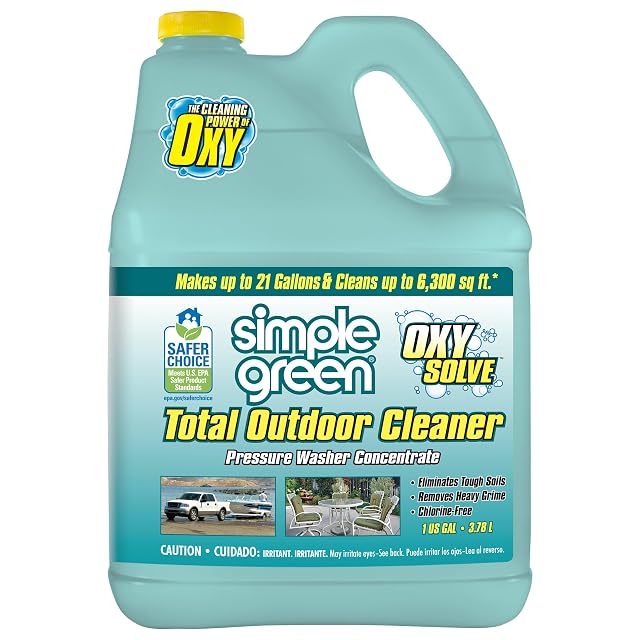
No surface coverage. Two listings publish square footage: Krud Kutter 5,800 sq ft at $15.98 — about 0.276 cents a square foot — and Simple Green 6,400 sq ft at $23.99, about 0.375 cents. On a concentrate whose own dilution figure is published two ways, coverage would be the more useful number.
No dilution guidance by surface or by method. “You control the amount of dilution” is true and unhelpful: a foam cannon, a siphon and a bucket all want different strengths, and eleven surfaces want more than one answer.
No mold or algae claim, where Zep leads with “algae, mold and mildew”, Simple Green brings peroxide to it, and both Briggs bottles claim mold stains. Worth knowing, since “homes” and “fencing” are exactly where organic growth lives.
No anti-corrosive claim, as above.
No certification. Simple Green carries EPA Safer Choice in its title, the only third-party program on this shelf; the Simpson Green Formula claims to meet “OSHA, USDA, EPA, DNR” requirements with no standard cited.
No steam cleaner or automatic scrubber use, which all three Simpsons claim.
Availability
Read on the day this page was built: $19 at the American Amazon shop.
Read from Keepa on the day this page was last revised; stock and price both move without notice.
Prices quoted in this text were read on 2026-10-05. The live price is at the top of the page.