What the maker puts in writing
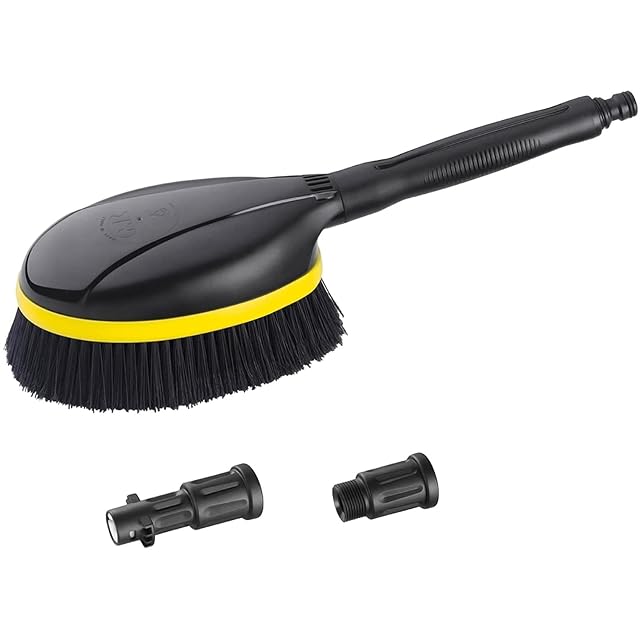
- “Universal Compatibility: Compatible with most Karcher & most non-Karcher gas power pressure washers rated up to 4000 PSI/4.0 GPM; Easily connects to wands with standard quick-connect fittings”
- “The brush automatically dispenses soap from the pressure washer, making it even more convenient to clean with detergents; Incoming water causes inner brushes to rotate”
- “Multi-Surface Cleaner: Perfect for cleaning RVs, cars, boats, patio furniture, and more”
- “Included adapters: Includes adaptors for Karcher bayonet and threaded connections”
- Description: “Reduce the time & effort required to loosen bugs, mud & other debris from vehicles, patio furniture & more” · “Includes adapters to work with Archer electric pressure washers & gas pressure washers, as well as other major brands of pressure washers with quick connect fittings”
- Reference 8.923-682.0 · Catalog: 340 g (12 oz), 406 × 89 × 127 mm (16 × 3.50 × 5 in)
Two numbers nobody else publishes
“rated up to 4000 PSI / 4.0 GPM.”
One is a ceiling and the other is a driver, and this is the only listing on this shelf to give either.
The PSI is the limit the brush survives. A plastic head on a gun has one, and at least nine of the fourteen items here publish nothing — the only other figure on the shelf is the Sun Joe SPX-ACS-MAX at “up to 3500-PSI”. Domestic electric washers rarely exceed 2000 PSI, so 4000 is headroom rather than a requirement.
The GPM is what makes the brush spin. Every brush here is driven by a turbine in the head converting water flow into rotation — so a high-pressure, low-flow machine spins one of these more slowly than a lower-pressure machine with more flow.
4.0 GPM is a generous ceiling. A petrol washer sits near 3 to 4 GPM; a domestic electric under 2. And this is the figure the rest of the shelf leaves you to guess at — which matters, because a brush that barely turns is a brush you end up pushing by hand.
The WORX trio is honest about the other end of the range: those fit the Hydroshot, a battery washer, and the WA1820 description calls the drive “a low-pressure water flow” making the brush “spin at a moderate speed”.
The adaptors, which solve a problem Kärcher created
“Includes adaptors for Karcher bayonet and threaded connections.”
Kärcher’s own machines come in more than one fitting family — a bayonet collar on its electric range and a threaded connection elsewhere — and neither is a standard 1/4 inch quick-connect. So a universal brush would not fit a Kärcher without help, and this ships the help.
The result is the most complete compatibility statement on this shelf: it attaches to wands with standard quick-connect, to Kärcher bayonet, and to Kärcher threaded — with the description adding “as well as other major brands of pressure washers with quick connect fittings.”
The rest of the shelf, by fitting:
Universal 1/4 inch quick connect — the TUHUT at $15.99, the Kuuleyn at $27.39, the Hyuduo at $29.31, and this, which goes further
Worx Hydroshot only — the WA1820 and WA1821 at $44.99, and the WA4042 at $22.79, which names its five models outright: “WG625, WG629, WG630, WG640, and WG644”
Sun Joe SPX only — the SPX-RB1 at $25.99 and the SPX-CCK at $54.97, the latter including a “transfer adapter”
Garden hose, 1/2 inch — the KUJOBUY at $27.99, which fits no washer at all
So three of eleven items on this shelf fit one brand only, and a fourth fits no machine. This is the one built to fit whatever you own.
One typo worth noting for clarity: the description says “adapters to work with Archer electric pressure washers”, which is plainly Kärcher.
Soap from the machine, with no nozzle change
“The brush automatically dispenses soap from the pressure washer, making it even more convenient to clean with detergents.”
The mechanism is worth setting out, because it connects this shelf to the detergent shelf of this site.
A washer draws soap by venturi — water rushing past a port creates suction — and a venturi only pulls at low pressure. Fit a high-pressure tip and the suction collapses and nothing comes through.
That is why those detergent listings specify the wide black soap nozzle at around 65°. The Sun Joe concentrate there is the only one of eleven bottles to explain it — “may require the use of a soap nozzle. Other models may need to use a soap-sprayer attachment” — and the Briggs & Stratton pages give the other half: “apply detergent to the dry surface then switch to a high pressure spray tip to rinse.”
A rotary brush is inherently low pressure, because it is a plastic head held against paint. So it siphons soap for free, with no nozzle to change.
The sequence: detergent in the machine’s tank, brush on the wand, scrub with soap coming through the bristles, then swap the brush for a 25° or 40° tip to rinse.
Only this and the TUHUT name the function on this shelf. The KUJOBUY carries its own reservoir with a 3-gear foam knob, because with a garden hose there is no siphon to borrow.
Bugs and mud, which is the specific claim
“Reduce the time & effort required to loosen bugs, mud & other debris from vehicles, patio furniture & more.”
Both soils are well chosen, and neither yields to pressure alone.
Insect residue is protein bonded to paint by heat, and blasting a grille harder does not shift it — it needs soaking and agitation, which is precisely a soft rotary brush with detergent coming through it. The WORX WA1820 names the same job: “They’re great at getting bugs out of the grill or off the windshield.”
Dried mud sits in texture, and a jet skates across it. A brush gets into the grain of a plastic bumper or a patio chair.
The surfaces are the shelf’s standard set — “RVs, cars, boats, patio furniture” — and RVs is the one that most justifies a rotary brush: a large flat-sided vehicle is where the labor saving is real, and where washing by hand means a ladder.
Three hundred and forty grams
The second lightest item on this shelf.
TUHUT — 200 g · this — 340 g · Kuuleyn — 403 g · Hyuduo — 412 g · Sun Joe SPX-RB1 — 417 g · WORX WA1820, WA1821, WA4042 — 454 g each · KUJOBUY — 454 g · Sun Joe SPX-ACS-MAX — 1089 g for five items
Light is good at the end of a lance, where the mass sits a meter or more from your wrists — and more so on an RV, where you are working above shoulder height.
The catalog box is 406 × 89 × 127 mm (16 × 3.50 × 5 in), which is the carton. No brush diameter is published, which is the dimension that decides how many passes a panel takes: only the Sun Joe SPX-ACS-MAX gives one, at 5.7 inches, and the Kuuleyn publishes an overall size of “22.5 x 11.5 x 15cm (8.9 × 4.5 × 5.9 in) / 8.9 x 4.5 x 5.9in”, correctly converted.
Genuine Kärcher, and what that is worth here
“Genuine Karcher Accessory.”
On this shelf that mostly means the two things above — a published rating and the adaptors — plus a real part number, 8.923-682.0, which is something you can quote.
Three listings here have no usable reference at all: the Kuuleyn carries Kuuleyn9wi3pmkzgf865 and the Hyuduo Hyuduoh96g5rne73 — a brand name plus a random string — and the TUHUT carries 01. The KUJOBUY carries KB. On a tool with a wearing head, that is the difference between being able to order a replacement and not.
The other manufacturer-brand items here are the WORX trio and the three Sun Joe kits, all of which carry proper codes and all of which are closed to their own machines.
“Cleaner. Quicker” is Kärcher’s house line, and it appears on its detergent bottles on the neighboring shelf too. What it understates on a brush is the real benefit: a rotary brush lets you clean at lower pressure, which on a painted panel, a boat hull or a plastic RV skirt is the difference between cleaning it and marking it.
What is not published
No bristle material and no hardness, which on a brush sold for “RVs, cars, boats” is the specification that matters most. The Kuuleyn and Hyuduo both specify PP — polypropylene, “soft and does not hurt the surface”; the KUJOBUY “PVC filaments on the edge and chenille in the middle”; the Sun Joe SPX-RB1 “fine”, the SPX-CCK “soft”, the SPX-ACS-MAX “feathered”; the WORX WA4042 “soft”.
And WORX publishes the clearest version of this trade on the shelf, by selling the same body two ways at the same $44.99: the WA1820 soft, “without damaging paint or chrome”, and the WA1821 hard, whose own description warns you off — “though keep this brush away from the paint job, we have a softer brush for that.” Given what this page is for, soft is the safe assumption, and the page should say so.
No angle adjustment. Three listings have one: the WORX WA1820 and WA1821 with “dual articulating points on the side” and, on the WA1820, a knob that locks it; and the SPX-ACS-MAX, adjustable 0° to 180°. Which matters because of the limitation only the TUHUT is candid enough to publish: a quick-connect coupler gives a brush “360 degree freedom”, so a free head rolls off square under its own weight. The outer static ring is what holds it — the WORX WA1821 is the only listing to explain that architecture: “The outer, stationary bristles provide the first level of scrubbing, and then the rotating inner bristles do the hard work.”
No brush diameter, as above.
No replacement head or part number for one, despite having a part number for the brush.
No wheel or rim tool, where the WORX WA4042 at $22.79 is built for it and two Sun Joe kits include one.
No warranty.
Availability
Read on the day this page was built: $33 at the American Amazon shop.
Read from Keepa on the day this page was last revised; stock and price both move without notice.
Prices quoted in this text were read on 2026-10-05. The live price is at the top of the page.