What the maker puts in writing
- “NO SCRUBBING REQUIRED: Apply with a pressure washer, allow product to remain on the surface for 3–5 minutes to penetrate, then rinse clean”
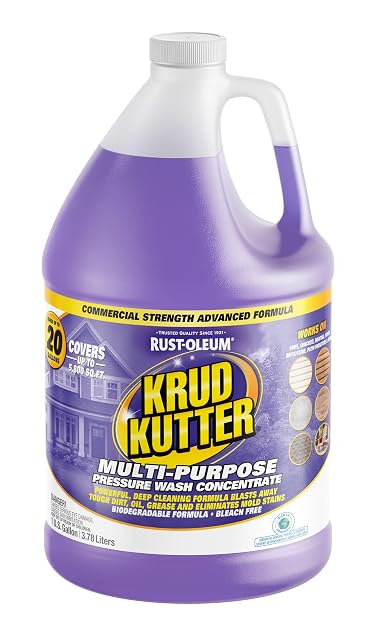
- “COMMERCIAL STRENGTH ADVANCED FORMULA: Penetrates and removes tough dirt, oil, grease, bird droppings, tree sap, and more”
- “EFFICIENT COVERAGE & DILUTION: One gallon makes up to 20 gallons of solution and cleans up to 5,800 square feet”
- “WIDE SURFACE COMPATIBILITY: Ideal for wood, vinyl, and aluminum siding; roofing shingles, gutters, stucco, brick, masonry, concrete, decks, walkways, pool areas, patio furniture, RVs, boats, engines, equipment, and more”
- “BLEACH FREE FORMULA: Fast-acting, biodegrabable formula”
- Description: “One gallon makes up to 11 gallons of solution” · “The water-based formula contains anti-corrosive agents to help safeguard pressure washer components” · “work in small sections, allow the product to penetrate for 3–5 minutes, and rinse thoroughly without allowing it to dry on the surface”
- Reference 385462 · Catalog: 3856 g (136 oz)
Three to five minutes, which is the only method on this shelf
“Apply with a pressure washer, allow product to remain on the surface for 3–5 minutes to penetrate, then rinse clean.”
And the description adds the two instructions that complete it: “work in small sections”, and “rinse thoroughly without allowing it to dry on the surface.”
All three matter, and no other listing here gives any of them.
Contact time is how a chemical cleaner works. It has to soften and lift the soil, and that takes minutes. The commonest mistake in pressure washing is to spray soap on and immediately blast it off — which cleans with the water alone and wastes the detergent entirely.
Small sections exist because of the third instruction. A gallon of soap spread across a whole wall will dry at one end before you reach the other.
And dried detergent is worse than the dirt. It leaves a film that then needs removing in its own right, and on glass or paint it can mark.
The one other piece of method on this shelf is the Briggs & Stratton half: “apply detergent to the dry surface then switch to a high pressure spray tip to rinse.”
Put the two together and you have the whole technique: dry surface, low-pressure soap tip, one small section, wait three to five minutes, change the tip, rinse before it dries.
Which is also what makes the bullet heading honest. “NO SCRUBBING REQUIRED” is a claim about chemistry doing the work — and it is only true if you give it the five minutes.
It protects the pump, which nothing else here mentions
“The water-based formula contains anti-corrosive agents to help safeguard pressure washer components.”
No other listing on this shelf mentions the machine at all.
Here is why it is a real consideration. When you use a washer’s detergent function, the soap is siphoned through the pump and the hose on its way out — it does not bypass them. A domestic pump contains aluminum castings, brass fittings, steel valves and rubber seals, and a strongly alkaline or chlorinated cleaner standing in that circuit between jobs attacks aluminum in particular.
Which is why the bleach free claim in bullet five belongs with this one: bleach is the ingredient most hostile to a pump.
The closest anything else comes is Kärcher, whose two bottles say “formulated to work in tandem with your pressure washer” — the same consideration without the chemistry, from a company that does make the machines.
The habit the page does not mention, and which is worth adopting whatever soap you use: run clear water through the detergent circuit for a minute at the end of a job. That flushes the siphon line and leaves nothing standing in the pump.
Twenty gallons, or eleven
Bullet four: “makes up to 20 gallons of solution and cleans up to 5,800 square feet.”
Description: “makes up to 11 gallons of solution and can clean up to 5,800 square feet.”
The square footage is identical in both, and that is the clue. If the coverage is fixed at 5,800 sq ft either way, then 11 gallons is the working dilution and 20 is the stretch — because covering the same area with less solution means a stronger mix.
At $15.98 that is 80 cents a gallon of solution on the first figure and $1.45 on the second.
Four listings on this shelf publish two ratios for themselves: both Kärchers say 40 gallons in a bullet and 20 in the description, and Zep says 26 on a case of four without saying per bottle or per case. Sun Joe publishes none at all.
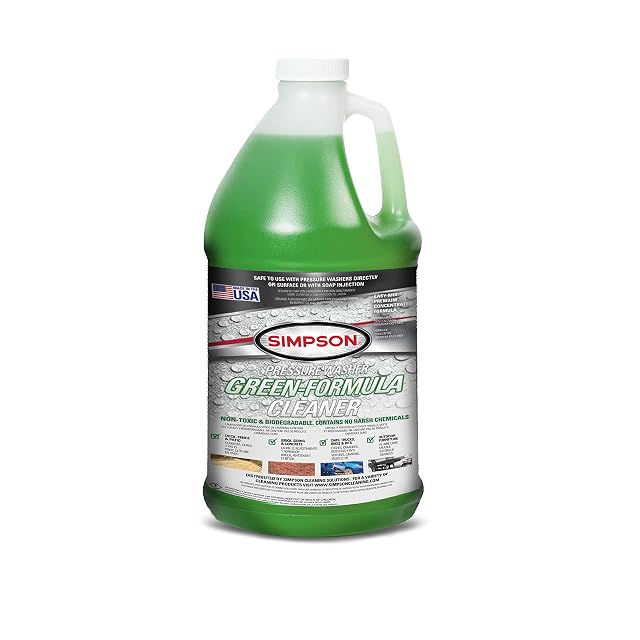
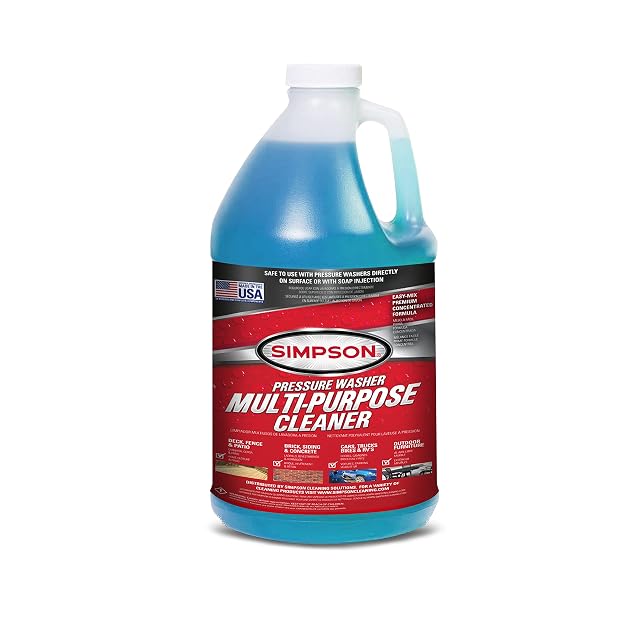
The one shelf-mate that does not contradict itself is Simpson, whose 256:1 verifies exactly — a US gallon is 128 fluid ounces, and half an ounce goes into it 256 times — putting its three bottles at 5.4 to 7.6 cents a gallon.
So this is roughly fifteen times the cost per gallon of a Simpson. The two reasons to pay it are the method above and the pump protection — and the coverage figure below, which is a fairer basis for comparison anyway.
Five thousand eight hundred square feet, which is the better metric
$15.98 for 5,800 sq ft = about 0.276 cents a square foot.
Only two listings on this shelf publish coverage, and this is the cheaper:
this — 5,800 sq ft at $15.98 = 0.276¢/sq ft
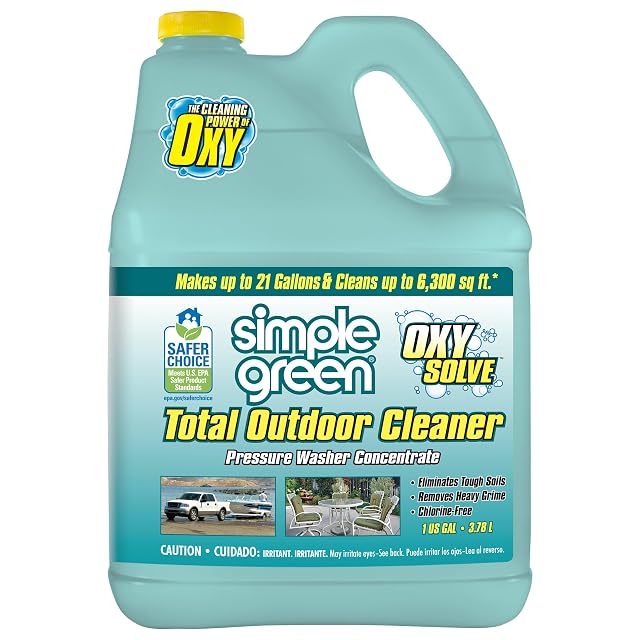
Simple Green — 6,400 sq ft at $23.99 = 0.375¢/sq ft
Coverage is the more meaningful figure than dilution, because it bakes in the strength you actually need. A concentrate rated at 256:1 sounds cheaper per gallon of solution, but if you need three passes to shift tree sap you have not saved anything.
Which makes this and Simple Green the two listings here you can compare properly — and this one is 26 per cent cheaper per square foot, over a far longer list of surfaces.
5,800 sq ft in context: a typical two-story house has perhaps 1,500 to 2,500 sq ft of siding, so one bottle is two or three whole-house washes.
Bird droppings and tree sap, which is the specific claim
“Penetrates and removes tough dirt, oil, grease, bird droppings, tree sap, and more.”
Those last two are worth noticing, because they are the soils nothing else on this shelf names.
Tree sap is a resin. It does not dissolve in water at any pressure, which is why a washer alone will not shift it — you need a solvent or a surfactant that will wet it, and five minutes of dwell to do so.
Bird droppings are a mix of uric acid and grit, and the grit is the problem: blasting them off a car or a deck drags the abrasive across the surface. Softening first is the right order of operations.
So the two named soils are exactly the two that require the dwell time the page publishes. The claims are coherent with each other, which on this shelf is not a given.
The surface list is the longest here, at fifteen items: “wood, vinyl, and aluminum siding; roofing shingles, gutters, stucco, brick, masonry, concrete, decks, walkways, pool areas, patio furniture, RVs, boats, engines, equipment.”
Roofing shingles and gutters are the unusual entries, and they fit the chemistry — organic growth and grit on a roof is the job that most needs soaking rather than pressure, because shingles will not take a jet.
Pool areas is the other notable one, since a bleach free formula is the right choice near water that is already chlorinated.
How the shelf divides on soil: the three Simpsons are non-butyl degreasers for oil and grease; Zep leads on “algae, mold and mildew”; Simple Green brings peroxide to wood, vinyl and concrete; both Briggs bottles claim mold stains with no chemistry declared; the Kärcher Vehicle waxes a car; the Sun Joe preps surfaces for painting.
Bleach free and biodegradable
Two claims, and both earn their place on this particular bottle.
Bleach free goes with the anti-corrosive claim above, and with “pool areas” in the surface list. It is also the honest flip side of what this bottle does not promise: unlike Zep and the two Briggs bottles, it makes no mold-stain claim. A mold stain is biological pigment, and removing it normally means oxidizing it — which means bleach or peroxide. This targets dirt, oil, grease, droppings and sap instead, and the absence of a mold claim is consistent with the absence of bleach.
Biodegradable — spelled “biodegrabable” in bullet five — says what happens to the runoff, which matters when the surfaces named drain onto soil and into storm water. The Simpson Green Formula at $15.18 is the only other listing here to claim it.
“Commercial strength” is the softer claim, with no reference point.
And manual use is in the title — “Pressure Washer Concentrate & Manual Use Outdoor Cleaner” — which at least nine of the thirteen items here offer and the two Briggs bottles do not. On shingles and gutters, brushing it on is often the only way.
What is not published
No certification. Simple Green at $23.99 carries “EPA Safer Choice Certified” in its title, which is an actual EPA program with a published ingredient list and a mark that is granted rather than claimed — the only third-party certification on this shelf. The Simpson Green Formula claims to meet “OSHA, USDA, EPA, DNR” requirements, with no standard cited.
No dilution guidance by surface. With a range of 11:1 to 20:1 and fifteen surfaces named, nothing says which end a cedar deck wants and which end a concrete drive does.
No soap nozzle note. The Sun Joe at $25.97 is the only listing here to explain the hardware: “may require the use of a soap nozzle. Other models may need to use a soap-sprayer attachment.” A pressure washer will not draw detergent through a high-pressure tip — the siphon is a venturi and only pulls at low pressure, which is what the wide black soap nozzle on the lance shelf of this site exists for. On a bottle this specific about method, that is the one step missing.
No foam cannon compatibility, which both Kärcher bottles name. A thick foam would suit a product that wants five minutes of dwell on a vertical wall better than anything.
No steam cleaner or scrubber use, which all three Simpsons claim.
No temperature or weather guidance, which matters for a product that must not dry: in sun or wind, three to five minutes is optimistic on anything but a small section.
Availability
Read on the day this page was built: $16 at the American Amazon shop.
Read from Keepa on the day this page was last revised; stock and price both move without notice.
Prices quoted in this text were read on 2026-10-05. The live price is at the top of the page.