What the maker puts in writing
- “Peroxide-powered formula safely cleans wood, vinyl, concrete, brick, and composite surfaces without harsh chemicals - giving families peace of mind around children and pets.”
- “Professional concentrate cleans decks, siding, driveways, and patios - perfect for homeowners preparing for BBQs, real estate agents staging homes, or contractors finishing jobs.”
- “Covers up to 6,400 sq. ft. per bottle, helping weekend warriors and maintenance crews save money versus hiring pressure washing services”
- “Ideal for businesses maintaining storefronts, homeowners restoring outdoor furniture, and anyone removing stubborn grime from driveways, fences, and walkways”
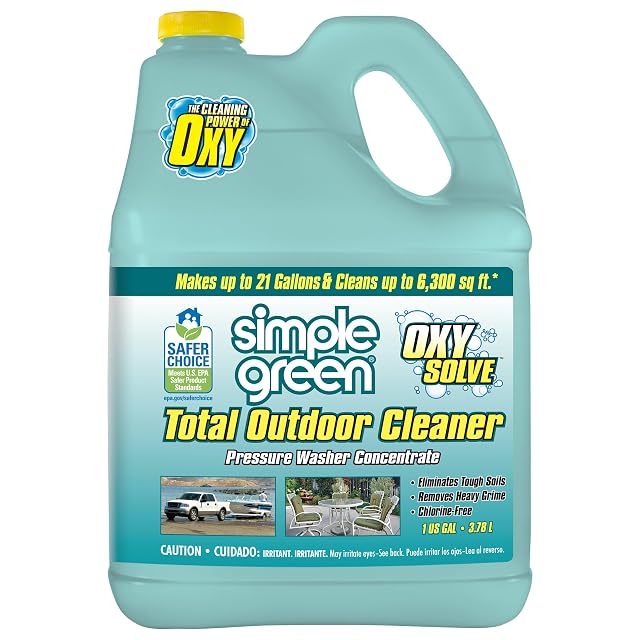
- Title: “Pressure Washer & Manual Use, EPA Safer Choice Certified, Peroxide Cleaner for Wood, Concrete, Vinyl & More”
- Reference 8541813566 · Catalog: 4205 g (148.3 oz)
A certification, which nothing else here has
“EPA Safer Choice Certified”, in the title.
Safer Choice is a program run by the US Environmental Protection Agency. Products carrying the label have had every ingredient reviewed against the program’s criteria for the function it performs, and the mark is granted rather than asserted.
That distinction is the whole value of it. Here is what the rest of the shelf offers in its place:
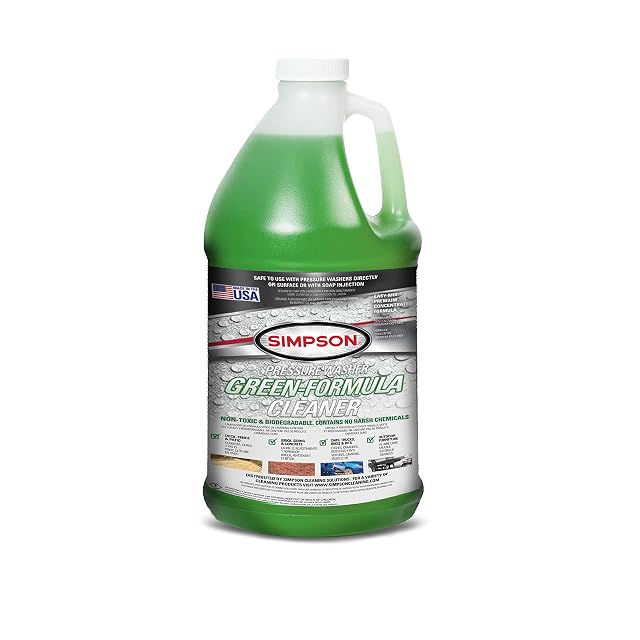
Simpson Green Formula, $15.18 — “Meets or exceeds OSHA, USDA, EPA, DNR requirements for health and safety”. Four agencies named, no standard cited — the maker describing itself.
Krud Kutter, $15.98 — “bleach free”, “biodegrabable”
Sun Joe, $25.97 — “bleach-free”
Both Kärcher bottles, both Briggs bottles, Zep — no chemistry declared at all
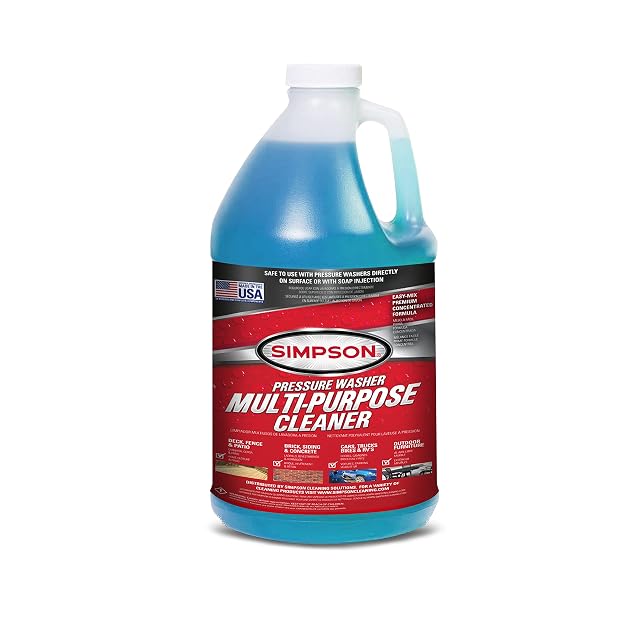
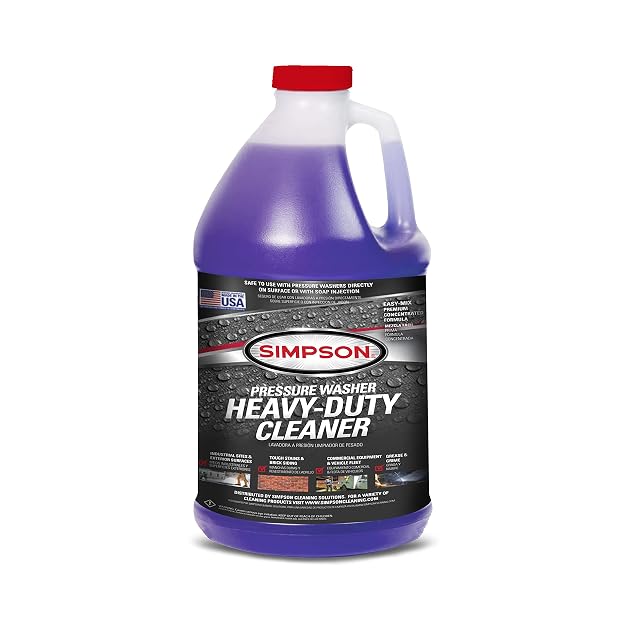
Simpson Heavy Duty and Multi-Purpose — “non-butyl degreaser”, which is a real chemical statement but not a certification
So this is the only page on this shelf where a reader can check something against an outside source.
Where it matters practically is the list of surfaces: “decks, siding, driveways, patios, fences, walkways”. All of those drain onto soil, into planting beds and into storm water — and bullet two draws the conclusion the certification supports: “cleans… without harsh chemicals - giving families peace of mind around children and pets.”
Peroxide, and why it is the right chemistry for wood
A detergent works by surfactancy: it wets greasy soil so water can carry it off. That is what the three Simpson “non-butyl degreaser” bottles do, which is why they are aimed at oil and grease.
Peroxide oxidizes. It breaks down the colored compounds themselves — which is what you need for the marks that are not dirt sitting on a surface but pigment in it: the grey of weathered timber, the green of algae, the black speckle of mildew on a deck board.
The title calls it “Oxy Solve”; bullet two calls it “peroxide-powered”.
And that explains the surface list — “wood, vinyl, concrete, brick, and composite” — because those are precisely the materials you cannot simply turn the pressure up on. A jet strong enough to lift grey off cedar raises the grain. A jet strong enough to clean composite decking furs it.
Chemistry is the alternative to pressure, and on timber that is not a convenience but the only correct method.
Three other listings on this shelf claim mold or algae — Zep at $59.99 leads with “algae, mold and mildew”, and both Briggs & Stratton bottles claim mold stains — and this is the only one that says what does the work.
Composite is the quietly useful entry in the list, because composite decking is the material people most often damage: it looks like timber, cleans like plastic, and the manufacturers almost universally cap the pressure you may use on it.
Coverage instead of dilution, which cuts both ways
“Covers up to 6,400 sq. ft. per bottle.” And nothing anywhere says how much water a gallon of this makes.
Every other listing except the Sun Joe gives a ratio: the three Simpsons at 256:1, both Kärchers at 40 or 20, Krud Kutter at 20 or 11, Zep at 26, both Briggs bottles at 16.
So on the usual basis this cannot be ranked against nine other bottles. That is a real gap on a concentrate.
But coverage is arguably the better metric, and the reason is worth stating. A dilution ratio tells you how far the bottle stretches, not how far it cleans. A concentrate rated at 256 gallons of solution sounds cheap until you need three passes to shift tree sap — at which point you have saved nothing. Coverage bakes in the strength actually required.
On that basis there is exactly one comparison available here:
this — 6,400 sq ft for $23.99 = about 0.375¢ a square foot
Krud Kutter — 5,800 sq ft for $15.98 = about 0.276¢ — 26 per cent cheaper
Krud Kutter also names fifteen surfaces against five here, and publishes a dwell time, which this does not. What this has instead is the certification and the named peroxide chemistry.
For scale: a typical two-story house has perhaps 1,500 to 2,500 sq ft of siding, so 6,400 sq ft is two or three whole-house washes.
Four bullets, and three of them are about who you are
This is the shortest listing on the shelf — four bullets where everything else has five, six or seven — and the content is unusual.
Bullet one names “homeowners preparing for BBQs, real estate agents staging homes, or contractors finishing jobs”. Bullet three names “weekend warriors and maintenance crews”. Bullet four names “businesses maintaining storefronts, homeowners restoring outdoor furniture”.
That is audience, not specification, and it is where the missing figures went.
What the page does contain, buried in bullet three, is the one commercial argument on this shelf: “helping weekend warriors and maintenance crews save money versus hiring pressure washing services.”
Which is a fair frame for the whole category. A bottle of concentrate at $23.99 against a contractor’s visit is not a close contest, and the surfaces here — a deck, siding, a driveway — are the ones people pay to have done.
The one word to treat carefully is “restoring” in bullet four. Restoring a surface is a larger claim than cleaning it, and peroxide on weathered timber does lift grey — but it does not replace sanding or a finish. The Briggs & Stratton gallon uses the same word for the same reason.
Four thousand two hundred and five grams
The heaviest single bottle on this shelf.
this — 4205 g · Simpson ×3 — 4082 g each, 9 lb exactly · Briggs 1-gallon — 3946 g · Krud Kutter — 3856 g · Kärcher ×2 — 3742 g each · Sun Joe — 3629 g · Briggs 32 oz — 1043 g · Zep — 22680 g for a case of four, which is 50 lb exactly and reads as a shipping weight
A US gallon of water weighs about 3785 g (133.5 oz), so every one-gallon bottle here is in the right region and the differences are bottle and formulation rather than anything meaningful.
Worth a line only because a gallon of concentrate is awkward to pour into a washer’s small detergent tank, and none of the eleven listings mentions a measure, a cap graduation or a pouring spout.
What is not published
No dilution ratio, as above — the central omission, and the reason this cannot be priced against most of the shelf.
No dwell time, and on peroxide chemistry that matters more than on a detergent, because oxidizing pigment is slow. Krud Kutter is the only listing here that publishes a method: “allow product to remain on the surface for 3–5 minutes to penetrate”, “work in small sections”, “rinse thoroughly without allowing it to dry on the surface”. Borrow it — those three instructions apply to this bottle at least as much as to that one.
No application guidance at all. The title says “Pressure Washer & Manual Use” and no bullet explains either. Which leaves out the thing the Sun Joe at $25.97 is alone on this shelf in explaining: “may require the use of a soap nozzle. Other models may need to use a soap-sprayer attachment.” A pressure washer will not draw detergent through a high-pressure tip — the siphon is a venturi and only pulls at low pressure, which is what the wide black soap nozzle on the lance shelf of this site exists for.
No mold or algae claim in words, which is odd given the chemistry. “Stubborn grime” is as far as bullet four goes, where Zep and both Briggs bottles name mold outright with no chemistry to support it. This page has the chemistry and declines the claim — arguably the more cautious position, and arguably a missed one.
No pressure limit for wood or composite, which is the caution this particular bottle is best placed to give. Composite decking manufacturers routinely cap the pressure permitted on their boards, and a page that names composite could say so.
No anti-corrosive claim. Only Krud Kutter mentions the machine: “anti-corrosive agents to help safeguard pressure washer components.” Detergent passes through your pump, and a pump contains aluminum and brass — and peroxide is a more reactive chemistry than a surfactant.
No foam cannon compatibility, which both Kärcher bottles name.
No steam cleaner or scrubber use, which all three Simpsons claim.
Availability
Read on the day this page was built: $24 at the American Amazon shop.
Read from Keepa on the day this page was last revised; stock and price both move without notice.
Prices quoted in this text were read on 2026-10-05. The live price is at the top of the page.