What the maker puts in writing
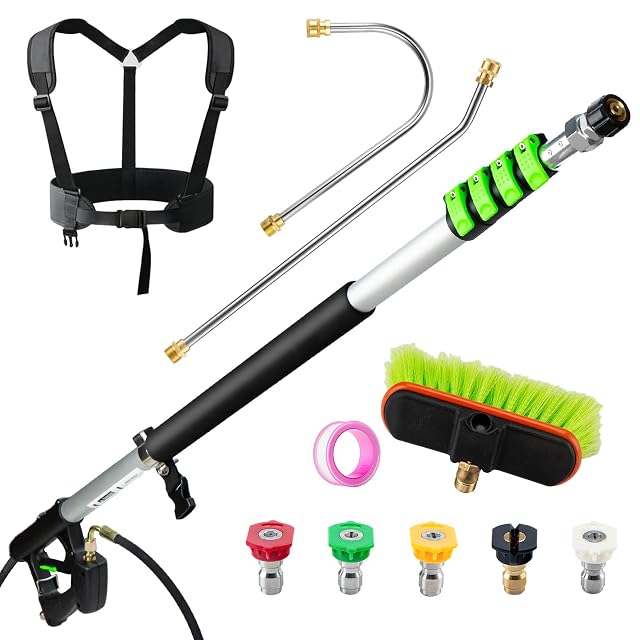
- “24ft High Reach Without Ladder: TOR telescoping wand features a 5-stage design that allows you to clean up to 24 feet high without a ladder. Comes with 2 extension wands and a brush, it enables easy access to soffits, fascia, siding and gutters from the ground”
- “Crafted with premium lightweight aluminum… Its comfortable padded grip reduces fatigue during extended use. The fully sealed spray gun and durable pressure washer hose ensure no leakage, and it is compatible with pressure washers up to 4,000 PSI”
- “the wand has 4 adjustable sections with lever locks—simply set your desired length and lock it in place… The M22-14mm male thread outlet ensures stable connection of extension wands, while 2 hose adapters and a 3/8” QC inlet make it compatible with most pressure washer hoses”
- “a brush head with jets to tackle stubborn dirt, 2 extension wands (15 degrees & gutter cleaner) for versatile cleaning in different areas, 5 spray nozzles with adjustable angles… and a lengthened support belt to save your strength during use”
Twenty-four feet, which is a different job rather than a longer one
Every other item on this shelf extends your reach. This replaces a ladder.
The mechanism is stated consistently, which on this shelf is worth remarking: a “5-stage design” with “4 adjustable sections with lever locks”. Five tubes give four sliding joints — the two figures agree. Add the 2 extension wands and the 24 feet is the whole assembly.
Where that puts you against the rest:
this — 24 feet
Selkie (three rods) — 97 inches, about 8 feet, and its parts confirm it
Selkie (120inch) — 105 inches by its parts, against a title claiming 120
Xiny Tool — about 105 inches, if the seven wands are the straight ones; it never says
Simpson — 31 inches, one wand
YunGuoGuo and POOPLE — about 17 to 18 inches, garden-hose wands
At eight feet plus your own reach you are at twelve or thirteen — a single-story gutter, a soffit, the top of a garage door. The Selkie bullets claim “second or third story” at that length, and they do not get there.
At twenty-four you clear a second-story gutter, fascia and soffit from the ground, which is what the first bullet says: “up to 24 feet high without a ladder.”
That is the argument for paying $91.99 against $29.99, and it is not a marginal one. Working at height off a ladder with a pressure washer in one hand is the genuinely hazardous version of this job — a jet’s reaction force pushing against someone standing on a rung.
No weight. On a 24-foot wand that is the specification that decides whether you can use the thing.
Every other clue on the page points the same way, and they all point to a tool whose designers knew this was the problem:
“Premium lightweight aluminum” — roughly a third the density of the stainless steel that the Selkie and Xiny Tool kits use. At this length there is no alternative material.
“Comfortable padded grip reduces fatigue during extended use.”
“A lengthened support belt to save your strength during use.” The only load-bearing accessory on this shelf, and a plain admission that weight is the limiting factor.
For scale, the only weights published anywhere here: the Selkie kit’s 4.3 pounds at about 8 feet of stainless — and it offers that as a selling point, “is weighter than others” — and the Simpson’s 181 g (6.4 oz) for a single 31-inch wand.
Three practical points the page does not make.
The wand is full of water under pressure at full extension, and that mass sits at the far end of a twenty-four-foot lever.
Use the shortest length that reaches. The lever locks exist for exactly that, and most jobs are not at the ceiling of the range.
The jet’s reaction force pushes back along the tube. Twenty-four feet above your head, that force is what tips the assembly out of line — it is a stability problem before it is a strength problem, which is what the belt is really for.
M22-14mm, and why naming the size is the best spec on the page
“The M22-14mm male thread outlet.”
M22 comes in two sizes that share one name. M22-14mm and M22-15mm differ in the diameter of the inner nipple. They thread together and then refuse to seal, or seal and then blow.
This is the only item on this shelf that states which. The Simpson says “industry standard M22” and leaves it. And 14mm (0.55 in) is the commoner domestic size — it matches the hoses on this site’s pressure-hose shelf.
The rest of the connection story, which is unusually complete:
Inlet: a 3/8” quick connect, plus two hose adapters. That is where your machine’s hose goes, and the two adapters are there to cover what you have.
And the box includes its own gun and hose — “the fully sealed spray gun and durable pressure washer hose”. So this is not an attachment for a gun you own; it brings one, and the M22 outlet is for attaching the extension wands rather than for your machine.
Which means the compatibility question to check is the inlet and the rating: “compatible with pressure washers up to 4,000 PSI”, through a 3/8 inch QC.
Against the shelf, the fittings divide cleanly: 1/4 inch quick connect on the Xiny Tool, both Selkie kits and the AURORA CAR nozzle; M22 at the gun end of the Simpson; 3/4 inch garden hose on the YunGuoGuo and POOPLE, which belong to a tap rather than a machine.
What else is in the box, and the one accessory that is unusual
A brush head with jets. Nothing else on this shelf has one, and at height it is the right idea: a brush that sprays while it scrubs lets you work siding and soffits where a jet alone only rinses. Twenty-four feet up, you cannot get a hand to the surface, so a brush on the end is the only contact cleaning available.
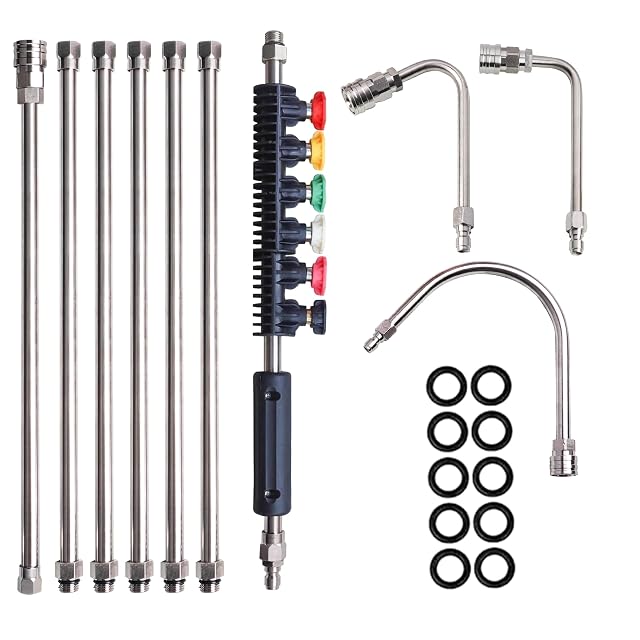
Two extension wands — 15° and a gutter cleaner. The 15° is a shallow bend for pushing water along a face; the gutter cleaner is the hook that puts the jet down the channel rather than across it. Fewer approach angles than the kits — the three-rod Selkie has 30°, 90° and 120°, the Xiny Tool 30°, 90° and U — but those kits are working at eight feet, where you can see the geometry. At twenty-four the hook is what matters.
Five nozzles with adjustable angles, and the angles are never named. The kits name theirs: 0, 15, 25, 40, 60 and soap on the Xiny, 0, 15, 25, 40, 65 on the Selkies. Which matters here more than elsewhere, because at full extension you want the wide fans — a 40° tolerates the sag and the sway that a 0° does not, and a 0° aimed at a soffit you can barely see is how you strip paint by accident.
The support belt, as above.
What is not published
No weight, which is the omission that matters, discussed above.
No nozzle angles, so you cannot tell before buying whether the five include the wide fans this length needs.
No section lengths, so there is no way to work out the collapsed length — the figure that decides whether it fits in a car or a cupboard.
No temperature limit, where the Xiny Tool and the Simpson both publish 140 °F and the Simpson adds “only for cold water use”. An aluminum wand with a sealed gun and rubber seals has a limit whatever it is. Worth stating: the steam cleaners on this site’s neighboring shelf run between 212 and 293 °F, and nothing on this shelf is rated to pass that.
No hose length, on a product that ships a hose.
No lock rating. Lever locks on a five-stage telescope are the part that wears, and nothing is said about what holds them or whether they are replaceable.
No warranty. “Superior customer service” and “feel free to contact us” are not terms. The Simpson’s 90 Day limited accessory remains the only actual warranty on this shelf.
Availability
Read on the day this page was built: $92 at the American Amazon shop.
Read from Keepa on the day this page was last revised; stock and price both move without notice.
Prices quoted in this text were read on 2026-10-04. The live price is at the top of the page.