What the maker puts in writing
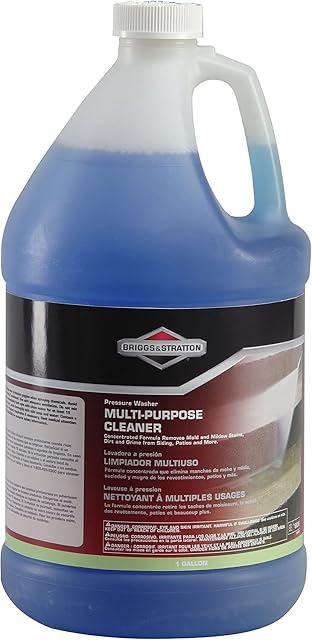
- “1-Gallon mixes with water for up to 16 gallons of pressure washer soap”
- “A versatile cleaner for getting rid of dirt, grime and mold stains”
- “Compatible with direct from concentrate soap system, no mixing required”
- “Restore and wash your siding, patio and more”
- Description: “perfect for removing dirt, mold and mildew from multiple surfaces… break down the grime on siding, patios and more”
- Title: “1-Gallon, blue” · Reference 6826 · Catalog: 3946 g (139.2 oz)
A third the cost of its own small bottle
1 gallon making up to 16 gallons is a 16 to 1 dilution. At $19.90, that is $1.24 a gallon of solution.
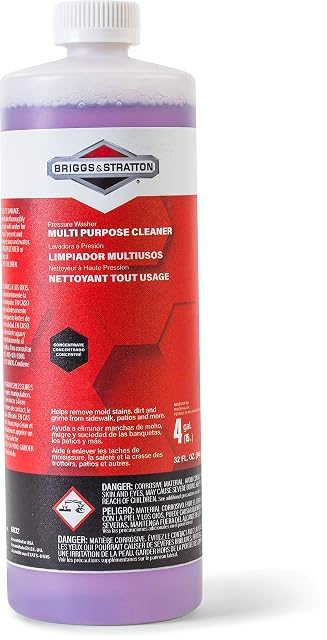
The Briggs & Stratton 6832 at $14.25 is 32 fl oz making “up to 4 gallons” — the identical ratio, and $3.56 a gallon.
Same soap, same strength, two dollars thirty-two a gallon less.
And the consistency deserves credit, because it is rare here. Four listings on this shelf publish two different ratios for themselves:
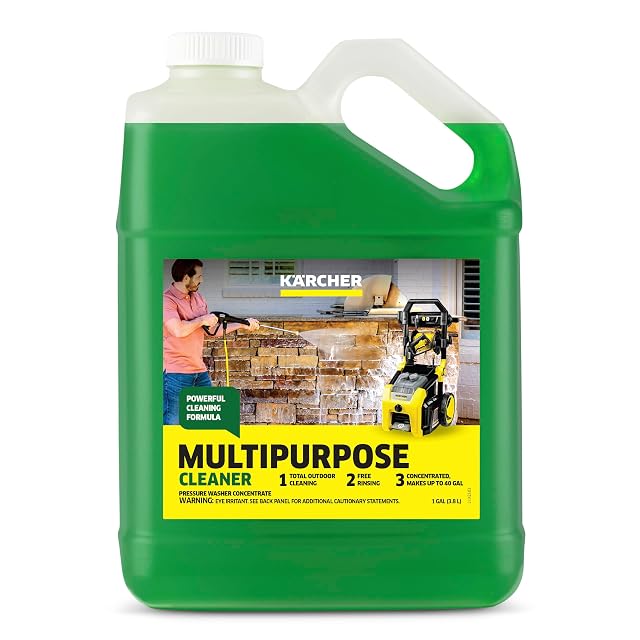
Kärcher Multi Purpose — 40 gallons in a bullet, 20 in the description
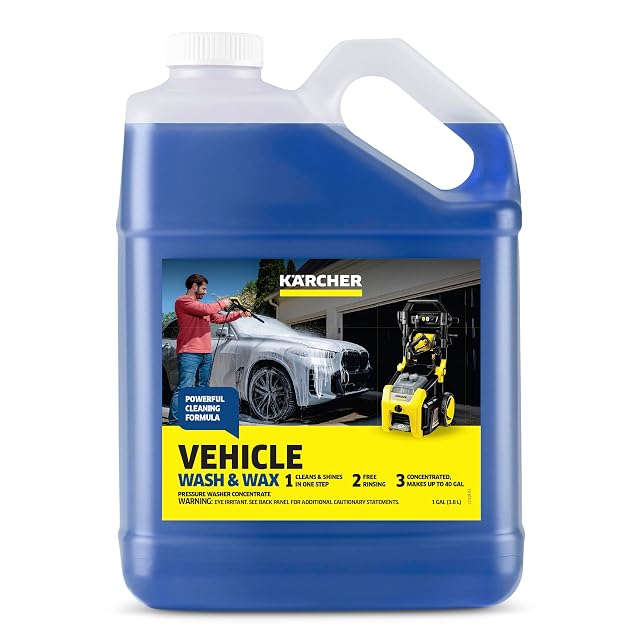
Kärcher Vehicle Wash & Wax — 40 in a bullet, 20 in the description
Krud Kutter — 20 in a bullet, 11 in the description
Zep — 26 gallons on a case of four, per bottle or per case unstated
Sun Joe — no ratio at all
These two Briggs pages each publish one figure, and the two figures describe the same dilution.
The only reasons to buy the small bottle instead: it weighs 1043 g against 3946 g here, so it stores where a nine-pound jug does not — and four gallons of soap may be all one patio ever needs.
But a dollar twenty-four is the wrong end of this shelf
Every item here is a concentrate, so the bottle price means nothing. What you buy is gallons of ready-to-use solution. Each at its own best published figure:
Simpson Heavy Duty — 5.4¢ · Simpson Green Formula — 5.9¢ · Simpson Multi-Purpose — 7.6¢ · Kärcher Vehicle — 36¢ · Kärcher Multi — 47¢ · Zep — 58¢ if its 26 gallons is per bottle · Krud Kutter — 80¢ · this — $1.24 · Briggs 32 oz — $3.56 · Sun Joe and Simple Green — not calculable in gallons
So this is roughly twenty times the cost per gallon of a Simpson.
Two fair points on the other side.
The Simpson 256:1 is its maximum dilution — “dilutions as great as half-ounce per gallon” — so at that strength it is a light solution for light soil. The comparison above is between each maker’s own best case.
And this bottle does something no Simpson does, which is the next section.
The direct-concentrate system, which is why this exists
“Compatible with direct from concentrate soap system, no mixing required.”
Some pressure washers — Briggs & Stratton’s own among them — carry a tank or siphon that draws undiluted concentrate and meters the dilution itself into the low-pressure stream. Pour this in neat and skip the bucket entirely.
Only this and the 6832 mention it. Nothing else on this shelf does.
If your machine has that system, the mixing step disappears, and that is the genuine thing you are paying for.
If it does not, you mix 1 part to 15 parts water, and then you need what the Sun Joe at $25.97 is the only listing here to explain:
“this power-washing detergent may require the use of a soap nozzle. Other models may need to use a soap-sprayer attachment.”
A pressure washer will not draw detergent through a high-pressure tip. The siphon is a venturi and only pulls at low pressure, which is exactly what the wide black soap nozzle on the lance shelf of this site exists for. Fit a green 25° tip and nothing comes through, and most people conclude the detergent is at fault.
Its sibling’s description supplies the other half of the method, and it applies here: “apply detergent to the dry surface then switch to a high pressure spray tip to rinse it all away.” Soap on through a low-pressure tip, off through a high-pressure one. Two tips, one job.
Mold and mildew, with nothing said about how
“getting rid of dirt, grime and mold stains”, and in the description, “removing dirt, mold and mildew from multiple surfaces.”
A mold stain is biological pigment in or on the surface, and removing it normally means oxidizing it — which in practice means bleach or peroxide.
The shelf divides precisely there:
Simple Green, $23.99 — names it: “peroxide-powered formula”, plus EPA Safer Choice Certified in the title
Zep, $59.99 — leads with “removes stains caused by algae, mold and mildew” and names no chemistry
this and the 6832 — claim mold and mildew, declare nothing
Krud Kutter, $15.98 and Sun Joe, $25.97 — declare themselves “bleach free” and make no mold-pigment claim; Krud Kutter targets “dirt, oil, grease, bird droppings, tree sap”
The three Simpsons — “non-butyl degreaser”, for oil and grease, no mold claim
So if a green or black stain on siding is the real job, Simple Green is the listing that tells you what is in the bottle.
And the surfaces named here are exactly where mold lives: “siding, patio”, “walkway”. North-facing render, a shaded deck and a damp path are the classic cases, which makes the silence about chemistry more conspicuous rather than less.
“Restore” in bullet one is the strongest word on the page, and nothing supports it — restoring a surface is a bigger claim than cleaning it.
Siding, patios and walkways — and nothing else
Three surfaces, which is the shortest list on this shelf.
Krud Kutter names fifteen, including roofing shingles, gutters, stucco, masonry, pool areas, RVs, boats and engines. Zep names thirteen, including fiberglass, metal, plastics and vehicles. Kärcher Multi names eleven. Simple Green names five plus composite. Sun Joe names five. The Simpson Multi-Purpose names cars, RVs, siding, grills and lawn furniture.
No vehicle is named here, which is worth noticing: the two Briggs bottles are the only items on this shelf aimed exclusively at the house. The Kärcher Vehicle Wash & Wax at $14.39 is the one built for a car, with a wax film and a gentle formulation.
And nothing here says what it is safe on, which matters because siding covers vinyl, painted timber, aluminum and render, and a cleaner strong enough for render is not obviously right for painted cedar. The listings that do address it: Simple Green — “safely cleans wood, vinyl, concrete, brick, and composite surfaces without harsh chemicals”; Krud Kutter — a named surface for each material; the Simpson Green Formula — “non-toxic, biodegradable… no harsh chemicals”.
What is not published
No chemistry. Not bleach-free, not biodegradable, not non-butyl, not peroxide. Six listings on this shelf declare something about what is in the bottle; the two Briggs bottles declare nothing.
No manual use. This and the 6832 are the only two items here that do not offer it. Both Kärcher bottles are suitable “as well as manual use”; all three Simpsons can be “sprayed, mopped, wiped”; Simple Green has “Manual Use” in its title; Krud Kutter has ”& Manual Use” in its title; Sun Joe can go on “with a brush or mop”; Zep offers “manual applications”. That is a real limitation: a detergent you can brush on reaches what a washer cannot, and gutters and fascias are exactly that.
No surface coverage. Two listings publish square footage: Krud Kutter 5,800 sq ft at $15.98 — about 0.276 cents a square foot — and Simple Green 6,400 sq ft at $23.99, about 0.375 cents. On a 16:1 concentrate, coverage is the figure that would make the price comparable with theirs.
No dwell time. Krud Kutter is the only listing here that publishes a method: “allow product to remain on the surface for 3–5 minutes to penetrate”, “work in small sections”, “rinse thoroughly without allowing it to dry on the surface.” Contact time is how a chemical cleaner works — and on a mold stain it matters more than anywhere, because oxidizing pigment is slow.
No foam cannon compatibility, which both Kärcher bottles name. A thick foam would suit a vertical wall better than a liquid.
No anti-corrosive claim. Only Krud Kutter mentions the machine: “anti-corrosive agents to help safeguard pressure washer components.” Detergent passes through your pump, and a pump contains aluminum and brass.
No certification. Simple Green carries EPA Safer Choice; the Simpson Green Formula claims to meet “OSHA, USDA, EPA, DNR” requirements.
And no explanation of the blue, which is in the title and is presumably the color of the liquid rather than the bottle.
Availability
Read on the day this page was built: $20 at the American Amazon shop.
Read from Keepa on the day this page was last revised; stock and price both move without notice.
Prices quoted in this text were read on 2026-10-05. The live price is at the top of the page.