What the maker puts in writing
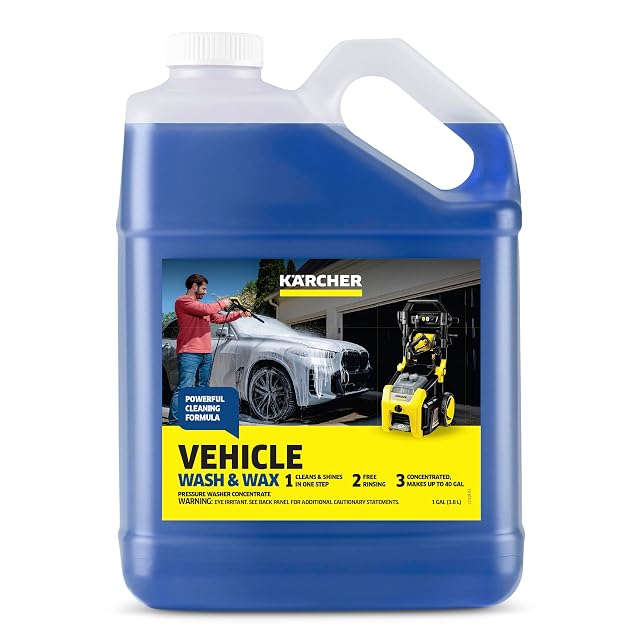
- “Karcher’s Vehicle Wash & Wax creates a perfect car wash system. The soap rinses away dirt and grime without leaving residue behind, revealing the original luster of your car, truck, SUV, motorcycle and more”
- “Highly Concentrated: Make up to 40 gallons of detergent from a single gallon”
- “Check label for instructions: Suitable for pressure washer or foam cannon application, as well as manual use”
- “Universal Compatibility: …compatible with most consumer gas & electric power pressure washers”
- “Made in the USA of domestic and imported materials.”
- Description: “one gallon of concentrate makes up to 20 gallons of ready to use Vehicle Wash (you control the dilution)” · “compatible with all Karcher Home & Garden pressure washers, as well as consumer pressure washers made by other brands”
- Reference 9.558-146.0 · Catalog: 3742 g (132 oz)
Forty gallons, or twenty
Bullet three: “up to 40 gallons.”
Description: “makes up to 20 gallons of ready to use Vehicle Wash.”
At $14.39 that is 36 cents a gallon of solution on the first figure and 72 cents on the second — a factor of two on the only number that makes a concentrate comparable with anything.
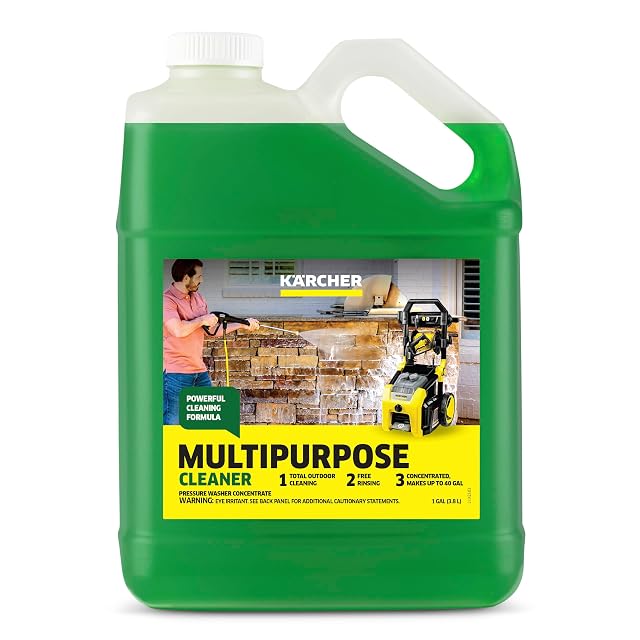
And the Kärcher Multi Purpose at $18.99 on this same shelf does exactly the same thing: 40 in the bullet, 20 in the description. Same brand, same discrepancy, both products.
Which to believe: the description is the more cautious, and it carries the qualifier that matters — “you control the dilution”. So read 20 gallons as the working figure and 40 as the stretch.
Set against the shelf, each at its own best published figure:
Simpson Heavy Duty — 5.4¢ · Simpson Green Formula — 5.9¢ · Simpson Multi-Purpose — 7.6¢ · this — 36¢ · Kärcher Multi — 47¢ · Zep — 58¢ if its 26 gallons is per bottle · Krud Kutter — 80¢ · Briggs 1-gallon — $1.24 · Briggs 32 oz — $3.56 · Sun Joe and Simple Green — not calculable in gallons
So this is the cheapest Kärcher and the fourth cheapest solution on the shelf. The three Simpsons are five to seven times less per gallon — on a 256:1 dilution whose arithmetic verifies exactly, since a US gallon is 128 fluid ounces and half an ounce goes into it 256 times.
What the premium buys is in the next two sections, and it is not nothing: a wax pass, and a formulation aimed at paint.
The wax, which is the only one on this shelf
Every other detergent here is designed to be rinsed off completely. Four of them make “no residue” a selling point.
A wash and wax leaves something behind on purpose. It cleans, and then deposits a thin hydrophobic film as the water sheets away.
What that film does: water beads and runs instead of sitting in flat sheets that dry into spots; dust keys less firmly to the surface; and the paint looks wetter, because a smoother surface reflects more directly.
What it does not do is replace a wax or a sealant. A film laid down during a rinse lasts weeks, not months.
The wording is careful, and worth reading closely: “The soap rinses away dirt and grime without leaving residue behind, revealing the original luster of your car.” So the no-residue claim is about the soap, and the lustre claim is about the finish. Both can hold at once.
Where this sits on the shelf: the three Simpsons are non-butyl degreasers for oil and grease; Krud Kutter and Zep are for masonry and siding; Simple Green for decks and concrete; Briggs for siding and patios. This and the Sun Joe at $25.97 are the two aimed at a painted surface, and only this one waxes.
And it is the gentle bottle, which matters more than it sounds
“This gentle vehicle soap rinses away without leaving residue behind.”
That is the word a car wants, and the comparison on this shelf makes the point.
The Simpson Heavy Duty at $13.85 — cheaper than this per bottle and sixty-five times cheaper per gallon — is “Formulated to be used on industrial sites, commercial equipment, construction machinery, fleet vehicles”, with no domestic surface list at all.
A “fleet vehicle” is a van washed at a depot. A motorcycle with polished aluminum, anodized fittings, a plastic screen and decals is a different proposition, and the risk with a strong degreaser is not the paint but everything around it: clear coat, rubber trim, plastic lenses, and the wax or sealant already on the car, which a heavy degreaser strips.
So the honest framing: this is the expensive bottle and the right one for a car. The Simpson Green Formula at $15.18 — “non-toxic, biodegradable… no harsh chemicals”, naming “vehicles” first in its list — is the one credible cheap alternative, at 5.9 cents a gallon.
The foam cannon, named here and almost nowhere else
“Suitable for pressure washer or foam cannon application, as well as manual use.”
Only this and the Kärcher Multi Purpose say it.
A foam cannon is a bottle-and-venturi attachment that mixes soap with air and water and lays down thick clinging foam. The point is dwell time on a vertical surface: foam stays on a car door where liquid runs straight off, so the detergent has time to work before the rinse.
For that to happen the soap has to foam and hold, and a thin degreaser will not. So naming it is a real statement about the formulation, even though no chemistry is declared anywhere on the page.
And it sidesteps the commonest failure in this whole category. A foam cannon fits on the lance and feeds from its own reservoir, so it does not use the machine’s detergent siphon at all.
Which is the problem the Sun Joe listing is alone in explaining: “this power-washing detergent may require the use of a soap nozzle. Other models may need to use a soap-sprayer attachment.” A pressure washer will not draw detergent through a high-pressure tip — the siphon is a venturi and only pulls at low pressure, which is what the wide black soap nozzle on the lance shelf of this site exists for. Fit a green 25° tip and nothing comes through.
Made by the people who make the machines
“compatible with all Karcher Home & Garden pressure washers, as well as consumer pressure washers made by other brands.”
Kärcher is a pressure-washer manufacturer, and on this shelf that puts two of the eleven bottles in the hands of someone who knows what the pump is made of.
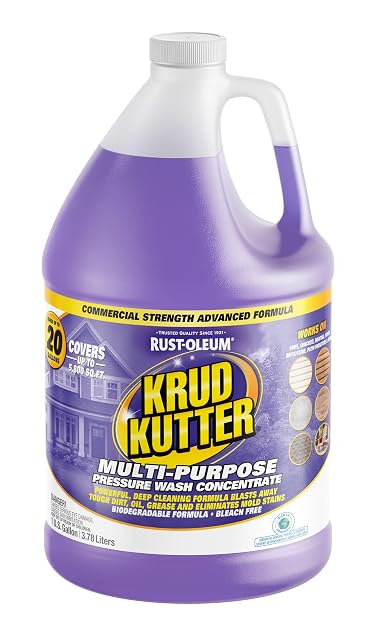
Which is relevant because of what Krud Kutter at $15.98 is the only listing here to say out loud: “the water-based formula contains anti-corrosive agents to help safeguard pressure washer components.”
Detergent passes through your pump, and a pump contains aluminum and brass. Kärcher does not make the anti-corrosive claim, but “formulated to work in tandem with your pressure washer” is on both its bottles and reads as the same consideration.
The other manufacturer-brand items here are the three Simpson bottles, the two Briggs & Stratton and the Sun Joe — so seven of eleven come from machine makers.
“Made in the USA of domestic and imported materials” is an origin statement with its own qualifier, and the same phrasing appears on the Flexzilla hose on this site’s pressure-hose shelf. It is not a warranty and not a certification.
What is not published
No chemistry. Not bleach-free, not biodegradable, not non-butyl, not peroxide. Six listings on this shelf declare something; both Kärchers declare nothing beyond “gentle”.
No dwell time. Krud Kutter is the only listing here that publishes a method: “allow product to remain on the surface for 3–5 minutes to penetrate”, “work in small sections”, and “rinse thoroughly without allowing it to dry on the surface”. On a car that last instruction is the one that counts — soap allowed to dry on paint in sun is how you get spots, and nothing on this page warns of it. Briggs gives the other half: apply to a dry surface, then switch to a high pressure tip to rinse.
No dilution guidance for the two uses. “You control the dilution” is true and unhelpful: a foam cannon, a siphon and a bucket all want different strengths, and the label is where that lives — “check label for instructions” is the whole of the direction given.
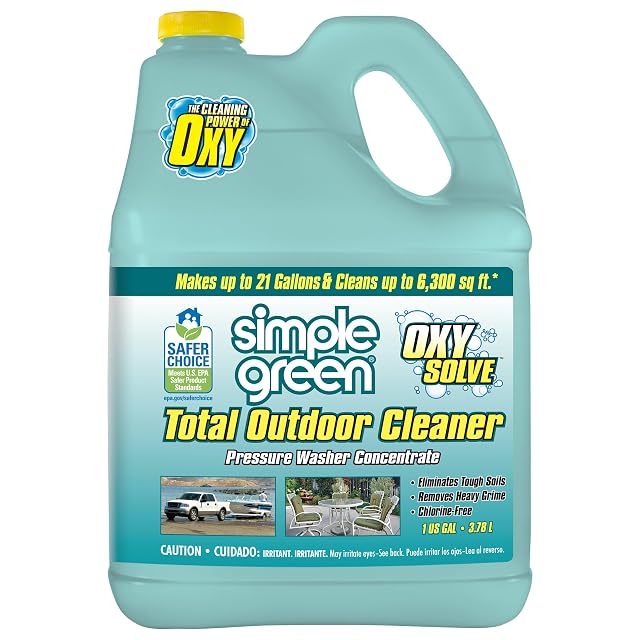
No surface coverage. Krud Kutter publishes 5,800 sq ft at $15.98 and Simple Green 6,400 sq ft at $23.99.
No certification. Simple Green carries EPA Safer Choice in its title; the Simpson Green Formula claims to meet “OSHA, USDA, EPA, DNR” requirements.
No wax durability, as above — the one figure that would tell you what the wax half is worth.
No warning about existing wax or sealant, on a bottle whose whole purpose is the finish.
Availability
Read on the day this page was built: $14 at the American Amazon shop.
Read from Keepa on the day this page was last revised; stock and price both move without notice.
Prices quoted in this text were read on 2026-10-05. The live price is at the top of the page.