What the maker puts in writing
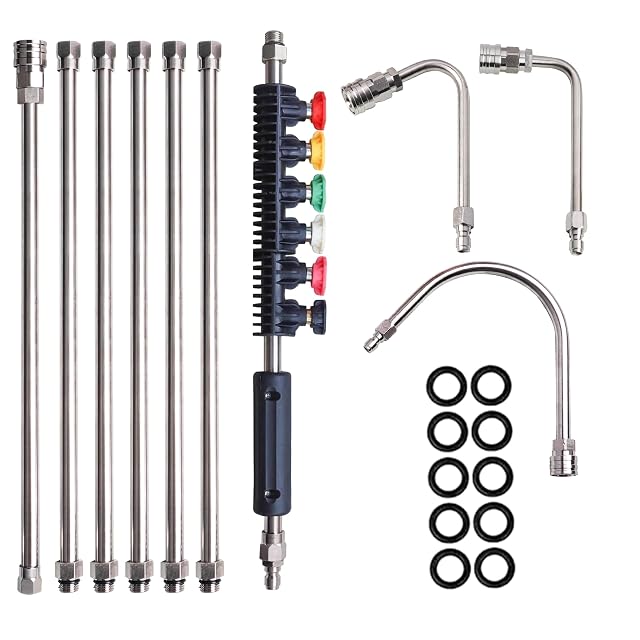
- “Package: Include 7 pack 15” high quality pressure washer wands, 30°, 90° and U shape curved wands, 6 different sizes nozzle tips and 10 replacement rings.”
- “Material: Xiny Tool pressure washer extension wand are made of solid stainless steel. Maximum Working pressure: 4000 PSI. Maximum Working temperature: 140 ℉.”
- “6 spray nozzle tips: 1/4” quick connector spray nozzle tips are for different use: 0, 15, 25, 40, 60 degree and soap nozzles.”
- “Connector: the size of the end of the extension wand is 1/4” quick conncetor, fit for all pressure washers with 1/4” quick conncetor.”
- “4 types of extension wand: Come with 30°, 90°, U shape and straight wand, suit for cleaning, roof, wall, gutter, floor, corner, etc.”
- Title: “10 Pack… 1 Gutter Cleaner Attachment Curved Rod, 1/4” Quick Connect, 4000 PSI” · Reference EJX-4648
Four shapes, which is the widest set of approach angles here
Straight, 30°, 90° and U shape.
Each one is a different way of getting water somewhere you cannot stand, and the four together cover more than anything else on this shelf.
Straight stacks for reach.
30° is the shallow push — up under a soffit, or along the inside face of a fascia, from a position where you can still see the surface.
90° is the gutter hook. Over the lip, jet pointing along the channel rather than at it, which flushes debris toward the downpipe instead of over the edge onto the drive.
U shape turns right back on itself, so from directly beneath you can aim toward yourself — the underside of a gutter lip, the back of a downpipe bracket, the hidden face of a railing.
The comparison: the sister-priced Selkie at $29.49 has 30°, 90° and 120°, where its 120 is the same idea as this U by a different name. The other Selkie has 30° and 90° only. The TOR at $91.99 ships “2 extension wands (15 degrees & gutter cleaner)”. The Simpson at $29.99 is a single straight wand.
So for varied work this and the three-rod Selkie are the two kits to consider, and this one has the extra nozzle.
And then it never tells you how long it is
Every figure is on the page except the total.
Bullet one: “Include 7 pack 15” high quality pressure washer wands, 30°, 90° and U shape curved wands.”
Bullet five: “4 types of extension wand, including 30°, 90°, U shape and straight wand.”
The title: “10 Pack.”
The two readings do not reconcile:
If the seven are straight wands and the three curved ones are extra — which is how the title’s ten comes out, 7 + 3 — then 7 × 15 inches = 105 inches, about 8.75 feet of straight extension.
If the seven is the whole count of tubes, four straight plus three curved, you have 60 inches of straight run.
That is a difference of nearly four feet, on the specification most likely to decide the purchase.
Both Selkie kits publish a total. One of them publishes it correctly — 97 inches, which its parts confirm — and the other publishes 120 in a title whose parts add to 105.
Treat 105 inches as the likely figure, since it is the reading that reconciles the title. And expect to assemble fewer than all of them: three wands is about four feet, which is the useful length for a car, a fence or wheel arches, and a long stack sags — the sister Selkie listing is the only one here honest about that: “Due to its long length, There is some deflection when using.”
Six tips, which is the full set plus one
“0, 15, 25, 40, 60 degree and soap nozzles.”
The industry standard set is five — 0° red, 15° yellow, 25° green, 40° white, 65° black for soap. This lists a 60° and a soap nozzle separately, which is where the sixth comes from.
So you get a wide fan and a dedicated detergent tip rather than one doing both jobs. A soap nozzle is low-pressure by design, so detergent leaves as liquid rather than mist, and having a separate 60° means you are not swapping the soap tip out to rinse.
Against the shelf: both Selkie kits name five angles — 0, 15, 25, 40, 65 — under a heading that says six and a package list that says five. The TOR ships five without naming them. The YunGuoGuo and POOPLE garden-hose wands have two. The AURORA CAR is one rotary nozzle. The Simpson includes none at all.
Which ones matter. The 40° and 25° do nearly all real work, and on a long wand the 40° is the sensible default — the wider the fan, the less an inch of sag in the tube matters.
The 0° is the one to leave in the box. It concentrates the pump’s whole output on a point a few millimeters across: it gouges timber, etches concrete in visible stripes, and is genuinely dangerous to skin. On a wand at full extension, where you cannot see the surface closely, it is worse again.
One wrong word in the title: these are called “6 Atomization Nozzle Tips”, and a 0° jet is precisely what atomization is not — the whole point of it is that the stream stays coherent.
A hundred and forty degrees, and why it is a statement about the seals
“Maximum Working pressure: 4000 PSI. Maximum Working temperature: 140 ℉.”
Two ceilings, and only one other item on this shelf publishes a temperature at all — the Simpson at $29.99, which gives the same 140 °F and spells out the consequence: “this extension is only for cold water use.”
What 140 °F rules out: the hot-water pressure washers that run at 180 °F and above, and — this is the one people try — anything from a steam cleaner. The steam shelf on this site runs between 212 and 293 °F, with saturated steam at 4 bar sitting near 291 °F.
Push that through this and the steel is untroubled; the rubber O-rings at every joint are not. Which is the point: the limit describes the seals, not the tube. And this kit already supplies ten replacement rings, which tells you where it expects to fail.
What 140 °F does allow is anything most people actually do — a cold mains feed, a bucket, or water that has stood in a hose in the sun.
The 4000 PSI ceiling puts it level with both Selkie kits and the TOR, and below the Simpson’s 4500. Worth matching against your machine: domestic electric washers rarely exceed 2000 PSI, so for most buyers this is headroom rather than a limit.
Solid stainless, ten rings, and one quick connect
“Solid stainless steel” throughout, with the same 1/4 inch quick connect at both ends — “fit for all pressure washers with 1/4” quick conncetor”, which is the one genuinely universal fitting in this category.
That is worth stating plainly, because the threaded fittings on this shelf are where the trouble is. The TOR specifies M22-14mm; the Simpson says only M22; and M22-14mm and M22-15mm share a name without sealing against each other. A 1/4 inch quick-connect either clips or it does not.
Ten replacement rings is the quiet useful item. Every joint in a 4000 PSI stack seals on a small rubber ring, the rings take a set once compressed, and a flattened one on the third wand up means water running down your arms. The Selkie kits ship twenty; nothing else here mentions rings at all.
Stainless against the alternatives: the Selkie pair are stainless with brass fittings, the POOPLE is an aluminum alloy tube with a brass connector, the TOR is aluminum throughout. Stainless is stiffer and heavier — which is what you want for pressure and not what you want at full extension overhead. The only published weight on this shelf is the Simpson’s 181 g for a single 31-inch wand; the Selkie bullet claims 4.3 pounds for a nine-piece kit and presents it as an advantage.
What is not published
No assembled length, as above — the central omission, and the one both Selkie kits attempt.
No weight, where a ten-piece stainless kit is the heaviest thing you would hold up a ladder.
No deflection note, which is true of this at 105 inches just as it is of the Selkie that admits it.
No curved rod lengths, where both Selkie listings give theirs (at two different figures, 6 and 7.5 inches, but they give them).
No support strap, which only the TOR at $91.99 supplies — and which is the right answer to a long wand held overhead.
No warranty, where the Simpson’s 90 Day limited accessory is the only term on this shelf.
And no brass anywhere, which is a genuine difference rather than an omission: the Selkie kits specify “stainless steel with brass fittings”, and brass at a threaded joint is softer, seats better against a seal and does not gall when you cross-thread it. Stainless on stainless, tightened with tools as the sister Selkie suggests, is how threads seize.
Availability
Read on the day this page was built: $30 at the American Amazon shop.
Read from Keepa on the day this page was last revised; stock and price both move without notice.
Prices quoted in this text were read on 2026-10-04. The live price is at the top of the page.