What the maker puts in writing
- “Unleash the deep-cleaning power of 3.5 bar steam… delivers a steady, high-temperature (248°F) blast to sanitize floors, tiles, and upholstery without leaving streaks or drips”
- “Fast 8-Minute Heat-Up… In 8 minutes, the steam cleaner will reach its operating temperature”
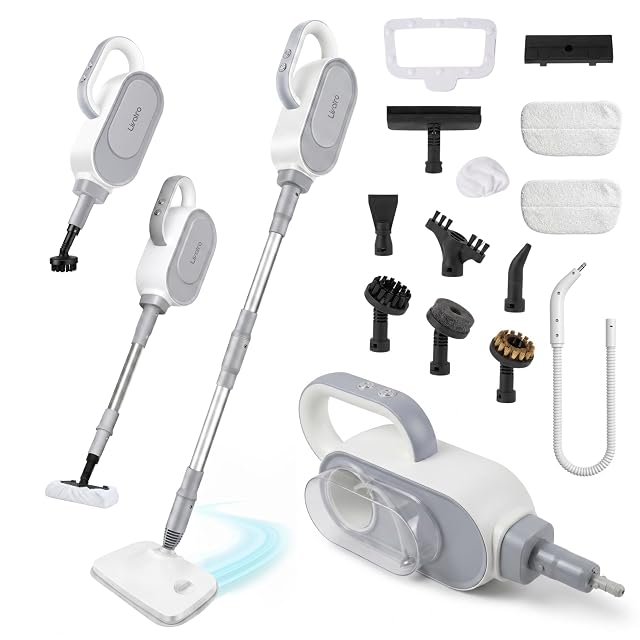
- “21 Professional Attachments… Each attachment clicks securely into place”
- “The generous 45.5 fl. oz. water tank delivers up to 45 minutes of continuous steam, enough to deep clean your entire home in one go. Thoughtful designs like the ergonomic soft-grip handle, smooth-rolling wheels, integrated mop holder and cord wrap make moving between rooms a breeze.”
- “the steam cleaner harnesses the power of purified water to clean naturally. With two steam trigger settings to regulate output based on your needs, as well as built-in overheat protection”
- “Compliant with EPA standards… effectively eliminating up to 99.9% of common household bacteria”
- Reference SLFCSC084 · Catalog: 3629 g (128 oz)
Forty-five minutes, which is the longest declared here
45.5 fl. oz. — about 1.35 liters — giving up to 45 minutes of continuous steam.
Divide it out: 30 milliliters a minute. And the one other machine on this shelf that publishes both figures lands on exactly the same rate — the Keenstone at $139.99, with 51 oz and 50 minutes, which is also 30 ml/min.
Two machines, independently, at the same consumption. Which makes both numbers more believable than either would be alone, and gives you a rate to apply to the rest of the shelf:
Keenstone — 51 oz / 50 min = 30 ml/min
this — 45.5 fl. oz. / 45 min = 30 ml/min
Phueut — 1.5 L, no runtime. At 30 ml/min that would be about 50 minutes
HJGJYWLQ — 3.5 L at a published 120 ml/min = 29 minutes. The biggest tank on the shelf and the shortest runtime, because it uses four times the steam
The four Sharks — “large” and “XL water capacity”, and no figures at all
“Enough to deep clean your entire home in one go” is the claim, and at 30 ml a minute it is a fair one. Forty-five minutes of steam is a kitchen, two bathrooms and a hall.
Which matters more here than on a mop, because of what a refill costs on a pressurized machine. A tank at 3.5 bar has to come down before the cap comes off, and the Keenstone is the only listing on this shelf that publishes the wait: “allow the unit to cool for 20 minutes before adding water”. Nothing here says whether the same applies — but on a pressurized tank it normally does, which is exactly why not needing a refill is worth something.
Eight minutes, and the arithmetic behind it
“In 8 minutes, the steam cleaner will reach its operating temperature.”
Check it. Bringing 1.35 liters from room temperature to boiling and beyond takes roughly 0.45 megajoules. At 1500 W that is about five minutes; at 1800 W, a little over four.
So eight minutes is conservative rather than slow — which on a shelf where two listings publish temperature-and-pressure pairs that do not agree is worth saying plainly.
The wattage is not published here, which is the one figure that would settle it exactly.
And the comparison is the real division on this shelf:
Shark S1000 and S3501 — 30 seconds. A steam mop does not heat a tank. It drips water onto a hot block at the head and flashes it to vapor, so there is almost nothing to warm up — and no pressure either.
Phueut, $119.64 — “heats up quickly”, 1.5 L at 1800 W, which by the same arithmetic is about four and a half minutes. So “quickly” there also means minutes.
Keenstone — no heat-up figure, but the cooling one instead.
HJGJYWLQ — “Fast Heating”, no figure, on a 3.5 L tank — which would be about eleven minutes at 1800 W and still seven at its claimed 2500 W.
What you buy with the eight minutes is pressure, and pressure is what drives steam into a grout line rather than merely wetting it. The thirty-second machines cannot do that.
And then the temperature and the pressure disagree
“3.5 bar steam” and “high-temperature (248°F)”, in the same bullet.
Steam temperature and pressure are locked together. At 1 bar, water boils at 100 °C (212 °F) / 212 °F. At 3.5 bar gauge — 4.5 bar absolute — saturated steam reaches about 148 °C (298 °F), or 298 °F.
248 °F is 120 °C, which corresponds to roughly 2 bar absolute, or 1 bar gauge.
So the two figures describe different machines. Either the temperature is right and the pressure is a third of what is claimed, or the pressure is right and the steam is fifty degrees hotter than stated. Nothing on the page resolves it.
Only one machine on this shelf publishes a pair that agrees:
Keenstone, $139.99 — 300 °F at 58 psi. 58 psi is about 5 bar absolute, where saturated steam sits near 306 °F. ✓
this — 248 °F at 3.5 bar. ✗
HJGJYWLQ, $591.99 — 110 °C at 4.0–5.0 bar. At 4.5 bar, saturated steam is 144 to 152 °C. ✗
NEWBULIG, $37.89 — 212 °F, no pressure claimed. Correct, since 212 °F is exactly 1 bar — an unpressurized mop. ✓
Phueut — “optimal heat and pressure”, no number of either kind
The four Sharks — neither figure
How to read it: 248 °F is the conservative number, it is well above boiling, and it puts this firmly among the pressurized machines rather than the mops. Treat the 3.5 bar as unverified.
Twenty-one attachments, and the one thing said about them
Phueut 28 · this 21 · Keenstone 17 · NEWBULIG 14 · HJGJYWLQ “multiple”, no count · Shark S8001 and S8201 four pads each · Shark S1000 and S3501 two pads each
Second on quantity, and the four Sharks are in a different business — floor machines with pads and no attachments at all.
“Each attachment clicks securely into place, allowing you seamlessly swith in different scenarios.”
That is the only thing said about the twenty-one, and it is a better thing to say than a count. A bayonet fitting that locks is what separates a kit you use from a kit that blows an attachment off a hot wand mid-job. The Keenstone is the only other listing to address fit, by naming “organized accessory storage”.
But like the Phueut, this page names none of the twenty-one. The Keenstone itemizes: “floor brushes, microfiber pads, nylon and brass brushes, a window tool, detail nozzle”. Two things that list tells you which this one cannot — whether there is a proper floor head, and what the brushes are made of. Brass lifts baked-on deposit from an oven rack without scoring it; steel scratches anything polished.
Though here there is one clue: the kit includes an “integrated mop holder”, which implies a mop head exists.
And accessory counts inflate. Spare seals, a funnel, a measuring cup and a bag are all legitimately in a box and none of them cleans anything.
A mop holder and a cord wrap, which nothing else here has
“Thoughtful designs like the ergonomic soft-grip handle, smooth-rolling wheels, integrated mop holder and cord wrap make moving between rooms a breeze.”
Two small fittings and they are the difference between a twenty-one-piece kit you still own in two years and a cupboard full of loose parts.
A cord wrap is the detail every corded machine needs and almost none publishes. An unwrapped cord is what tangles in the wheels, gets trodden on, and eventually fails at the plug.
A mop holder means the floor head stows on the body instead of leaning in a corner.
Neither appears on any other listing on this shelf. The Phueut has “super smooth wheels and ergonomic handle”; the HJGJYWLQ a “portable design with extended power cord”; the Sharks nothing, because at 2087 g (73.6 oz) and 2209 g (77.9 oz) the two light ones simply stand in a cupboard.
3629 g at the catalog, which is 8 lb — the third heaviest here, and heavy enough that the wheels are a necessity rather than a feature. The scale: Shark S1000 2087 g · S3501 2209 g · NEWBULIG 2341 g · Shark S8001 3130 g · Phueut 3447 g · this 3629 g · Shark S8201 4042 g · HJGJYWLQ 11489 g gross.
Two trigger settings and overheat protection
“With two steam trigger settings to regulate output based on your needs, as well as built-in overheat protection.”
Variable steam is not a luxury. Too much steam on a delicate surface is how damage happens, and a machine with one setting always gives you the maximum. Two settings is the coarse version of the right idea.
The shelf, on control:
Phueut — an adjustable dial on the handle, plus a lockable trigger. The best-placed of these, because you change it mid-pass
Shark S8001 and S8201 — three modes: “Light, Normal, Deep”, selected on the body
this — two trigger settings
HJGJYWLQ — “adjustable pressure control”, no detail
Shark S1000, S3501, Keenstone, NEWBULIG — nothing published
Overheat protection is the minimum safety feature and it is good that it is here. Running a steam machine dry is how it dies: an element with no water to carry the heat away reaches its limit in seconds.
The more thorough versions on this shelf: the NEWBULIG gives three signals for one condition — “a gentle pump sound”, an auto-shutoff, and a red indicator that stays on until refilled. The Keenstone has a steam child lock and a cap that “stays locked while the tank is hot or pressurized”, which is the safeguard a 3.5 bar machine most needs and which this page does not mention.
Purified water, and the hygiene claim
“the steam cleaner harnesses the power of purified water to clean naturally” — and “Compliant with EPA standards… eliminating up to 99.9% of common household bacteria.”
The chemical-free argument is the strongest the category has, and four listings here make it: no consumable, nothing with a shelf life, and no residue on a surface a child or a dog will be on.
“Purified water” is also a practical instruction in disguise. On a pressurized tank, every liter of tap water leaves its calcium behind in a vessel you cannot reach, and the deposit collects at the narrowest point. Distilled or filtered water from the first fill is the sensible precaution — and no descaling or rinse function is published here.
On the hygiene claim, what is missing is what would make it checkable: which EPA standard, which organisms, under what conditions.
Compare the Shark S3501 and S8201, whose footnote names five: “Demonstrated to be effective against Pseudomonas aeruginosa, Staphylococcus aureus, Escherichia coli, Salmonella enterica (typhi), and Klebsiella pneumoniae when used as directed.” Naming organisms says what was counted.
The Keenstone makes no hygiene claim and carries the only certification on this shelf, UL499 — electrical safety rather than hygiene. The NEWBULIG claims 99.9 per cent of stains, which have no unit. The Phueut, HJGJYWLQ and Shark S8001 publish no figure.
The requirement behind every version of this claim is the same: dwell time. Heat has to stay on the surface, which means moving slowly.
What is not published
No cord length, where the Shark S1000 gives 18 ft, the NEWBULIG 16.4 ft, the HJGJYWLQ 3.5 m and the Phueut 9.8 ft. On a canister the hose makes up some of it — and no hose length is published either.
No wattage, which is the figure that would confirm the eight-minute heat-up. The HJGJYWLQ claims 2500 W (and 3000 W in its own description), the Phueut 1800 W, the Keenstone 1500 W.
No sealed-floor caution, and bullet one names “floors, tiles, and upholstery”. All four Sharks carry a capitalized bullet reading “SEALED HARD FLOORS”, and the word is the caution: on unsealed or waxed timber steam swells the fiber and strips wax, on unglazed stone it soaks in, on laminate with open seams it lifts the surface layer, and on unsealed grout it erodes. At a claimed 248 °F that risk is higher here than on a mop, not lower. The cheap test is a drop of water on a joint.
No cooling-wait note, which the Keenstone publishes as 20 minutes and which a 3.5 bar tank normally needs.
No descaling or rinse function, as above.
No accessory names, as above.
No child lock, where the Keenstone has one.
No certification, where the Keenstone publishes UL499.
No warranty, where the Keenstone’s two years is the only term on this shelf.
Availability
Read on the day this page was built: $140 at the American Amazon shop.
Read from Keepa on the day this page was last revised; stock and price both move without notice.
Prices quoted in this text were read on 2026-10-05. The live price is at the top of the page.