What the maker puts in writing
- “Tackle built-up dirt, grime, and hard-to-clean areas with 1500W high-powered steam reaching up to 300°F and 58psi of pressure.”
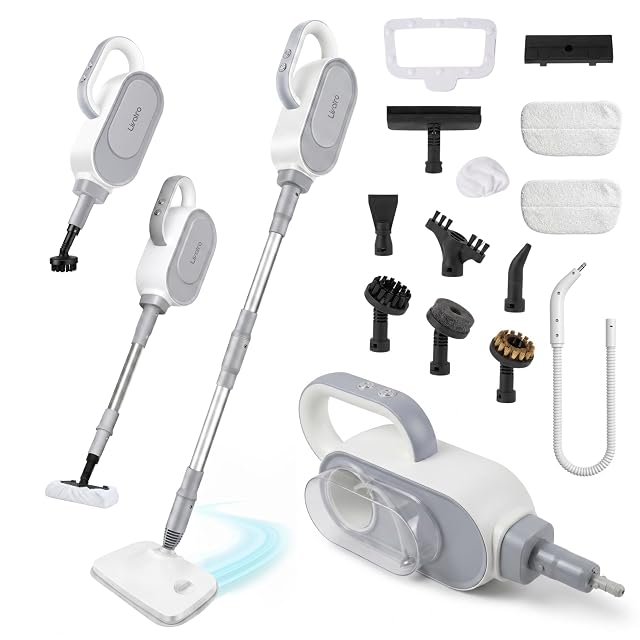
- “17 versatile accessories, including floor brushes, microfiber pads, nylon and brass brushes, a window tool, detail nozzle, and more.”
- “The large 51 oz water tank provides up to 50 minutes of continuous steam… When refilling, allow the unit to cool for 20 minutes before adding water.”
- “Designed with a steam child lock and organized accessory storage… The safety cap stays locked while the tank is hot or pressurized and opens normally after cooling.”
- “UL499 certified for added peace of mind and backed by a 2-year warranty”
- “Use the floor brush for floors, detail tools for grout and tile, and specialized attachments for bathrooms, kitchens, windows, upholstery, and other hard-to-reach areas.”
- Reference CB-101A
Three hundred degrees at fifty-eight psi, and the pair agrees
Steam temperature and pressure are locked together by physics. At 1 bar, water boils at 100 °C (212 °F) / 212 °F. At 58 psi — 4 bar gauge, or 5 bar absolute — saturated steam reaches about 152 °C (306 °F), or 306 °F.
This publishes 300 °F at 58 psi: within six degrees of what the steam tables require.
It is the only pair on this shelf that does.
Schenley, $139.99 — 248 °F at 3.5 bar. But 248 °F is 120 °C, about 2 bar absolute, where 3.5 bar gauge would put steam near 298 °F. ✗
HJGJYWLQ, $591.99 — “Steam temperature: 110 °C” and “Steam pressure: 4.0-5.0 Bar”. At 4.5 bar, saturated steam is 144 to 152 °C. ✗
NEWBULIG, $37.89 — 212 °F, no pressure claimed. Correct, since 212 °F is exactly 1 bar — an unpressurized mop. ✓
Phueut, $119.64 — “high heat and pressure”, no figure of either kind.
Shark S1000, S3501, S8001, S8201 — neither figure, on any of the four.
What the pair buys in practice is the difference between this and the mops. Steam at 300 °F melts grease on contact rather than merely wetting it. And 58 psi drives it into a grout line rather than letting it condense on top — which is why bullet two can sensibly say “detail tools for grout and tile”.
The 1500 W is the third figure, and it fits: it is enough to maintain that output on a 1.5 liter tank, and it is 12.5 amps at 120 V, inside a standard 15 A American circuit.
Fifty minutes, and then twenty minutes of waiting
51 oz — about 1.5 liters — giving up to 50 minutes. That is 30 milliliters a minute, and the Schenley independently lands on the same rate: 45.5 fl. oz. over 45 minutes.
Two machines at the same consumption, which makes both figures more credible than either alone. The shelf:
this — 51 oz / 50 min = 30 ml/min
Schenley — 45.5 fl. oz. / 45 min = 30 ml/min
Phueut — 1.5 L, no runtime. At that rate, about 50 minutes
HJGJYWLQ — 3.5 L at a published 120 ml/min = 29 minutes. The biggest tank here and the shortest runtime, because it uses four times the steam
The four Sharks — “large” and “XL water capacity”, no figures at all
And then the sentence nobody else writes: “When refilling, allow the unit to cool for 20 minutes before adding water.”
With the mechanism given in the next bullet: “The safety cap stays locked while the tank is hot or pressurized and opens normally after cooling.”
That is a correctly designed interlock. You cannot open a vessel at 58 psi and 300 °F — which is precisely what you should not be able to do, and what a cheaper machine may let you try.
The consequence is that the fifty minutes has to cover the job. At 30 ml a minute that is a kitchen, two bathrooms and a hall, so for most houses it will. If it does not, the interruption is not two minutes at a tap: it is twenty minutes of cooling plus the heat-up again.
Which also makes the absent heat-up figure more annoying than it would be elsewhere. The Schenley publishes 8 minutes for a slightly smaller tank, and the arithmetic supports it — about 0.45 megajoules to bring 1.35 L to the boil, which at 1500 W is roughly five minutes. On 1.5 liters at 1500 W the same sum gives about five and a half. So expect five to eight minutes, and plan one tank.
For contrast: the Shark S1000 and S3501 reach steam in 30 seconds and refill whenever you like, because they hold cold water and flash it at the head. No pressure, no wait — and no grout penetration either.
Seventeen accessories, and the only kit here you can inspect
“17 versatile accessories, including floor brushes, microfiber pads, nylon and brass brushes, a window tool, detail nozzle, and more.”
The smallest kit of the four canisters, and the only itemized one:
Phueut 28 — none named · Schenley 21 — none named · this 17 — itemized · NEWBULIG 14 — only the carpet glider named · HJGJYWLQ — “multiple specialized attachments”, no count
Three of those items are worth separating.
The brass brush. Brass is softer than most of what you clean: on an oven rack, a grill bar or a stubborn tile joint it lifts baked-on deposit without scoring the metal underneath. Steel scratches anything polished and leaves particles on aluminum that corrode later. Having nylon as well is the right spread — nylon for visible surfaces where you want no risk at all. This is the only listing on the shelf that tells you which brushes you are getting, and it is the detail that decides whether a brush helps or marks.
The floor brush, which confirms this can actually mop. On the Phueut — titled “Steam Mop” — no floor head is named at all. The Schenley implies one by including a “mop holder”.
The window tool. A squeegee attachment, which is what makes a steam cleaner usable on glass: steam loosens the film, the blade takes the water off.
And accessory counts inflate. Spare seals, a funnel, a measuring cup and a bag are all legitimately in a box and none of them cleans anything — which is part of why seventeen named items is a better proposition than twenty-eight unnamed ones.
“Organized accessory storage” is the other half of it. Seventeen attachments in a cupboard become six within a year. Only the Schenley, with its “integrated mop holder and cord wrap”, addresses the same problem.
UL499 and two years, which nothing else here has
“UL499 certified for added peace of mind and backed by a 2-year warranty.”
Both are unique on this shelf. No other listing publishes a certification of any kind, and no other listing publishes a warranty term at all.
UL499 is the American safety standard for electric heating appliances — which is exactly the right standard for a 1500 W element heating a pressurized vessel of water, and it is tested by a third party rather than asserted.
Set that beside what the rest of the shelf offers in its place:
Schenley — “Compliant with EPA standards”, with no standard cited, applied to a hygiene claim rather than safety
Shark S3501 and S8201 — a named-organism footnote for their sanitization claim, which is a strong hygiene statement and not a certification
Phueut, HJGJYWLQ, NEWBULIG, Shark S1000 and S8001 — nothing
Two years is a long warranty for this category. The parts that fail on a steam cleaner are the element, the pump, the pressure switch and the seals, and two years covers the period in which a manufacturing fault in any of them will show.
The child lock, and why this machine needs one most
“Designed with a steam child lock.”
At 300 °F and 58 psi this is the hottest, highest-pressure machine on the shelf by its own published figures, which makes a lock on the trigger a necessity rather than a courtesy.
The shelf, on safety:
this — a steam child lock, plus a safety cap that stays locked while hot or pressurized
NEWBULIG — anti-dry-burn with three signals: a pump sound, an auto-shutoff, and a red indicator that stays on until refilled
Schenley — built-in overheat protection
Phueut — a safety cap that “ensures a tight seal”, and a trigger lock, which is the opposite of a child lock: it holds the steam on
HJGJYWLQ — “temperature monitoring and automatic shutoff” and a heat-resistant housing
The four Sharks — nothing published
The Phueut comparison is worth holding onto. A trigger lock keeps steam running; a child lock stops it starting. A machine with the first and not the second, and no published temperature, is the riskier arrangement.
What is not published
No weight, and this is the clearest omission on a canister. The shelf: Shark S1000 2087 g · S3501 2209 g · NEWBULIG 2341 g · Shark S8001 3130 g · Phueut 3447 g · Schenley 3629 g · Shark S8201 4042 g · HJGJYWLQ 11489 g gross. A 1.5 liter tank plus a 1500 W element will not be light, and the page says nothing about wheels or a handle either, where the Schenley publishes “smooth-rolling wheels” and the Phueut “super smooth wheels and ergonomic handle”.
No heat-up time, as above — five to eight minutes is the arithmetic, and the cooling wait makes it matter.
No cord length, where the Shark S1000 gives 18 ft, the NEWBULIG 16.4 ft, the HJGJYWLQ 3.5 m and the Phueut 9.8 ft. And no hose length, which on a canister is the other half of your reach.
No sealed-floor caution, and bullet two names “floors”, “grout and tile”, “upholstery”. All four Sharks carry a capitalized bullet reading “SEALED HARD FLOORS”, and the word is the caution: on unsealed or waxed timber steam swells the fiber and strips wax, on unglazed stone it soaks in, on laminate with open seams it lifts the surface layer, on unsealed grout it erodes. At a published 300 °F this is the machine on this shelf most capable of doing that damage, and the risk rises with the temperature rather than falling. The cheap test is a drop of water on an inconspicuous joint: does it bead, or soak?
No descaling or rinse function, and on a pressurized tank run at 58 psi that is the omission that governs how long it lasts. Every liter of tap water leaves its calcium in a vessel you cannot reach, and the deposit collects at the narrowest point. Distilled or filtered water from the first fill is the sensible precaution — the Schenley hints at the same thing by specifying “purified water”.
No steam adjustment. The Phueut has a dial on the handle and a trigger lock; the Schenley two trigger settings; the Shark S8001 and S8201 three modes. Nothing is said here, which on a 300 °F machine is the control you would most want for upholstery.
No sanitization claim, where four machines here make one. This page claims cleaning performance and leaves hygiene alone — which is arguably the more honest position, and it is the one listing whose certification is about something that was actually tested by someone else.
Availability
Read on the day this page was built: $140 at the American Amazon shop.
Read from Keepa on the day this page was last revised; stock and price both move without notice.
Prices quoted in this text were read on 2026-10-05. The live price is at the top of the page.