What the maker puts in writing
- “automatically collects dust, debris and pet hair into a large 4L dust bag for up to 120 days”
- “Powered by 6000Pa suction, this robot vacuum cleaner easily lifts crumbs, dust and embedded pet hair from carpets, tile, and hardwood floors… Automatic carpet boost increases suction power when needed”
- “360°Smart LiDAR Mapping… supports saving up to 4 floor maps… Set no-go zones and virtual walls in the app”
- “3 suction levels and 3 water flow settings”
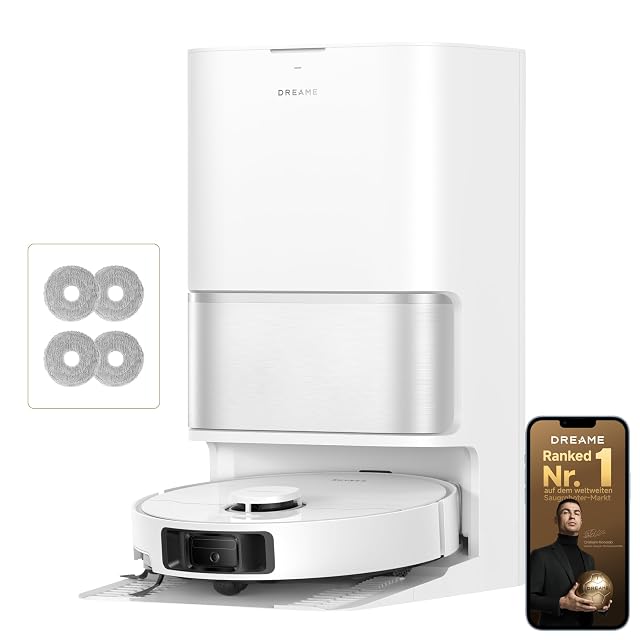
- “Note: If you don’t want it to mop, just remove the mopping cloth, and then it will only vacuum”
- “Its roller brush is designed to reduce hair tangles, and the side brush can flexibly clean various hidden corners”
- “works with Amazon Alexa, Google Assistant and dedicated smart app”
A hundred and twenty days, on one of the thinnest assumptions here
4 liters over 120 days is 33 milliliters a day.
That is the longest interval claimed on this shelf, from close to the lowest daily rate. The comparison:
TRDIOL — 4 L / 120 days = 33 ml/day
iRobot 115X — 2.5 L / 90 days = 28 ml/day
roborock Q10 S5+ — 2.7 L / 70 days = 39
eufy E25 — 3 L / 75 days = 40
roborock Qrevo S Pro — 2.7 L / 7–9 weeks = 43 to 55
eufy Omni C20 — 3.1 L / 60 days = 52
Only one listing on this shelf says what household it is describing, and it is the eufy Omni C20: “*Based on a 3-person household without pets; intervals vary.”
That single qualification is worth more than any of the headline figures, and it points the opposite way from the marketing. Every listing here sells itself on pet hair — and a household with a shedding dog fills a bag in a fraction of the time one without does.
So read 120 days as a best case. What is not in doubt is the 4 liter bag, which is the largest on this shelf: the eufy Omni C20 has 3.1 L, the eufy E25 3 L, both roborocks 2.7 L, the iRobot 115X 2.5 L.
And the Shark Matrix Plus avoids the question entirely with a “bagless base with no replacement bags required” — the only self-emptying machine here with no consumable.
Six thousand pascals, and where it costs you
The lowest published figure on this shelf, in a field that runs a factor of five:
ECOVACS T90 PRO 30,000 Pa · iRobot 415X and eufy E25 20,000 · roborock Qrevo S Pro 18,500 · iRobot 115X 15,000 · roborock Q10 S5+ 10,000 · eufy Omni C20 7000 · this 6000
Where it matters is carpet. Pulling embedded grit and hair out of a pile is precisely what suction does, and the listing hedges with “automatic carpet boost increases suction power when needed” — which is the right feature to have at this figure.
On hard floors the picture is different. Above a few thousand pascals the returns fall off fast, because there is no pile to pull against: the brush sweeps the debris into the path and the airflow carries it. Tile, wood and a few flat rugs do not need 30,000 Pa.
Worth knowing that five listings on this shelf publish no pascal figure at all. The Shark, and four iRobot models that publish “70X more power-lifting suction” or “175x stronger suction” against the Roomba 600 series — a discontinued product whose own suction none of them states, which makes the multiplier impossible to convert or compare.
So this listing’s 6000 is the smallest number here and it is a number, which is more than a third of the shelf manages.
LiDAR and four maps, at the bottom of the price range
360° LiDAR, four saved floor maps, no-go zones and virtual walls.
That is the full navigation specification, and it is the same architecture as machines at five times the price — the iRobot 705X at $1399.99 has “ClearView Pro LiDAR”, the roborock Q10 S5+ “PreciSense LiDAR”, the eufy E25 “Laser-Guided Navigation”.
LiDAR is the thing worth having at any price. It maps the room with a spinning laser and then cleans in rows, rather than bouncing off furniture until the battery runs down. The difference in coverage and in time taken is large, and it is why the random-pattern robots have largely disappeared.
Four floor maps covers a house on three levels with room to spare — the eufy E25 stores five, the eufy Omni C20 three.
What LiDAR does not do is see small objects on the floor. For that the better machines add cameras or structured light: the roborock Q10 S5+ has “ReactiveTech… structured light technology”, the iRobot 505X and 705X have “PrecisionVision AI” that recognizes “cords, socks, pet waste”. This listing has no obstacle recognition beyond the LiDAR itself, so cables and socks are a pre-clean job.
Three levels of water, and a cloth you take off
Three suction levels, three water-flow levels, and the honest note: “If you don’t want it to mop, just remove the mopping cloth.”
Three water levels is the right number and it is the setting people actually change — a bathroom wants more water than a hallway, and too much water on a wood floor is the one way these machines do damage.
What this does not have is any form of mop lift. Five listings publish a height for it — the ECOVACS at 0.6 inch (15.2 mm), the eufy E25 at 10.8 mm (0.43 in), the iRobot 415X and roborock Qrevo S Pro at 10 mm (0.39 in), the roborock Q10 S5+ at 8 mm (0.31 in) — and three more lift without giving a figure.
Two others avoid carpet rather than lifting over it: the iRobot 105 and 105X both “detect carpet and avoid mopping”. That is a meaningful difference, because a machine that avoids will also leave the hard floor at the edge of a rug unmopped.
This listing publishes neither, which on a floor with rugs is the question to settle before buying.
What is not published
No runtime. Only three listings give one: the eufy Omni C20 at 132 min, the eufy E25 at 125 min — and the eufy specifies the demanding case, “vacuum + mop, standard mode” — and the iRobot 115X, which gives an area instead: “up to 900 sq ft/charge”.
No noise figure. Two listings publish one: the roborock Qrevo S Pro at 55 dB, the eufy E25 at “≤61dB (max mode)”, and only the eufy names the mode.
No height, which decides what furniture it fits under. The published figures: iRobot 115X 79 mm, 415X 84 mm, eufy Omni C20 85 mm, roborock Qrevo S Pro 3.8 in, iRobot 105/105X/705X 104 mm, 505X 107 mm, Shark 145 mm.
No mop washing or drying, as above.
No filtration standard. The Shark publishes “True HEPA… 99.97% of dust and allergens (down to 0.3 microns)”; the iRobot 105X and 105 publish “99% of allergens (0.7 microns)”. Those are different thresholds, and the Shark’s is the real HEPA definition.
No weight, where the catalog gives 17,001 g for the eufy E25 system, 14,000 g for the ECOVACS and 6700 g for the roborock Q10 S5+ — figures that describe the robot plus its dock.
Availability
Read on the day this page was built: $230 at the American Amazon shop.
Read from Keepa on the day this page was last revised; stock and price both move without notice.
Prices quoted in this text were read on 2026-10-04. The live price is at the top of the page.