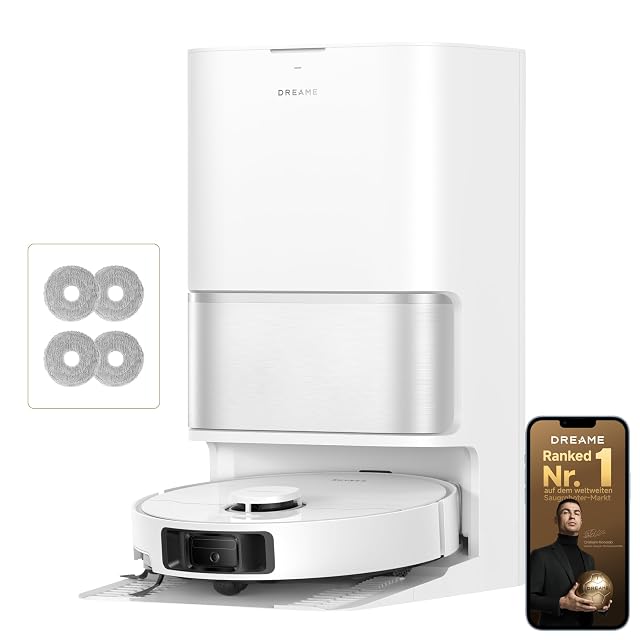
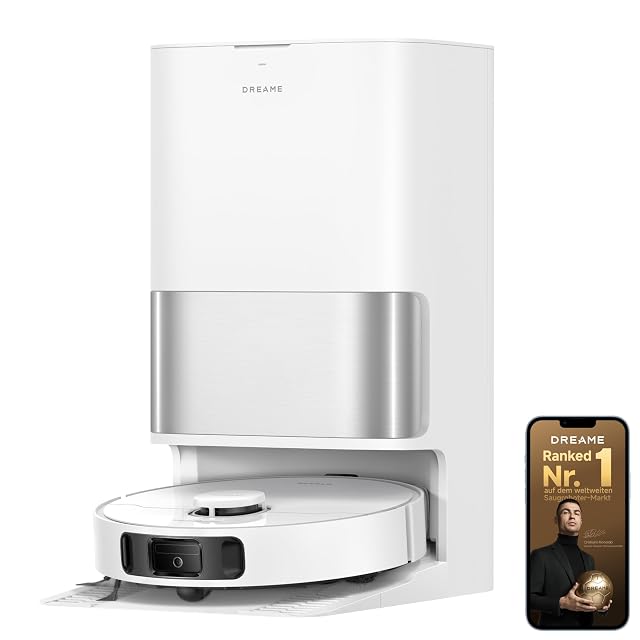
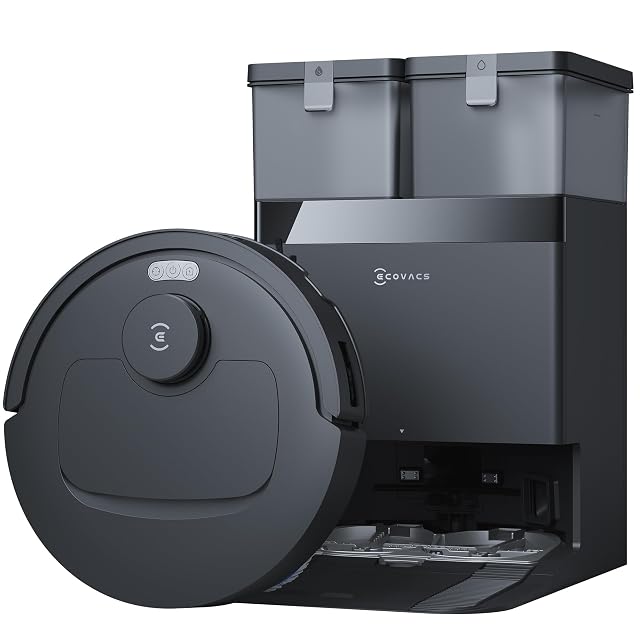
What the maker puts in writing
- “dual-zone sonic vibration technology, with scrubbing up to 3000 times per minute to remove all stains and mess… It lifts up to 8mm (0.31 in) on carpets”
- “With an impressive 10,000 Pa suction, it effortlessly lifts embedded pet hair, crumbs, and debris”
- “The large 2.7L dust bag provides up to 70 Days of maintenance-free cleaning”
- “Equipped with a JawScrapers Comb main brush and a specialized anti-tangle side brush”
- “Intelligently identifies carpets and lifts mopping modules to avoid wetting, while automatically increasing suction power” — Ultrasonic Detection
- “ReactiveTech Obstacle Avoidance - Advanced structured light technology”
- “PreciSense LiDAR… scans 360° to create highly detailed maps and supports multi-level mapping”
- Catalog: 6700 g (236.3 oz) · 526 × 353 × 259 mm (20.7 × 13.9 × 10.2 in)
Three thousand a minute, and what the word “sonic” is worth
3000 scrubs a minute is 50 Hz. That is genuinely in the audible range, which is what “sonic” means.
The Shark Matrix Plus at $442.95 publishes “sonic mopping scrubs hard floors 100x per minute” — 1.67 Hz, slower than a resting heartbeat, and not sonic by any definition of the word.
So the machine at $279.99 publishes thirty times the oscillation rate of a machine at a hundred and sixty dollars more, and only one of the two figures earns its adjective.
What vibration does that a dragged pad does not: it breaks the bond between a dried mark and the floor. A pad pulled across a dried splash of sauce polishes it; a pad oscillating fifty times a second abrades it.
The other scrubbing figures here are rotations and are not directly comparable: the eufy Omni C20 turns its pad at 180 rpm, the iRobot 705X at 200 rpm. Nine of thirteen listings publish no scrubbing figure at all.
And one rival publishes something nobody else does — the eufy Omni C20’s “6N of downward pressure”. Scrubbing work is pressure times speed, so a slow pad pressed hard can beat a fast one resting lightly. That is the figure this listing is missing.
Ten thousand pascals, mid-shelf
10,000 Pa HyperForce, which places this in the middle of a field spanning a factor of five:
ECOVACS T90 PRO 30,000 · iRobot 415X and eufy E25 20,000 · roborock Qrevo S Pro 18,500 · iRobot 115X 15,000 · this 10,000 · eufy Omni C20 7000 · TRDIOL 6000
And five listings publish nothing: the Shark, plus four iRobot models that publish “70X” or “175x more suction” against the discontinued Roomba 600 series — a baseline whose own figure none of them states, which makes the multiplier unconvertible.
Where suction matters is carpet, lifting grit and hair out of a pile. On hard floors the returns above a few thousand pascals fall away quickly, because there is nothing to pull against.
So on a flat with tile and wood, 10,000 Pa with 3000 scrubs a minute is a better pairing than 30,000 Pa with a dragged pad.
Ultrasonic carpet detection, which nobody else uses
“Ultrasonic Detection - Intelligently identifies carpets and lifts mopping modules to avoid wetting, while automatically increasing suction power.”
Every machine here detects carpet somehow. This is the only one that says how.
Ultrasound reads the surface by echo, so it distinguishes a hard floor from a pile regardless of color — where an optical sensor can be fooled by a dark tile or a pale rug.
Two things happen at once when it fires: the mop lifts 8 mm (0.31 in), and suction rises. That second half is the part people forget to want, and it is the right behavior: carpet needs more suction and no water, hard floor needs water and less suction.
Eight millimeters is the lowest lift published on this shelf — ECOVACS 15.2 mm (0.60 in), eufy E25 10.8 mm (0.43 in), iRobot 415X and roborock Qrevo S Pro 10 mm (0.39 in) — which is enough for a flat-weave or a low pile and not for a deep one.
Structured light on top of LiDAR
PreciSense LiDAR for the map, ReactiveTech structured light for the obstacles.
Those are two different jobs and this listing does both, which is unusual at the price.
LiDAR spins a laser and builds the floor plan, so the machine cleans in rows instead of bouncing around. Every listing on this shelf has it.
Structured light projects a pattern and reads its distortion, which detects low objects the LiDAR sweeps straight over — a sock, a cable, a shoe. The rivals that address the same problem do it with cameras: the iRobot 505X and 705X use “PrecisionVision AI” to recognize “cords, socks, pet waste”, and the ECOVACS carries an RGB camera.
Structured light has one advantage worth noting over a camera: it works in the dark, and it does not put a lens in your house.
Multi-level mapping stores floor plans so the machine recognizes where it is when carried upstairs. The eufy E25 stores five maps, the TRDIOL four, the eufy Omni C20 three.
Two combs, for the thing that actually stops these machines
“a JawScrapers Comb main brush and a specialized anti-tangle side brush.”
Hair wrapping the main brush is the most common reason a robot vacuum stops working properly, and the fix is a comb permanently engaged with the roller, stripping it as it turns.
Doing it on the side brush as well is the less obvious half, and the more irritating failure: long hair winds around the side brush spindle until it stalls.
The rivals name their own versions: “DuoSpiral Anti-Tangle Brushes” (eufy E25), “Pro-Detangle Comb flips down mid-clean” (eufy Omni C20), “ZeroTangle 4.0” (ECOVACS), “zero-tangle side brush, all rubber main brush” (roborock Qrevo S Pro), “self-cleaning brushroll” (Shark), “anti-tangle Dual Rubber Brushes” (iRobot 705X).
It is the universal claim of this shelf, and no listing here offers a test or a figure for it.
What the station does not do
It empties dust. It does not wash the mop.
That is the dividing line on this shelf, and it runs straight through roborock’s own range: this machine’s stablemate, the Qrevo S Pro at $429.99, washes its mops at 167 °F and dries them with 113 °F warm air.
Six listings here wash the mop automatically: the Qrevo S Pro, the ECOVACS T90 PRO (up to 167 °F wash, 145 °F dry), the iRobot 415X (113 °F), the iRobot 505X and 705X (hot, unspecified), the eufy E25 (50 °C (122 °F) dry), and the eufy Omni C20 — which uses room-temperature air and publishes the power draw as a virtue.
Three go further and wash the mop during the run: the eufy E25 “refreshes the roller mop 2 times per second”, the ECOVACS “cleans the roller in real time”, the iRobot 705X “continuously washes itself during use”.
What that means here: after a mopping run, the pad is damp and dirty until you rinse it. The ECOVACS listing puts the consequence bluntly — “Dirty pads re-soil floors” — and that applies to at least seven of the eighteen machines on this shelf, this one included.
For a machine whose strength is 3000 scrubs a minute, having to hand-rinse the thing doing the scrubbing is the honest cost of the price.
What is not published
No runtime. Only the eufy Omni C20 (132 min) and eufy E25 (125 min, specified as “vacuum + mop, standard mode”) give one, plus the iRobot 115X which gives an area: “up to 900 sq ft/charge”.
No noise figure, where its own stablemate publishes 55 dB and the eufy E25 “≤61dB (max mode)”.
No height, which decides what it fits under. The Qrevo publishes “3.8 in”; the shelf runs from the iRobot 115X at 79 mm to the Shark at 145 mm.
No water tank capacity, which no listing on this shelf publishes.
No filtration standard. The Shark publishes “True HEPA… 99.97% down to 0.3 microns”; the iRobot 105X and 105 publish 99% at 0.7 microns.
And 2.4 GHz Wi-Fi only, which is true of at least thirteen of the eighteen listings here.
Availability
Read on the day this page was built: $280 at the American Amazon shop.
Read from Keepa on the day this page was last revised; stock and price both move without notice.
Prices quoted in this text were read on 2026-10-04. The live price is at the top of the page.