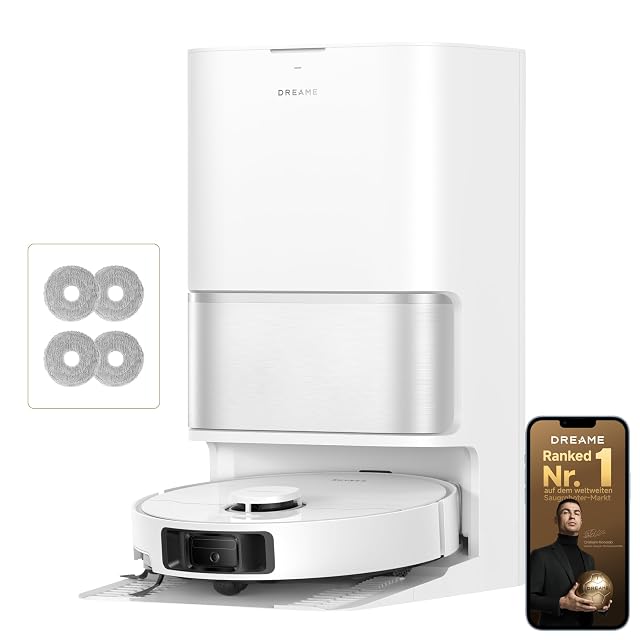
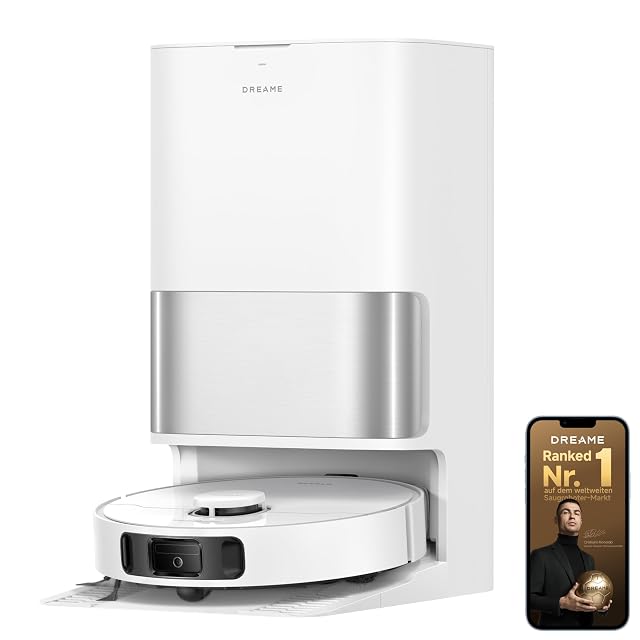
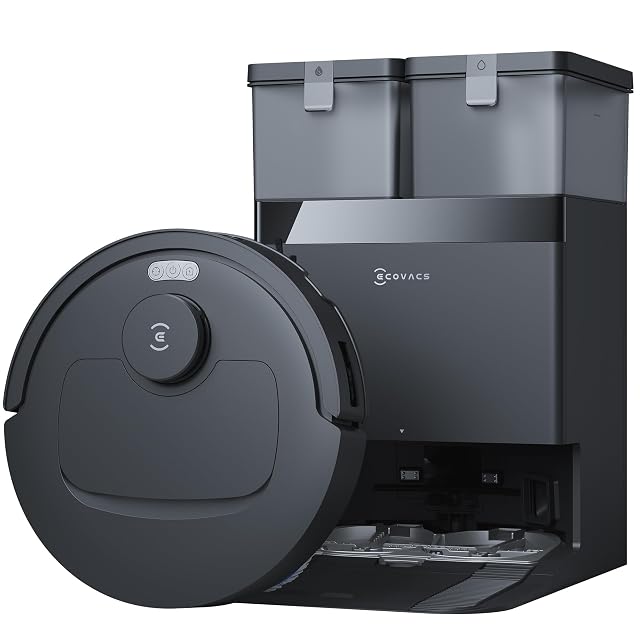
What the maker puts in writing
- “The Roomba 105X Combo + AutoEmpty Dock captures dirt and dust in a sealed bag that locks in 99% of allergens (0.7 microns)” — 75 days
- “Devours dirt with 70X more power-lifting suction to pull embedded dust, crumbs, and pet hair… The 3-Stage Cleaning System combines intense suction, a Multi-Surface brush, and an Edge-Sweeping brush. Compared to Roomba 600 series robots”
- “SmartScrub uses a micro-pump to keep the mop pad evenly moist for deeper cleaning”
- “ClearView LiDAR maps your home quickly and cleans in neat, efficient rows”
- “Detects carpet and avoids mopping automatically, keeping rugs dry with no setup or mode switching required”
- “Adjust suction, water flow, and passes to match kitchens, bathrooms, bedrooms, or entryways”
- “Target specific rooms and set keep-out zones… Uses a 2.4 GHz network”
- Catalog: 335 × 335 × 104 mm (13.2 × 13.2 × 4.09 in)
Read the Roomba 105 beside it first
The cheaper Roomba 105 at $299 publishes:
the same AutoEmpty dock · the same 75 days · the same bag at 99 per cent of allergens, 0.7 microns · the same ClearView LiDAR · the same 70X suction claim against the Roomba 600 series · the same SmartScrub at “2× deeper” with a micro-pump · the same automatic carpet avoidance · the same adjustable suction and solution · the same 104 mm (4.09 in) catalog height
And the 105 publishes two things this one does not: a box list (“1 Roomba 105 Combo robot, 1 AutoEmpty Dock, 1 Extra Mop Pad”) and an edge claim of “20% better edge and corner cleaning”.
What this listing adds is prose — cleaning “day or night”, the voice assistants named, a sentence about keep-out zones.
On the published specifications there is nothing identifiable in the forty-five dollars. If both are on the shelf, the $299 listing is the one to take.
Three stages here, four stages there
This listing: “The 3-Stage Cleaning System combines intense suction, a Multi-Surface brush, and an Edge-Sweeping brush.”
The Roomba 105 description: “The 4-stage cleaning system… combining 70X more intense power-lifting suction, an edge-sweeping brush, a multi-surface brush, and a washable, re-usable microfiber pad.”
The fourth stage is the mop pad, counted as a cleaning stage on one listing and not on the other.
Both machines have all four components. Which is the point worth taking away: “stages” is a marketing count, not an engineering specification, and the same hardware supports either number depending on who is writing.
The components themselves are the right arrangement, and worth understanding because it is common to the whole shelf: a multi-surface brush lifts debris off the floor, an edge-sweeping brush flicks what sits against skirting into the path, suction carries it to the bin, and a pad follows behind.
Seventy times something unstated
“70X more power-lifting suction Compared to Roomba 600 series robots.”*
The 600 series is discontinued and this listing does not say what it lifted, so 70 × an unknown is an unknown.
Four iRobot listings on this shelf use that convention — this, the 105 (70X), the 505X (up to 70X) and the 705X (175x) — which means they cannot be ranked against the nine other machines here, or usefully against each other.
And iRobot publishes pascals on its other two listings on this same shelf: 15,000 Pa on the 115X, 20,000 Pa on the 415X.
The comparable field runs from 6000 Pa (TRDIOL) to 30,000 Pa (ECOVACS T90 PRO) — a factor of five — and four of iRobot’s six models here opt out of it.
A micro-pump, which is the best thing in this listing
“SmartScrub uses a micro-pump to keep the mop pad evenly moist.”
Genuinely good engineering, and the detail that separates a mopping robot from a robot dragging a damp cloth.
A gravity-fed reservoir soaks the leading edge of a pad, leaves the trailing edge dry, and keeps dripping when the machine stops — which is how wooden floors get damaged. A pump meters water against movement, so the pad is uniformly damp and a stationary robot is not leaving a puddle.
What this does not publish is a scrubbing rate or force. Four listings do: the roborock Q10 S5+ at 3000 oscillations a minute, the iRobot 705X at 200 rpm, the eufy Omni C20 at 180 rpm with 6 N of pressure — the only force figure on the shelf — and the Shark at 100 a minute, which it calls sonic.
“SmartScrub applies extra pressure” appears on four iRobot listings here and is quantified on none.
Carpet avoided, not lifted
“Detects carpet and avoids mopping automatically, keeping rugs dry with no setup or mode switching required.”
The reliability argument is real: no lifting mechanism to fail, nothing to configure.
The cost is coverage. A machine that avoids stops short of a rug, so the hard floor along its edge — where grit collects — is never mopped.
The alternatives, with heights published:
ECOVACS T90 PRO — 0.6 inch (15.2 mm)
eufy E25 — 10.8 mm
iRobot 415X, roborock Qrevo S Pro — 10 mm
roborock Q10 S5+ — 8 mm
Plus three that lift without a figure, including the iRobot 705X with “a built-in cover” over its roller.
Its own sibling the 115X takes a third approach: a software “No Mop Zone” you draw in the app — avoidance you control rather than avoidance a sensor decides.
Ninety-nine per cent at nought point seven microns, sealed
“a sealed bag that locks in 99% of allergens (0.7 microns).”
The sealing is the part that matters, and the listing is right to lead with it: the dustiest moment in owning one of these machines is emptying it, and a bag that closes as you lift it out is the answer.
The threshold is worth comparing though. The Shark Matrix Plus publishes “True HEPA filtration captures and traps 99.97% of dust and allergens (down to 0.3 microns)” — the standard HEPA definition, a higher percentage at a smaller particle.
99% at 0.7 microns is an easier test on both axes.
And the Shark has no bag at all — a “bagless base with no replacement bags required” — which trades a consumable for a dustier emptying.
The dock empties and does not wash
The real structure of iRobot’s six listings on this shelf is the dock, not the model number:
AutoEmpty — empties dust, pad left to you: 105 ($299), 105X ($344), 115X ($469.99)
AutoWash — empties, washes and heat-dries the pad: 415X ($668.95), 505X ($778.90), 705X ($1399.99)
So after every mopping run here, the pad is damp and dirty until you rinse it by hand.
The ECOVACS T90 PRO states the consequence plainly: “Dirty pads re-soil floors.”
Six machines on this shelf wash the mop automatically, and three wash it during the run — the eufy E25 “refreshes the roller mop 2 times per second”, the ECOVACS “in real time”, the iRobot 705X “continuously… during use”.
What is not published
No pascal figure. No runtime — only the two eufy listings (132 and 125 min) and the 115X (as an area) give one. No noise figure, where the roborock Qrevo S Pro publishes 55 dB. No mop lift, because there is none. No water tank capacity, which nothing here publishes. No weight, true of all five iRobot listings on this shelf.
Availability
Read on the day this page was built: $345 at the American Amazon shop.
Read from Keepa on the day this page was last revised; stock and price both move without notice.
Prices quoted in this text were read on 2026-10-04. The live price is at the top of the page.