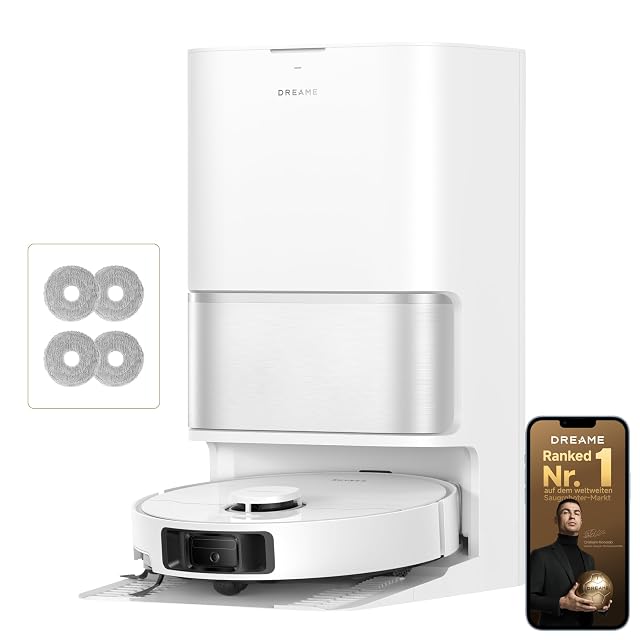
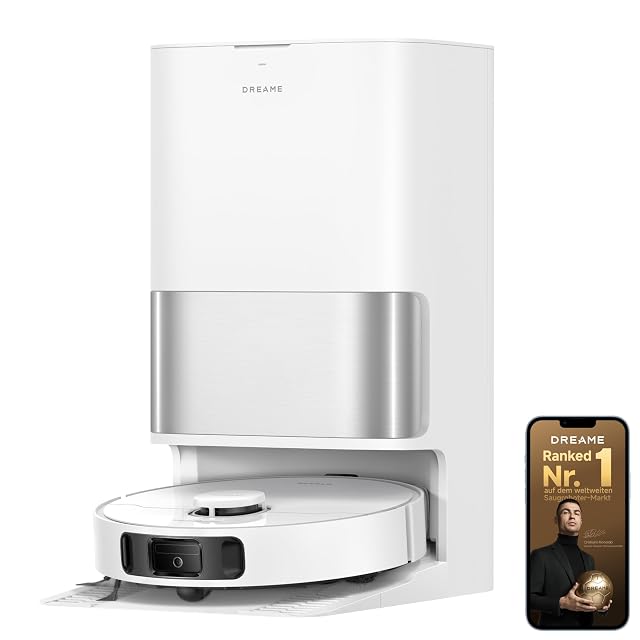
What the maker puts in writing
- “The upgraded dock automatically empties dust into a sealed 2.7L bag that lasts 7–9 weeks, while 167℉ high-temperature self-cleaning helps refresh the mops after each use and 113℉ warm air drying keeps them ready”
- “18,500 Pa Powerful Suction”
- “the zero-tangle side brush, all rubber main brush, and easy-to-clean omnidirectional wheel help reduce hair wrap”
- “the advanced dual mop system tackles daily messes with ease while adjusting water flow”
- “The robot automatically adapts to different carpet types with boosted suction, 10 mm (0.39 in) mop lifting, and customized cleaning modes”
- “Obstacle Avoidance & 3.8 in Low-Profile Cleaning”
- “With AI-powered Roborock SmartPlan 2.0, cleaning settings automatically adjust based on your home layout, floor types, and cleaning history. Enjoy powerful cleaning at 55 dB noise level”
- Catalog: 11,598 g (409.1 oz) · 340 × 487 × 521 mm (13.4 × 19.2 × 20.5 in)
A hundred and sixty-seven degrees, at the cheapest price here
“167℉ high-temperature self-cleaning… and 113℉ warm air drying.”
167 °F is 75 °C, and it is the point of this machine.
Hot water shifts kitchen grease. Cold water moves it around, which is why a mop pad rinsed cold comes out of a dock looking clean and smelling of last week.
What the rest of the shelf does:
ECOVACS T90 PRO ($799.99) — wash up to 167 °F, dry 145 °F
roborock Qrevo S Pro ($429.99) — wash 167 °F, dry 113 °F
iRobot 415X ($668.95) — wash and heat-dry 113 °F
iRobot 505X, 705X — hot, unspecified
eufy E25 — dry 50 °C (122 °F)
eufy Omni C20 — room-temperature air
Shark, TRDIOL, iRobot 105, 105X, 115X — no mop washing at all
So at $429.99 this matches the wash temperature of a machine at nearly double, and beats the $668.95 iRobot by thirty degrees Celsius.
Where it gives ground is drying: 113 °F against the ECOVACS’s 145 °F. Hot air is what stops a parked pad going sour between runs, so the ECOVACS has the better second half — and the three iRobot AutoEmpty models and the Shark have neither half.
Fifty-five decibels, and almost nobody else says
55 dB is one of two noise figures on this entire shelf.
The other is the eufy E25 at “≤61dB (max mode)” — higher, but it names the mode, which makes it the more informative figure of the two. This listing does not say whether 55 dB is standard or maximum.
Fifty-five decibels is a quiet conversation or a fridge: audible in the room, easy to talk over, usable while you are at home. Robots at full suction typically run nearer 65 to 70 dB, which is loud enough to send people out of the room — and why most of them get scheduled for an empty house.
The eleven listings that publish nothing include every iRobot here, from the $299 model to the $1399.99 one.
For a product whose whole proposition is that it cleans while you live your life, that is a strange omission for eleven of thirteen.
Three weeks less than its own stablemate, from the same bag
2.7 liters, claimed at 7 to 9 weeks — which is 49 to 63 days.
The roborock Q10 S5+ at $279.99 has the same 2.7 liter bag and claims 70 days.
Divide for the daily assumption: 43 to 55 ml a day here, 39 ml a day on the Q10. Same maker, same capacity, up to three weeks apart in the claim.
Neither is false. They assume different households — and only one listing on this shelf tells you which household it assumes. The eufy Omni C20 footnotes: “*Based on a 3-person household without pets; intervals vary.”
That is the qualification every figure here needs, given that all thirteen listings sell themselves on pet hair.
Compare the capacities, which are facts: TRDIOL 4 L · eufy Omni C20 3.1 L · eufy E25 3 L · both roborocks 2.7 L · iRobot 115X 2.5 L · Shark bagless.
The sealed bag is worth noting too: the dustiest moment of owning one of these is emptying it, and a bag that closes on removal is the answer. The Shark’s bagless base avoids the consumable and reintroduces the dust cloud.
Rubber all the way, which is the right construction
“the zero-tangle side brush, all rubber main brush, and easy-to-clean omnidirectional wheel.”
Three parts, and all three are places hair actually collects.
An all-rubber main brush is the meaningful one. Bristle brushes grip hair and hold it; rubber fins flex, release, and can be wiped clean with a hand. It is why rubber has largely replaced bristles on serious machines — the iRobot 705X names “anti-tangle Dual Rubber Brushes” for the same reason.
The side brush is the more irritating failure: long hair winds around its spindle until it stalls, and most listings ignore it.
The omnidirectional wheel is the one nobody mentions at all, and anyone who has unscrewed a robot’s front castor to cut hair out of it will recognize why it is on the list.
Across the shelf the claim is universal and unquantified: “DuoSpiral Anti-Tangle Brushes” (eufy E25), “Pro-Detangle Comb flips down mid-clean” (eufy Omni C20), “ZeroTangle 4.0” (ECOVACS), “JawScrapers Comb” (roborock Q10 S5+), “self-cleaning brushroll” (Shark).
Ten millimeters of lift, adapted by carpet type
“automatically adapts to different carpet types with boosted suction, 10 mm mop lifting, and customized cleaning modes.”
Two correct behaviors at once: the mop comes up and the suction goes up, because carpet wants air and no water while hard floor wants the reverse.
The lift heights on this shelf:
ECOVACS T90 PRO — 0.6 inch (15.2 mm)
eufy E25 — 10.8 mm
iRobot 415X, this — 10 mm
roborock Q10 S5+ — 8 mm
eufy Omni C20, iRobot 505X, iRobot 705X — lift, no figure
iRobot 105, 105X — avoid carpet rather than lifting
iRobot 115X — a software “No Mop Zone”
Ten millimeters clears a flat weave and a low pile. Nothing on this shelf handles deep pile, and the only listing willing to say so is the eufy Omni C20: “For carpet pile over 20mm (0.79 in) / 0.78 in., set No-Go Zones.”
“Adapts to different carpet types” is the claim beyond the number, and it is unverifiable — but SmartPlan 2.0 adjusting “based on your home layout, floor types, and cleaning history” is at least a described mechanism rather than an adjective.
Eighteen thousand five hundred pascals
Mid-upper on a shelf spanning a factor of five:
ECOVACS 30,000 · iRobot 415X and eufy E25 20,000 · this 18,500 · iRobot 115X 15,000 · roborock Q10 S5+ 10,000 · eufy Omni C20 7000 · TRDIOL 6000
And five listings publish no figure: the Shark, plus four iRobot models claiming “70X” or “175x” more suction than the discontinued Roomba 600 series — a baseline whose own figure none of them gives, which makes the multiplier unconvertible.
What this listing does not publish is a scrubbing rate, and its cheaper stablemate does: the Q10 S5+ gives “3000 times per minute” of sonic vibration. So within roborock’s own pair, the £150-cheaper machine tells you more about its mopping action than this one does — while this one washes the mop hot and the Q10 does not wash it at all.
What is not published
No runtime, which on a machine that must finish a floor in one pass is the figure you most need. Only the eufy Omni C20 (132 min) and eufy E25 (125 min, “vacuum + mop, standard mode”) publish one.
No scrubbing rate or pressure, where the Q10 S5+ publishes 3000 a minute, the eufy Omni C20,180 rpm at 6 N — the only force on the shelf — and the iRobot 705X 200 rpm.
No automatic water refill, which the eufy E25, iRobot 415X and iRobot 705X docks all claim. Without it, you top up a tank by hand even though the dock washes the mops for you.
No water tank capacities, which nothing on this shelf publishes.
No filtration standard, where the Shark publishes “True HEPA… 99.97% down to 0.3 microns” and two iRobot listings publish 99% at 0.7 microns.
And 2.4 GHz Wi-Fi only, as on at least thirteen of the eighteen listings here.
Availability
Read on the day this page was built: $700 at the American Amazon shop.
Read from Keepa on the day this page was last revised; stock and price both move without notice.
Prices quoted in this text were read on 2026-10-04. The live price is at the top of the page.