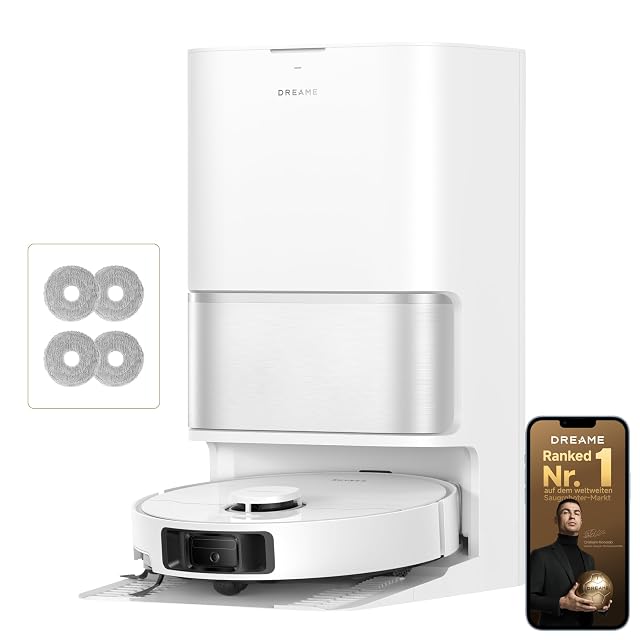
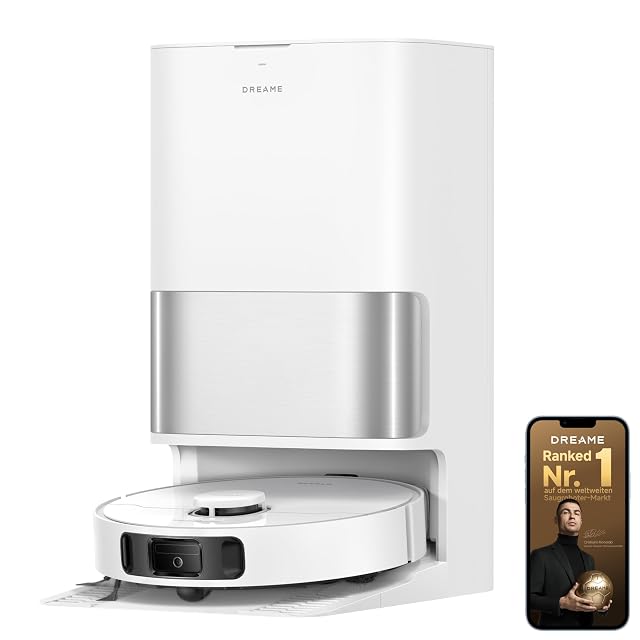
What the maker puts in writing
- “Refreshes the roller mop 2 times per second with clean water, ensuring every pass is spotless and preventing cross-contamination. Removes tough stains like coffee and sauce”
- “Auto-empties dust into a 3L bag (lasts ~75 days), self-washes roller mops, hot air dries at 50°C (122 °F), and auto-refills water… up to 5 floor plans”
- “Powerful 20,000 Pa Suction… Lifts deeply embedded dirt and pet hair from carpet fibers, captures dust in grout lines”
- “DuoSpiral Anti-Tangle Brushes”
- “CornerRover Arm… Extends to scrub along baseboards, furniture legs, and tight corners. Works on hard floors, wood, tile, and short carpet. 10.8mm (0.43 in) mop lift protects carpets; 21mm (0.83 in) climbing navigates thresholds”
- “Precision mapping remembers up to 5 floor plans with auto floor switching. 125-minute runtime (vacuum + mop, standard mode)… Operates at ≤61dB (max mode)”
- “No drilling required—ready in 5 minutes… 2.4GHz Wi‑Fi only (no 5GHz). 110V US”
- Catalog: 17,001 g (599.7 oz) · 370 × 462 × 436 mm (14.6 × 18.2 × 17.2 in)
Twice a second, with clean water
“Refreshes the roller mop 2 times per second with clean water… preventing cross-contamination.”
This is the single most consequential difference on this shelf, and it divides thirteen machines into three and ten.
Ten of them drag a pad or a cloth. Every iRobot here except the 705X, the Shark, both roborocks, the eufy Omni C20, the TRDIOL. The pad picks up the kitchen’s dirt and carries it into the living room.
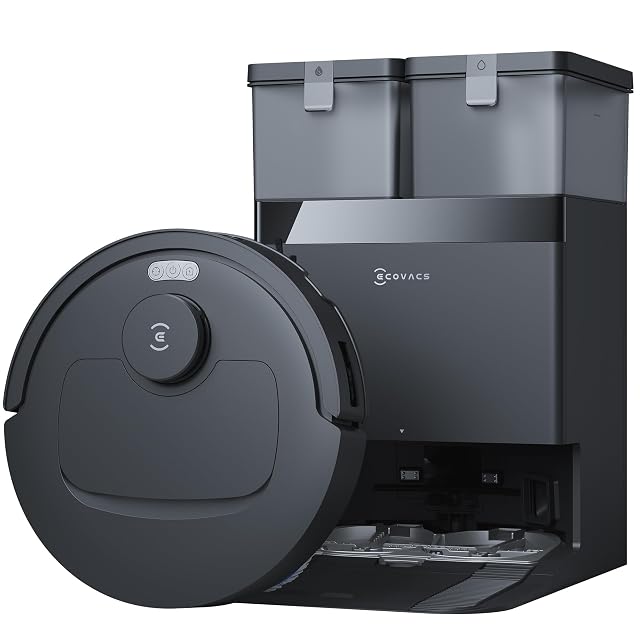
Three wash the mop while it works: this, the ECOVACS T90 PRO (“pressurized self-washing with fresh-flow rinsing cleans the roller in real time”) and the iRobot 705X at $1399.99 (“continuously washes itself during use”).
The ECOVACS listing makes the case against the other ten in its own words: “Pads wipe, they don’t scrub… removing mess instead of spreading it”, and “Dirty pads re-soil floors.”
Those three are also the three most expensive mopping systems here, which is what the mechanism costs: a pump, a clean-water feed to the roller, and a scraper and drain taking the dirty water away while the machine is moving.
For “coffee and sauce” — the listing’s own example — that is the difference between lifting a stain and smearing it.
This listing gives numbers where the rest of the shelf gives adjectives:
Runtime 125 minutes, and it names the conditions: “vacuum + mop, standard mode” — the demanding case, not vacuum-only. Only the eufy Omni C20 (132 min) also publishes a time.
Noise ≤61 dB (max mode), and it is the only listing on this shelf that names the mode. The roborock Qrevo S Pro publishes 55 dB without saying which — so the lower figure is less informative than the higher one.
Mop lift 10.8 mm — second highest here after the ECOVACS’s 15.2 mm, ahead of the iRobot 415X and roborock Qrevo S Pro at 10 mm and the roborock Q10 S5+ at 8 mm.
Climbing 21 mm — the only climbing figure on the shelf.
Suction 20,000 Pa — joint second behind the ECOVACS’s 30,000, and a real number where four iRobot listings publish “70X” or “175x” against a discontinued 2010 product.
Five floor plans with automatic switching, the most here.
Twenty-one millimeters, and the rooms it opens
Thresholds are the quiet reason robots miss rooms. A strip at a bathroom door, a lip into a conservatory, the raised edge of a tiled hall — a machine that cannot climb one never cleans what is behind it, and you discover this a week after buying.
Twenty-one millimeters is a little over three quarters of an inch, which covers most domestic thresholds and the edge of a thick rug.
No other listing on this shelf publishes a figure. That does not mean they cannot climb; it means you find out afterwards.
The surface list is where to be careful: “hard floors, wood, tile, and short carpet.” Short is doing real work in that sentence, and unlike its stablemate the eufy Omni C20 — which states “For carpet pile over 20mm (0.79 in) / 0.78 in., set No-Go Zones” — this listing does not say where short ends.
A roller mop on deep pile is worse than a pad, because a roller is pressed down and wets the fibers it touches.
A station that refills itself
“Auto-empties dust into a 3L bag (lasts ~75 days), self-washes roller mops, hot air dries at 50°C, and auto-refills water.”
Four jobs, and the water refill is the one most of this shelf omits — only the iRobot 415X and 705X also claim it. Without it, a dock that washes the mop for you still needs a tank topped up by hand, which is most of the chore it was meant to remove.
On drying, 50 °C (122 °F) is 122 °F and sits mid-field: the ECOVACS dries at 145 °F after a 167 °F wash, the roborock Qrevo S Pro at 113 °F after a 167 °F wash, the iRobot 415X at 113 °F both ways.
What this listing does not publish is a wash temperature, and hot water is what shifts grease. The continuous rinsing offsets much of that — a roller cleaned twice a second during the run reaches the dock far less soiled than a pad that mopped for an hour — but the figure is absent.
On interval, 3 L over ~75 days is 40 ml a day. The shelf’s assumptions: iRobot 115X 28, TRDIOL 33, roborock Q10 S5+ 39, this 40, roborock Qrevo S Pro 43–55, eufy Omni C20 52. Only the Omni C20 says what household it means: “*Based on a 3-person household without pets”.
An arm for the corners
“CornerRover Arm… extends to scrub along baseboards, furniture legs, and tight corners.”
A round robot cannot reach a 90-degree corner; the geometry forbids it. The shelf offers four answers:
An extending arm or roller — this, and the ECOVACS which “extends the roller 0.6 inches beyond the body”
An extended pad — the iRobot 115X, and the 505X with “PerfectEdge… covering 18% more floor area”
Air — the Shark’s “CleanEdge Detect uses targeted air blasts and corner recognition”
A side brush alone — everything else
An arm that scrubs is the strongest of the four, because the corner of a kitchen is where grease collects and a side brush only flicks dry debris inward.
Seventeen kilograms, and where it goes
17,001 g with the station, at 370 × 462 × 436 mm — the heaviest and bulkiest system on this shelf.
ECOVACS 14,000 g · roborock Qrevo S Pro 11,598 g · eufy Omni C20 9004 g · Shark 7702 g · roborock Q10 S5+ 6700 g · the five iRobot listings publish no weight at all
The robot itself is a few kilos; the rest is the dock, its clean and dirty water tanks, the bag, the heater and the pumps. That is the trade for a station that empties, washes, dries and refills — it becomes a piece of furniture, and it needs a spot near a wall with a socket.
Setup is at least straightforward: “No drilling required—ready in 5 minutes.”
What is not published
No wash temperature, as above.
No scrubbing rate or pressure. Four listings publish one — the roborock Q10 S5+ at 3000 oscillations a minute, the iRobot 705X at 200 rpm, the eufy Omni C20 at 180 rpm with 6 N, the Shark at 100 a minute — and a roller mop’s contact pressure is exactly the figure you would want.
No carpet pile limit, where its own stablemate publishes 20 mm.
No water tank capacities, which nothing on this shelf publishes.
No filtration standard, where the Shark publishes “True HEPA… 99.97% down to 0.3 microns” and two iRobot listings publish 99% at 0.7 microns.
And 110 V, 2.4 GHz only, with a note to buy the version for your region.
Availability
Read on the day this page was built: $600 at the American Amazon shop.
Read from Keepa on the day this page was last revised; stock and price both move without notice.
Prices quoted in this text were read on 2026-10-04. The live price is at the top of the page.