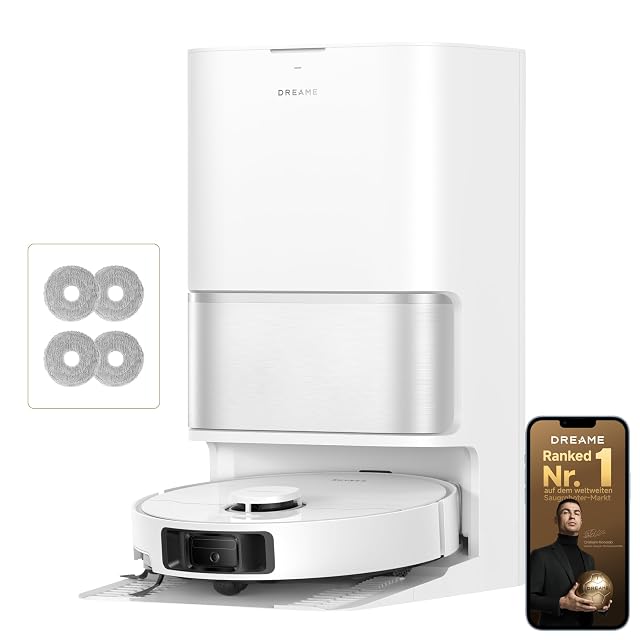
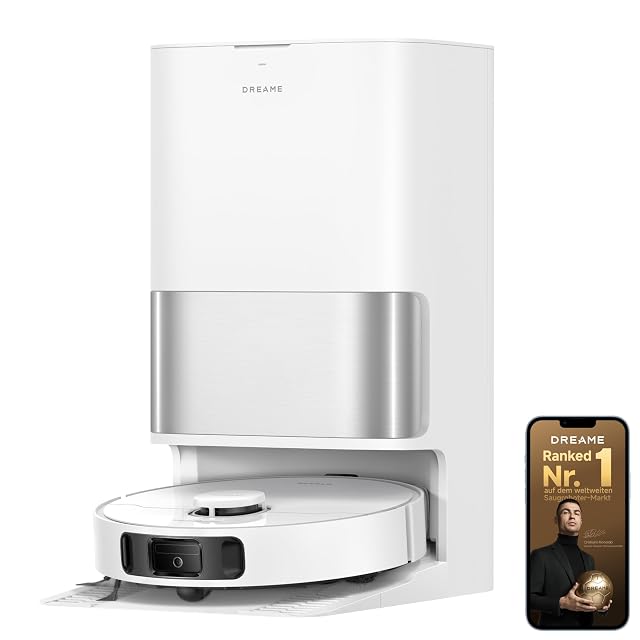
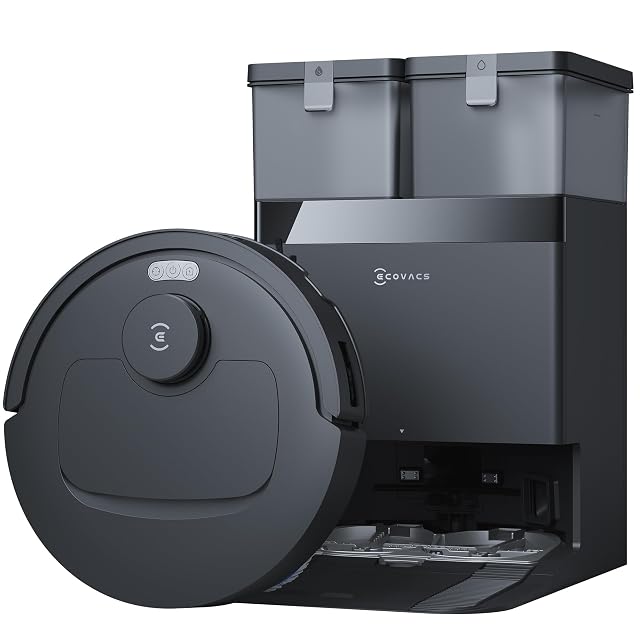
What the maker puts in writing
- “BLAST 30,000Pa high-airflow suction lifts dust, pet hair, and crumbs from carpets and hard floors in one go”
- “Pads wipe, they don’t scrub. OZMO ROLLER 3.0 uses a 10.6-inch self-washing roller with continuous, pressurized scrubbing to lift sticky spills, dried stains, and kitchen grime—removing mess instead of spreading it”
- “Dirty pads re-soil floors. Pressurized self-washing with fresh-flow rinsing cleans the roller in real time, so it always mops with clean water”
- “TruEdge 3.0 extends the roller 0.6 inches beyond the body, gliding along baseboards and corners to remove dust lines where side brushes can’t scrub”
- “A 0.6-inch roller lift keeps carpets dry. Carpets First mode vacuums carpets with a dry roller, then mops hard floors”
- “The OMNI station auto-adjusts mop washing up to 167°F by room and soil level, then fully dries the roller with 145°F hot air”
- “The OMNI station automatically flushes residue from the dirty water system, reducing sludge and smell over time”
- “The built-in RGB camera supports two-way video calls, one-tap pet search, and pet snapshots”
- Catalog: 14,000 g (493.8 oz) · 338 × 281 × 500 mm (13.3 × 11.1 × 19.7 in)
The listing that argues against most of its shelf
“Pads wipe, they don’t scrub.” and “Dirty pads re-soil floors.”
Two sentences aimed squarely at at least ten of the eighteen machines here: every iRobot except the 705X, the Shark, both roborocks, the eufy Omni C20, the TRDIOL.
And the argument holds on both counts.
A roller abrades where a pad polishes. It is pressed down and turning, so a dried splash of sauce comes off rather than being spread thinner. A pad dragged over the same mark burnishes it.
A roller washed while working cannot carry dirt between rooms. “Pressurized self-washing with fresh-flow rinsing cleans the roller in real time, so it always mops with clean water.” A pad collects the kitchen’s grease on pass one and distributes it for the next forty minutes.
10.6 inches of roller, which is close to the full width of the machine.
The only other rollers on this shelf are the eufy E25 (“refreshes the roller mop 2 times per second with clean water”) and the iRobot 705X at $1399.99 (“continuously washes itself during use”). Those three are the most expensive mopping systems here — a pump, a clean-water feed and a drain running while the machine moves is what the money buys.
Thirty thousand pascals
The highest figure on this shelf, by a fifth:
this 30,000 · iRobot 415X and eufy E25 20,000 · roborock Qrevo S Pro 18,500 · iRobot 115X 15,000 · roborock Q10 S5+ 10,000 · eufy Omni C20 7000 · TRDIOL 6000
And five listings publish no figure at all — the Shark, plus four iRobot models claiming “70X” or “175x” more suction than the discontinued Roomba 600 series, whose own figure none of them states.
Where 30,000 Pa earns its keep is carpet: pulling grit and hair out of a pile is what suction does, and the listing’s framing is right — “Weak suction leaves dirt behind… cleaning faster with fewer repeat passes.”
On hard floors the returns above a few thousand pascals fall away, because there is no pile to pull against. So the suction is for the rugs and the roller is for the tiles, which is a coherent pair.
ZeroTangle 4.0 adds the detail that makes high airflow useful rather than just loud: “BLAST airflow guides hair directly into suction” instead of letting it wrap the brush.
A hundred and sixty-seven degrees to wash, a hundred and forty-five to dry
“auto-adjusts mop washing up to 167°F by room and soil level, then fully dries the roller with 145°F hot air.”
The hottest drying on this shelf and the joint hottest wash.
167 °F is 75 °C — hot enough to shift kitchen grease. 145 °F is 63 °C — enough to dry a roller properly rather than leaving it damp in a dock.
The field:
this — 167 °F wash, 145 °F dry
roborock Qrevo S Pro ($429.99) — 167 °F wash, 113 °F dry
iRobot 415X ($668.95) — 113 °F wash and dry
iRobot 505X, 705X — hot, unspecified
eufy E25 — 50 °C dry, wash unstated
eufy Omni C20 — room-temperature air
Shark, TRDIOL, iRobot 105, 105X, 115X — no mop washing at all
The clever part is “by room and soil level”, which the listing explains: “powerful kitchen cleaning, gentler care elsewhere, no odor, longer mop life.” Washing a bathroom roller at 75 °C (167 °F) every time shortens its life for no reason.
And then the feature nobody else here has: “The OMNI station automatically flushes residue from the dirty water system, reducing sludge and smell over time.”
That is the part of these machines that actually goes wrong. Grey water sits in a tank and a pipe between runs, and after a few months the dock itself is the thing that smells. Flushing it is the right answer, and this is the only listing on the shelf that addresses it.
A camera on wheels
“The built-in RGB camera supports two-way video calls, one-tap pet search, and pet snapshots.”
Worth a decision rather than a shrug.
This is a camera and a microphone that can drive to any room in your house and send images to an app. For checking on a dog from work, that is a genuine service and the listing is not wrong to sell it.
For anyone who would not put a camera in their living room, it is a reason to choose something else — and that consideration is not reduced by the feature being presented as a convenience.
Two rivals handle the obstacle-detection half without a lens: the roborock Q10 S5+ uses “ReactiveTech… structured light technology”, which reads a projected pattern and works in the dark. The iRobot 505X and 705X use PrecisionVision AI — also camera-based, but with no video-call function claimed. Everything else here navigates by LiDAR alone.
The listing also names an AI assistant, “AGENT YIKO”, for “one-command cleaning and proactive planning”.
Carpets first, which is the right order
“Carpets First mode vacuums carpets with a dry roller, then mops hard floors—reducing cross-contamination.”
The best sequencing idea on this shelf, and it fixes a problem most of these machines create.
A robot cleaning room by room arrives at a carpet with a wet roller. It lifts it, vacuums, puts it back down and carries whatever the carpet released onto the next stretch of tile.
Doing all the carpet dry first and all the hard floor wet afterwards means the roller never meets a carpet while wet, and never leaves a carpet to go mopping.
The iRobot 415X and 505X offer “vacuum then mop” as a mode without tying it to surface type, which is the same instinct applied less precisely.
And the 0.6 inch (15.2 mm) roller lift is the highest published here: eufy E25 10.8 mm (0.43 in), iRobot 415X and roborock Qrevo S Pro 10 mm (0.39 in), roborock Q10 S5+ 8 mm (0.31 in). Three more lift with no figure, and the iRobot 105 and 105X avoid carpet instead of lifting at all.
Six tenths of an inch past the body
“TruEdge 3.0 extends the roller 0.6 inches beyond the body, gliding along baseboards and corners to remove dust lines where side brushes can’t scrub.”
The last clause is the honest one. A side brush flicks dry debris inward; it does not scrub, so the greasy line along a kitchen skirting board stays there.
A roller that reaches past the chassis scrubs the edge. That is the strongest edge solution on this shelf, alongside the eufy E25’s “CornerRover Arm”.
The alternatives: an extended pad (the iRobot 115X, and the 505X with “PerfectEdge… 18% more floor area”), air (the Shark’s “targeted air blasts”, claimed at “50% better edge cleaning (vs. RV2600 with CleanEdge off)”), or a side brush alone.
Charging while it washes
“PowerBoost charging replenishes energy during wash cycles, while adaptive charging predicts power needs by home size and mode—reducing mid-clean stops.”
A small, genuinely thoughtful piece of engineering. A roller machine stops at the dock repeatedly during a long run to rinse itself, and each of those stops is dead time. Charging through them turns a pause into a top-up.
“Adaptive charging predicts power needs by home size and mode” is the other half: charging to the level the job needs rather than to full every time, which is better for the cell.
No runtime is published, which makes those claims hard to size — and on a $799.99 machine that is the figure most worth having. Only the two eufy listings publish one: 132 min and 125 min.
What is not published
No runtime, as above.
No noise figure, where the roborock Qrevo S Pro publishes 55 dB and the eufy E25 “≤61dB (max mode)”.
No bag capacity or self-empty interval. Every other self-emptying machine here gives one: TRDIOL 4 L / 120 days, eufy Omni C20 3.1 L / 60, eufy E25 3 L / ~75, both roborocks 2.7 L, iRobot 115X 2.5 L / 90, Shark bagless at 60. This listing describes the station in detail and never says how long the bag lasts.
No mop pressure or scrubbing rate. “Continuous, pressurized” is an adjective; the eufy Omni C20 publishes “6N of downward pressure at 180 RPM”, the only force on this shelf.
No height, which decides what furniture it fits under. The published range here runs 79 mm (iRobot 115X) to 145 mm (Shark).
No filtration standard, where the Shark publishes “True HEPA… 99.97% down to 0.3 microns”.
And 2.4 GHz Wi-Fi only, as on all thirteen.
Availability
Read on the day this page was built: $800 at the American Amazon shop.
Read from Keepa on the day this page was last revised; stock and price both move without notice.
Prices quoted in this text were read on 2026-10-04. The live price is at the top of the page.