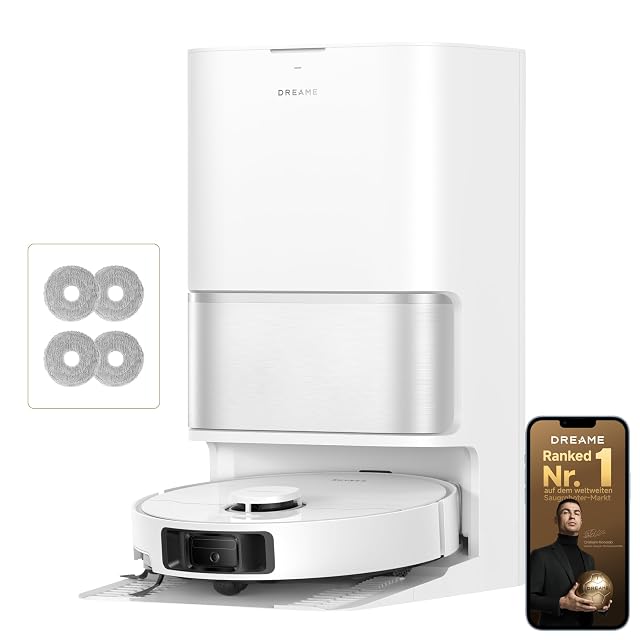
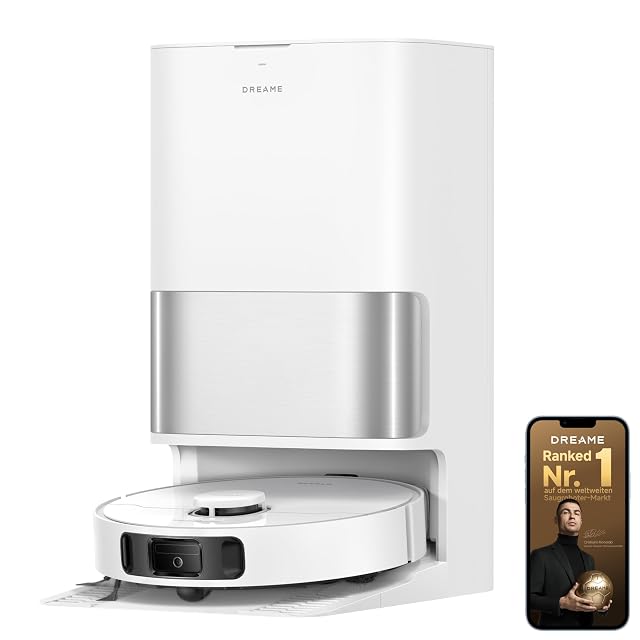
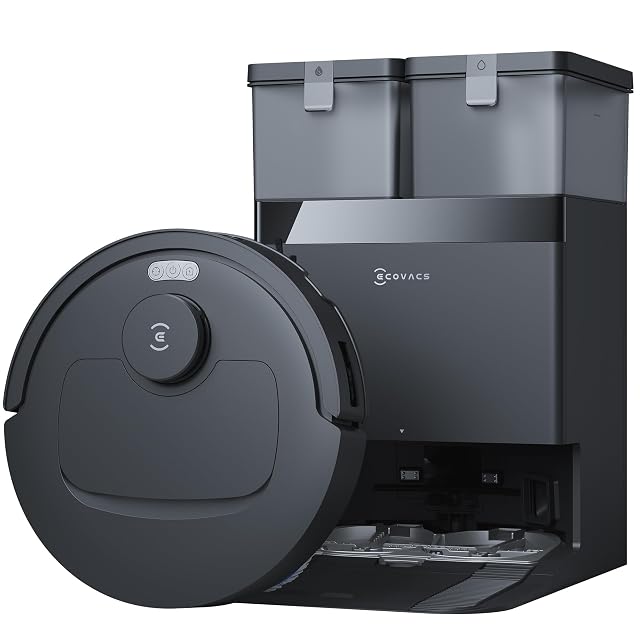
What the maker puts in writing
- “Vacuums with a suction power of 15,000 Pa to lift crumbs and fine dust while the pad mops everyday buildup, covering up to 900 sq ft/charge”
- “Empties into the AutoEmpty dock; the 2.5 L AllergenLock bag traps 99% of pollen and mold and seals on removal, no dust cloud and hands stay clean” — up to 3 months
- “The washable microfiber pad gently lifts dusty pawprints and light smudges on sealed hard floors, and you can set a No Mop Zone so rugs stay protected”
- “CLEARVIEW LiDAR MAPS ROOMS AND AVOIDS OBSTACLES — Cleans in neat rows, even in low light”
- “An extended mop pad and edge-sweeping brush work together to clean along baseboards and into corners other robots miss”
- “SmartScrub mops 2× deeper; choose 1-2 cleaning passes, 4 suction levels, and 3 mopping-water or solution* levels”**
- “LOW-TOUCH UPKEEP — Launder the washable pad as needed; replace filters and brushes every 3-6 months”
- Catalog: 298 × 303 × 79 mm (11.7 × 11.9 × 3.11 in)
Seventy-nine millimeters, which is the reason to buy this one
The slimmest machine on this shelf, and height is the specification you cannot work around afterwards.
this 79 mm · iRobot 415X 84 mm · eufy Omni C20 85 mm · roborock Qrevo S Pro 96 mm (3.8 in) · iRobot 105, 105X, 705X 104 mm · iRobot 505X 107 mm · Shark 145 mm
Most sofa and bed frames sit at 100 to 127 mm (3.94 to 5 in). So the difference between this and the Shark is the difference between the dust under your furniture being dealt with every day and never being reached at all.
What usually makes a robot tall is the LiDAR turret — a spinning laser on the lid. This one has LiDAR and is still the lowest here, which is the engineering worth paying for.
One caution that applies to every figure above: only the eufy Omni C20 publishes the clearance it actually needs rather than its own height — 85 mm (3.35 in) of body asking for “as little as 3.54” clearance”, which is 90 mm (3.54 in). Add a few millimeters before measuring your own furniture.
And the sibling 415X claims a “46% slimmer design* *Compared to Roomba 105”, where the catalog gives those two as 84 mm (3.31 in) and 104 mm (4.09 in) — 19 per cent.
Fifteen thousand pascals, and why that is unusual for an iRobot
This is one of two iRobot listings on this shelf that publishes a real suction figure. The other is the 415X at $668.95, with 20,000 Pa.
The remaining four publish a multiple of a discontinued product:
Roomba 105 ($299) — 70X · 105X ($344) — 70X · 505X ($778.90) — up to 70X · 705X ($1399.99) — 175x
All footnoted “*Compared to Roomba 600 series robots”, and none of them says what the 600 series lifted. Seventy times an unknown is an unknown.
So iRobot’s $299 and $1399.99 machines cannot be compared with anything here, while its $469.99 one can.
The comparable field: ECOVACS T90 PRO 30,000 Pa · iRobot 415X and eufy E25 20,000 · roborock Qrevo S Pro 18,500 · this 15,000 · roborock Q10 S5+ 10,000 · eufy Omni C20 7000 · TRDIOL 6000.
Fifteen thousand places this comfortably in the upper half.
Nine hundred square feet, which is not a runtime
“covering up to 900 sq ft/charge.”
An area rather than a time, and it is the only listing on this shelf that does it this way.
The three that publish a time: the eufy Omni C20 at 132 min, the eufy E25 at 125 min — specified as “vacuum + mop, standard mode”, which is the demanding case — and nobody else.
An area figure is arguably more useful, because it answers the question you have: will it finish my flat in one go? Nine hundred square feet is a decent two-bedroom.
But it is also less honest in one way: area depends entirely on how dirty the floor is and how many passes it takes, where a runtime is a runtime. And neither this nor any iRobot listing here mentions recharge and resume — the behavior that makes a short battery irrelevant — which the Shark and eufy Omni C20 both publish explicitly.
A bag that seals as you lift it
“the 2.5 L AllergenLock bag traps 99% of pollen and mold and seals on removal, no dust cloud and hands stay clean.”
The sealing is the right thing to emphasize, because emptying is the dustiest moment in owning one of these machines, and a bag that closes itself on the way out solves it entirely.
Worth setting against the alternative. The Shark Matrix Plus has a “bagless base with no replacement bags required” — no consumable, and a bin you tip, which puts the dust back in the air. Its answer is to filter the base: “True HEPA… 99.97% of dust and allergens down to 0.3 microns”.
99% at 0.7 microns here — which is the figure the 105X and 105 also quote — is a lower percentage at a larger particle, so an easier test on both counts.
On interval, 90 days from 2.5 liters is 28 ml a day, the thinnest assumption on this shelf. For comparison: TRDIOL 33 ml/day, roborock Q10 S5+ 39, eufy E25 40, roborock Qrevo S Pro 43–55, eufy Omni C20 52. And only the eufy Omni C20 states its household — “*Based on a 3-person household without pets”.
Four suction levels and three water levels
More control than most of this shelf offers, and the water levels are the ones you will actually use: a bathroom wants more water than a hallway, and too much water is the single way these machines damage a wooden floor.
One or two passes is the other setting worth having. The Shark makes multiple passes its headline — “Matrix Clean… a precision matrix grid, taking multiple passes” — and crossing your own path is genuinely how you get carpet clean.
SmartScrub adds pressure, claimed at “2× deeper” with no stated basis. It appears on four iRobot listings here and is quantified on none — where the eufy Omni C20 publishes “6N of downward pressure at 180 RPM”, the only force figure on this shelf.
The extended mop pad is the detail that goes with the edge-sweeping brush: a pad reaching beyond the body is how a round robot mops along a skirting board rather than six centimeters away from it. The ECOVACS T90 PRO does the same thing further, extending its roller “0.6 inches beyond the body”.
The dock empties, and does not wash
iRobot’s six listings on this shelf divide on the dock, not the model number:
AutoEmpty — empties dust, pad left to you: 105 ($299), 105X ($344), 115X ($469.99)
AutoWash — empties, washes and heat-dries the pad: 415X ($668.95), 505X ($778.90), 705X ($1399.99)
At $469.99 this is the most expensive AutoEmpty machine, which means nearly five hundred dollars and you still rinse the pad in a sink.
The listing is honest about the upkeep: “Launder the washable pad as needed; replace filters and brushes every 3-6 months.”
For comparison the roborock Qrevo S Pro at $429.99 — forty dollars less — washes its mops at 167 °F and dries them with warm air. The ECOVACS T90 PRO does it at up to 167 °F with 145 °F drying.
And the ECOVACS states what that is for: “Dirty pads re-soil floors.”
What is not published
No runtime as a time, as above.
No noise figure, where the roborock Qrevo S Pro publishes 55 dB and the eufy E25 “≤61dB (max mode)”. No iRobot on this shelf publishes one.
No mop lift, because there is none — rugs are handled by a No Mop Zone you draw yourself.
No scrubbing rate or pressure.
No water tank capacity, which nothing on this shelf publishes.
No weight, true of all five iRobot listings here.
And 2.4 GHz Wi-Fi required for setup, as on all thirteen.
Availability
Read on the day this page was built: $470 at the American Amazon shop.
Read from Keepa on the day this page was last revised; stock and price both move without notice.
Prices quoted in this text were read on 2026-10-04. The live price is at the top of the page.