What the maker puts in writing
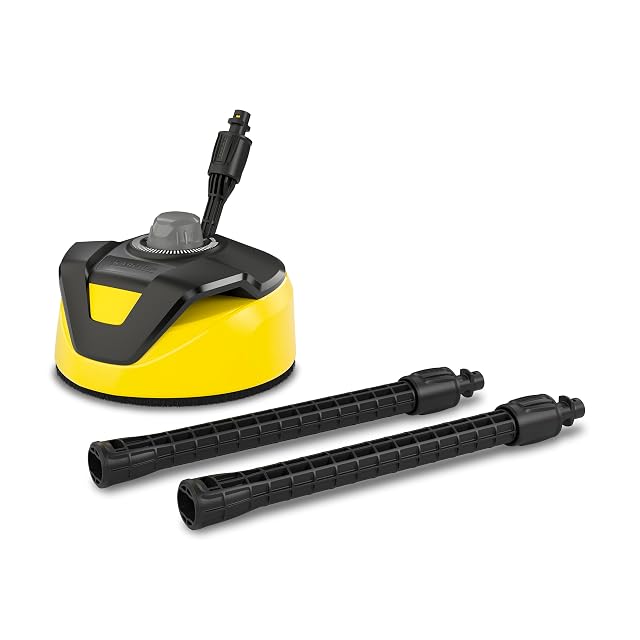
- “Compatible with most pressure washers rated 2600-3200 PSI up to 2.7 GPM”
- “Delivers professional level cleaning over an area 15” wide with two spinning nozzles instead of one, significantly reducing your cleaning time and water usage”
- “Perfect for cleaning large surfaces such as concrete, driveways, patios, decks, sidewalks and more. It can also be used to clean hard vertical surfaces like brick and stucco”
- “Eliminates streaks by keeping the nozzles at a fixed height from the surface”
- “The Surface Cleaner’s shroud and splash-free skirt minimize overspray, keeping you safe and dry while you clean”
- Description adds: “also cleans vertical surfaces including garage doors & home siding”
- Catalog: 1724 g (60.8 oz) · 381 × 170 × 381 mm (15 × 6.69 × 15 in)
A window, not a ceiling
2600 to 3200 PSI, up to 2.7 GPM.
This is the only listing on the shelf sold as a band in both directions, and it means a 3600 PSI machine is out of range rather than comfortably over-specified.
Why a floor exists at all: a surface cleaner has no motor. The two nozzles sit on a swivel and are spun by the water leaving them, in reaction. Below a certain flow they turn too slowly, and the result is uneven cleaning and visible stripes.
Only two other listings publish one: the Westinghouse 15” at “minimum of 2500 PSI”, and the Simpson 16.5” at “recommended minimum 2000 PSI and 2.5 GPM” — the most complete version, because it pairs pressure with flow.
Why a ceiling exists: the bearing and swivel seal carry a pressure rating, and exceeding it is how they begin leaking upward at the operator.
What a narrow window buys is the same advantage the Hiclean 12” argues for its electric-only design — lighter internals that spin faster within the band, instead of being over-built to survive 4000 PSI. At 1724 g (60.8 oz) this head has visibly made that choice: the stainless 14-inch heads rated to 4000 PSI weigh 3175 g (112 oz).
The rest of the shelf, for comparison: 3000 PSI (Westinghouse 12”) · 3200 (Hiclean) · 3400 (Westinghouse 15”) · 4000 (JANZ, TOR, JaxonBilt, Simpson) · 4400 (Westinghouse 16.5”) · “2000+” (MEKOH) · nothing at all from either Greenworks.
Flow published, which half the shelf omits
Up to 2.7 GPM is the figure that actually governs how fast the head spins.
PSI is the number every listing quotes. GPM is the one that matters here, and only five listings give it:
JANZ 14” — 1.8 to 3.7 · Simpson 16.5” — 2.5 to 4 · Kärcher 15” — up to 2.7 · Westinghouse 12” — max 2.3 · MEKOH 20” — 2+
Seven publish nothing, including the TOR, the JaxonBilt, both Greenworks heads and the two larger Westinghouse models.
Check your washer’s own label: the GPM is usually printed next to the PSI and ignored.
Seventeen hundred grams, and brickwork
“It can also be used to clean hard vertical surfaces like brick and stucco”, with the description adding “garage doors & home siding”.
At 1724 g (60.8 oz) — second lightest here after the Hiclean’s 998 g (35.2 oz) — that is a realistic claim rather than a hopeful one.
Five listings mention vertical work, and they are all the lighter heads. The Westinghouse 12” at a stated two pounds (“an easy lift for vertical use on walls and fences”), the Westinghouse 15” at four pounds (“horizontally and vertically”), the Westinghouse 16.5” (same phrase, weight unpublished), and this.
The heads that say nothing are the heavy ones: the Simpson at 5375 g (189.6 oz) and the MEKOH at 7860 g (277.3 oz). Nobody holds seventeen pounds against a gable end, and the silence is honest.
One caution none of these listings raises: used vertically there are no wheels on the wall. The anti-streak mechanism is wheels holding the nozzles at a fixed distance, and against brickwork you are holding that distance by hand. The shroud and skirt steady it; they are not four casters on a floor.
The opposite argument, for weight, belongs to the JANZ 14” and is also correct: “It is heavy enough not to rise up under high pressure.” The jets point down, so reaction lifts the head — too light on a strong machine and it skates. Within a 3200 PSI ceiling, 1724 g (60.8 oz) is manageable.
A shroud and a skirt, which is the fullest description here
“The Surface Cleaner’s shroud and splash-free skirt minimize overspray, keeping you safe and dry.”
Two parts, and this is the only listing that names both.
The skirt is the flexible lip around the rim. It rides the surface, holds the nozzle height constant — which is what eliminates streaks, as the next bullet says — and traps most of the spray at ground level.
The shroud is the rigid dome above it, and it is what stops water escaping upward and sideways after hitting concrete at three thousand PSI. Without one you get grit on your car, your windows and the neighbor’s paintwork, which is the real reason people abandon bare wands on driveways.
The others describe one part: a “splash-free skirt decreases overspray” (JANZ), a skirt that “keeps you dry” (TOR), a “brush skirt” that “stops water from hitting nearby objects” (Westinghouse 12”), a “stainless steel shroud” that “helps to prevent overspray” (Simpson).
Four listings describe neither.
Two nozzles instead of one, and less water
“two spinning nozzles instead of one, significantly reducing your cleaning time and water usage.”
Eight listings on this shelf state a jet count and all eight say two. Nobody publishes three.
Which gives the sizing rule nobody advertises: at equal flow, a wider head spreads the same water over a bigger circle, so energy per square inch falls as the disc grows. Wider is not stronger — wider needs more flow.
Fifteen inches on 2.7 GPM is a coherent pairing. The 12-inch heads here are the electric ones; the 20-inch MEKOH sets a floor of “2000+ PSI & 2+ GPM”.
The water usage point is real and rarely made. A surface cleaner does not use less water per minute — it uses the same water for less time, because it covers more ground per pass. Over a driveway that is a genuine saving, and the MEKOH makes the same argument about “saving your bill”.
No speed multiplier is claimed here, which puts this among the restrained listings. Elsewhere: 4× (JANZ, Westinghouse 12”), 5× (TOR), 8× against other surface cleaners (MEKOH), 10× (JaxonBilt), and 10× more coverage (Simpson — geometry rather than timing, and the most honest phrasing).
What is not published
No wheel count. Four listings publish four (JANZ, TOR, JaxonBilt, MEKOH) and the Hiclean publishes three — three points define a plane, so a tripod cannot rock on uneven concrete. This describes a fixed nozzle height without saying what holds it.
No material. Five listings here are stainless steel (JANZ, TOR, JaxonBilt, Simpson, Westinghouse 16.5”), the Hiclean has an all-metal spinner, the MEKOH is PP plastic with brass. At 1724 g and 15 inches, this is unlikely to be all steel.
No inlet filter, which the JANZ and TOR have — and the TOR names clogged nozzles as “a common issue in other brands”, which the Simpson concedes by shipping a cleaning needle.
No spare nozzles and no extension wand, where the JANZ ships seven items, the TOR five, the JaxonBilt two wands, and the Greenworks 15” one.
No warranty, where both Greenworks listings publish 3 years and the Westinghouse 16.5” publishes 180 days.
No maximum water temperature, where the Simpson publishes “only for cold water use; max temp 140° F”.
Availability
Read on the day this page was built: $65 at the American Amazon shop.
Read from Keepa on the day this page was last revised; stock and price both move without notice.
Prices quoted in this text were read on 2026-10-04. The live price is at the top of the page.